Department of Nursing, Universitat Jaume I, Av. de Vicent Sos Baynat, 12071 Castelló, Spain.
Department of Nursing, Universitat de València, 46010 Valencia, Spain.
Int J Environ Res Public Health. 2022 Apr 29;19(9):5411. doi: 10.3390/ijerph19095411.
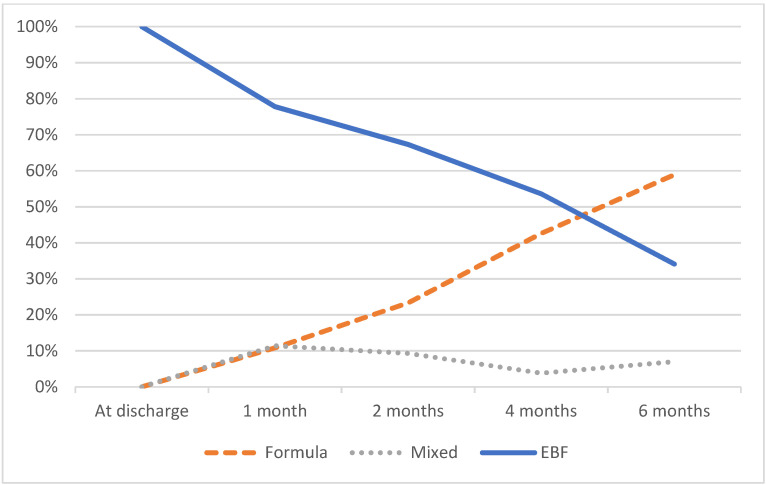
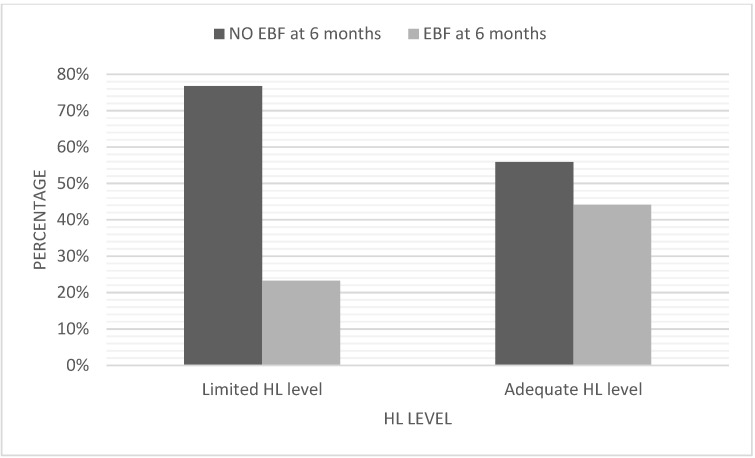
Background: International organizations recommend initiating breastfeeding within the first hour of life and maintaining exclusive breastfeeding for the first 6 months. However, worldwide rates of exclusive breastfeeding for 6-month-old infants is far from meeting the goal proposed by the World Health Organization, which is to reach a minimum of 50% of infants. Education is one of the factors affecting the initiation and continuation of breastfeeding, and incidentally, it is also related to lower health literacy. This study explored the influence of health literacy on maintenance of exclusive breastfeeding at 6 months postpartum. Methods: A longitudinal multicenter study with 343 women were recruited between January 2019 and January 2020. The first questionnaire was held during the puerperium (24−48 h) with mothers practicing exclusive breastfeeding, with whom 6-month postpartum breastfeeding follow-up was performed. Socio-demographic, clinical and obstetric variables were collected. Breastfeeding efficiency was assessed using the LATCH breastfeeding assessment tool. The health literacy level was evaluated by the Newest Vital Sign screening tool. A multivariate logistic regression model was used to detect protective factors for early exclusive breastfeeding cessation. Results: One third of the women continued exclusive breastfeeding at 6 months postpartum. Approximately half the participants had a low or inadequate health literacy level. An adequate health literacy level, a high LATCH breastfeeding assessment tool score (>9 points) and being married were the protective factors against exclusive breastfeeding cessation at 6 months postpartum. Conclusion: Health literacy levels are closely related to maintaining exclusive breastfeeding and act as a protective factor against early cessation. A specific instrument is needed to measure the lack of “literacy in breastfeeding”, in order to verify the relationship between health literacy and maintenance of exclusive breastfeeding.
国际组织建议在生命的第一个小时内开始母乳喂养,并在头 6 个月内进行纯母乳喂养。然而,全球范围内纯母乳喂养 6 个月大婴儿的比例远未达到世界卫生组织提出的目标,即至少有 50%的婴儿达到这一目标。教育是影响母乳喂养开始和持续的因素之一,而且巧合的是,它也与较低的健康素养有关。本研究探讨了健康素养对产后 6 个月纯母乳喂养的维持的影响。
这是一项 2019 年 1 月至 2020 年 1 月期间进行的、具有纵向多中心特点的研究,共招募了 343 名女性。第一次问卷调查是在产褥期(24-48 小时)进行的,当时母亲正在进行纯母乳喂养,对她们进行了 6 个月的产后母乳喂养随访。收集了社会人口统计学、临床和产科变量。使用 LATCH 母乳喂养评估工具评估母乳喂养效率。使用最新生命体征筛查工具评估健康素养水平。使用多变量逻辑回归模型来检测早期纯母乳喂养停止的保护因素。
三分之一的女性在产后 6 个月时继续进行纯母乳喂养。大约一半的参与者健康素养水平较低或不足。足够的健康素养水平、较高的 LATCH 母乳喂养评估工具评分(>9 分)和已婚是产后 6 个月纯母乳喂养持续的保护因素。
健康素养水平与维持纯母乳喂养密切相关,是防止早期停止母乳喂养的保护因素。需要一种特定的工具来衡量“母乳喂养方面的缺乏素养”,以验证健康素养与维持纯母乳喂养之间的关系。