Da-Veiga Marc-Antoine, Rogister Bernard, Lombard Arnaud, Neirinckx Virginie, Piette Caroline
Laboratory of Nervous System Disorders and Therapy, GIGA Institute, University of Liège, 4000 Liège, Belgium.
Department of Neurology, CHU of Liège, 4000 Liège, Belgium.
Cancers (Basel). 2022 May 4;14(9):2296. doi: 10.3390/cancers14092296.
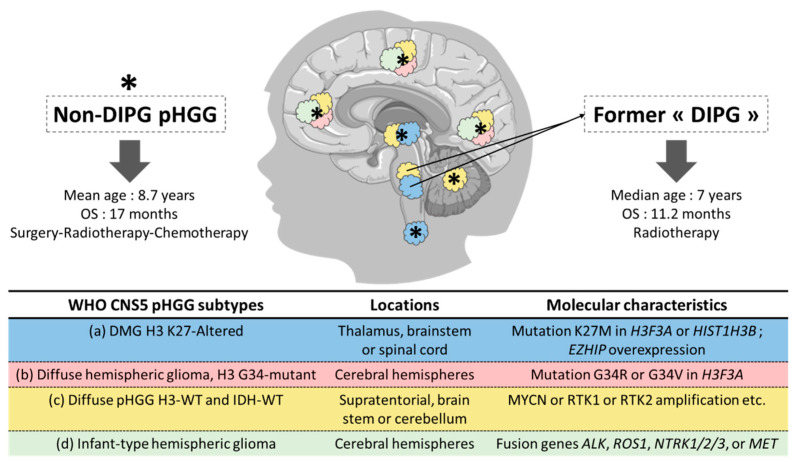
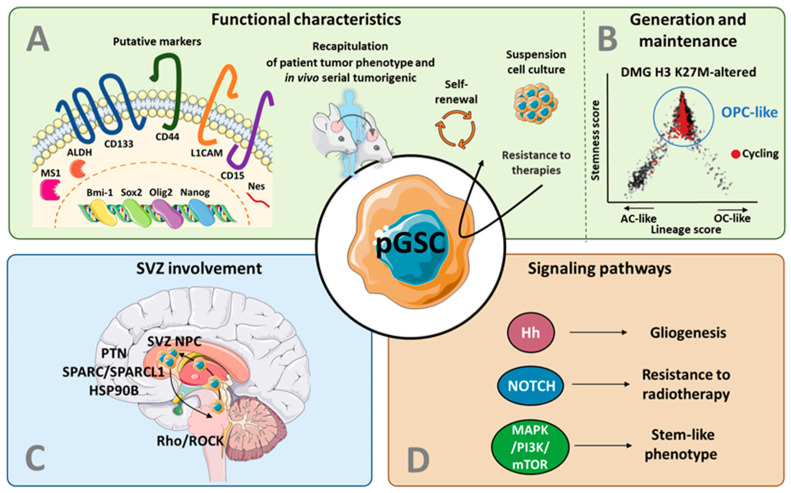
In children, high-grade gliomas (HGG) and diffuse midline gliomas (DMG) account for a high proportion of death due to cancer. Glioma stem cells (GSCs) are tumor cells in a specific state defined by a tumor-initiating capacity following serial transplantation, self-renewal, and an ability to recapitulate tumor heterogeneity. Their presence was demonstrated several decades ago in adult glioblastoma (GBM), and more recently in pediatric HGG and DMG. In adults, we and others have previously suggested that GSCs nest into the subventricular zone (SVZ), a neurogenic niche, where, among others, they find shelter from therapy. Both bench and bedside evidence strongly indicate a role for the GSCs and the SVZ in GBM progression, fostering the development of innovative targeting treatments. Such new therapeutic approaches are of particular interest in infants, in whom standard therapies are often limited due to the risk of late effects. The aim of this review is to describe current knowledge about GSCs in pediatric HGG and DMG, i.e., their characterization, the models that apply to their development and maintenance, the specific signaling pathways that may underlie their activity, and their specific interactions with neurogenic niches. Finally, we will discuss the clinical relevance of these observations and the therapeutic advantages of targeting the SVZ and/or the GSCs in infants.
在儿童中,高级别胶质瘤(HGG)和弥漫性中线胶质瘤(DMG)在癌症死亡原因中占比很高。胶质瘤干细胞(GSCs)是处于特定状态的肿瘤细胞,其定义为经连续移植后具有肿瘤起始能力、自我更新能力以及重现肿瘤异质性的能力。几十年前在成人大脑胶质母细胞瘤(GBM)中证实了它们的存在,最近在儿童HGG和DMG中也得到了证实。在成人中,我们和其他人之前曾提出,GSCs定位于脑室下区(SVZ),即一个神经源性微环境,在那里,它们可以躲避治疗。基础研究和临床证据都有力地表明,GSCs和SVZ在GBM进展中发挥作用,推动了创新靶向治疗的发展。这种新的治疗方法对婴儿尤其有意义,因为在婴儿中,由于存在后期效应的风险,标准治疗往往受到限制。本综述的目的是描述目前关于儿童HGG和DMG中GSCs的知识,即它们的特征、适用于其发育和维持的模型、可能是其活性基础的特定信号通路,以及它们与神经源性微环境的特定相互作用。最后,我们将讨论这些观察结果的临床相关性以及针对婴儿SVZ和/或GSCs的治疗优势。