Departmento de Endocrinologia y Nutrición, Quironsalud Málaga Hospital Av. Imperio Argentina, 29004 Málaga, Spain.
Unidad de Gestion Clínica de Endocrinología y Nutrición, Hospital Universitario Virgen de la Victoria de Málaga, 29010 Málaga, Spain.
Nutrients. 2022 Apr 28;14(9):1851. doi: 10.3390/nu14091851.
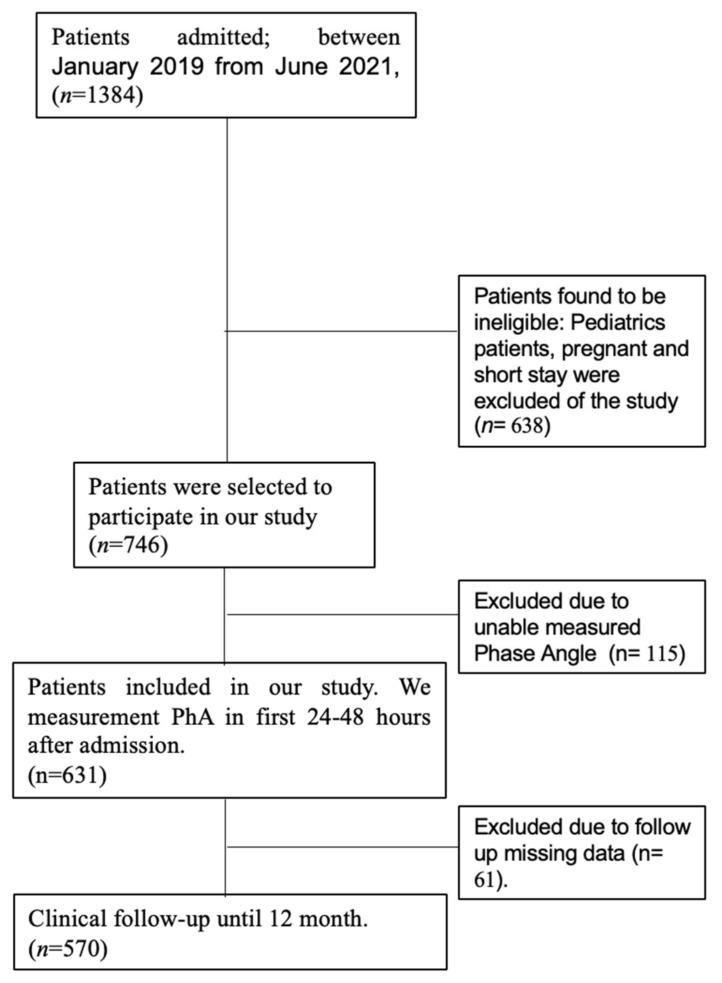
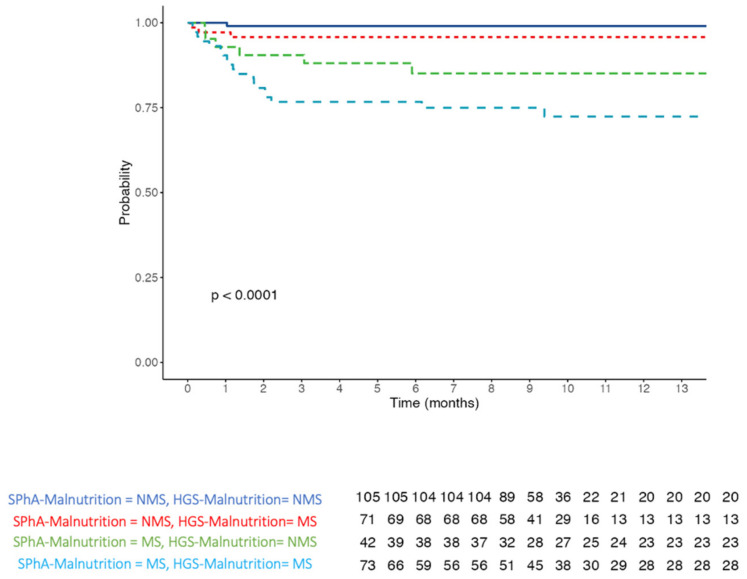
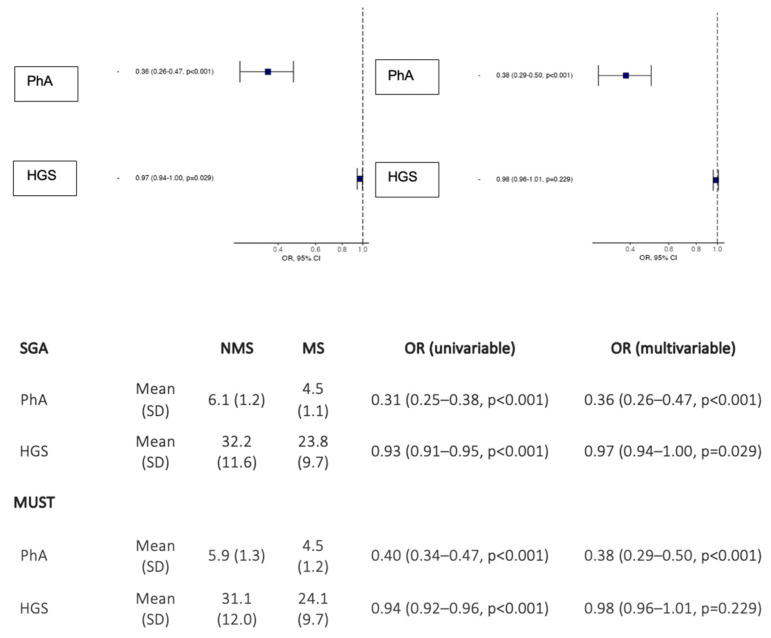
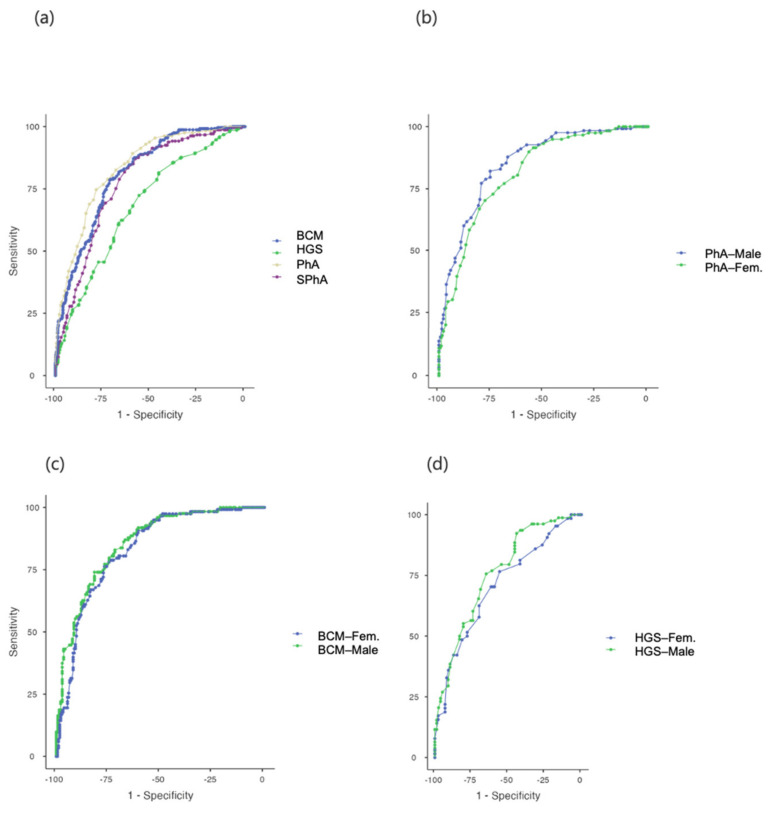
Background: Phase Angle (PhA) value measured by bioelectrical impedance analysis (BIA) could be considered a good marker of the patient’s cell mass and cellular damage. Various studies have shown that the value of PhA is associated with an increased nutritional risk in several pathologies. However, not many studies have focused on the use of PhA as a screening tool in admitted patients. The aim of this study is to evaluate the prognostic value of PhA to determine disease-related malnutrition (DRM) and the risk that this entails for mortality and length of stay (LOS). Methods: 570 patients admitted to the hospital for different causes were included in this retrospective observational study. Patients’ nutritional risk was assessed by screening tests such as the Malnutrition Universal Screening tool (MUST) and Subjective Global Assessment (SGA), in addition to non-invasive functional techniques, such as BIA and handgrip strength (HGS), 24−48 h after admission. After performing an SGA as the gold standard to assess malnutrition, PhA and SPhA values were used to determine DRM. Furthermore, both samples: malnutrition status (MS) and non-malnutrition status (NMS) were compared, with SphA-Malnutrition corresponding to a diagnosis of malnutrition. Statistical analysis of the sample was conducted with JAMOVI version 2.2.2. Results: Patients with MS had lower PhA and SPhA than patients with NMS (p < 0.001). The ROC curve analysis (AUC = 0.81) showed a cut-off point for MS for PhA = 5.4° (sensitivity 77.51% and specificity 74.07%) and AUC = 0.776 with a cut-off point for SPhA = −0.3 (sensitivity 81.74% and specificity 63.53%). Handgrip strength (HGS) was also observed to be a good predictor in hospitalized patients. Carrying out a comparative analysis between MS and NMS, length of stay (LOS) was 9.0 days in MS vs. 5.0 days in NMS patients (OR 1.07 (1.04−1.09, p < 0.001)). A low SPhA-malnutrition value (SPhA < −0.3) was significantly associated with a higher mortality hazards ratio (HR 7.87, 95% CI 2.56−24.24, p < 0.001). Conclusion: PhA, SPhA and HGS are shown to be good prognostic markers of DRM, LOS and mortality and could therefore be useful screening tools to complement the nutritional assessment of admitted patients.
相位角(PhA)值可通过生物电阻抗分析(BIA)测量,可被视为患者细胞群和细胞损伤的良好标志物。多项研究表明,PhA 值与多种病理状态下的营养风险增加有关。然而,很少有研究关注 PhA 作为入院患者筛查工具的使用。本研究旨在评估 PhA 的预后价值,以确定与疾病相关的营养不良(DRM)及其对死亡率和住院时间(LOS)的影响。方法:本回顾性观察研究纳入了 570 名因不同原因住院的患者。通过营养不良普遍筛查工具(MUST)和主观全面评估(SGA)等筛查试验以及 BIA 和握力(HGS)等非侵入性功能技术,在入院后 24-48 小时内评估患者的营养风险。在进行 SGA 作为评估营养不良的金标准后,使用 PhA 和 SPhA 值来确定 DRM。此外,对样本进行了比较,其中 SphA-营养不良对应于营养不良的诊断。使用 JAMOVI 版本 2.2.2 对样本进行统计分析。结果:与 NMS 患者相比,MS 患者的 PhA 和 SPhA 值更低(p<0.001)。ROC 曲线分析(AUC=0.81)显示 PhA=5.4°为 MS 的截断点(敏感性 77.51%,特异性 74.07%),AUC=0.776 时 SPhA=-0.3 为截断点(敏感性 81.74%,特异性 63.53%)。握力(HGS)也被观察到是住院患者的良好预测指标。在 MS 和 NMS 之间进行比较分析时,MS 患者的住院时间(LOS)为 9.0 天,而 NMS 患者为 5.0 天(OR 1.07(1.04-1.09,p<0.001))。低 SPhA-营养不良值(SPhA<-0.3)与更高的死亡风险比(HR 7.87,95%CI 2.56-24.24,p<0.001)显著相关。结论:PhA、SPhA 和 HGS 是 DRM、LOS 和死亡率的良好预后标志物,因此可能是补充入院患者营养评估的有用筛查工具。