Zhang Hanyu, Lam Carly S Y, Tang Wing-Chun, Leung Myra, Qi Hua, Lee Paul H, To Chi-Ho
Centre for Myopia Research, School of Optometry, The Hong Kong Polytechnic University, Hong Kong SAR, China.
Centre for Eye and Vision Research (CEVR), Hong Kong SAR, China.
J Clin Med. 2022 Apr 20;11(9):2294. doi: 10.3390/jcm11092294.
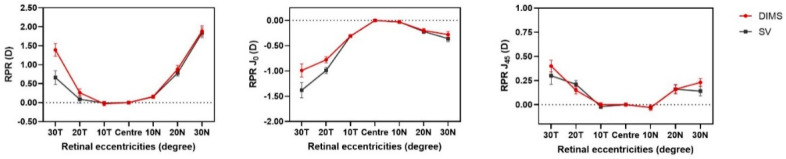
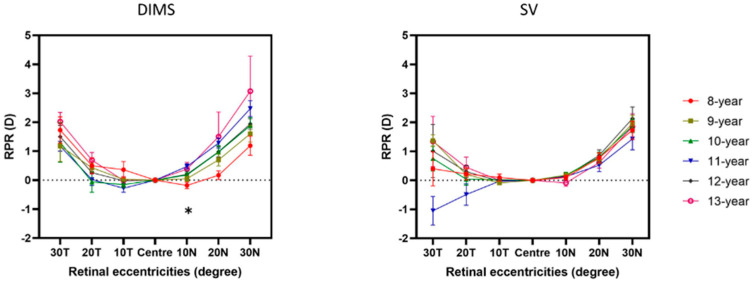
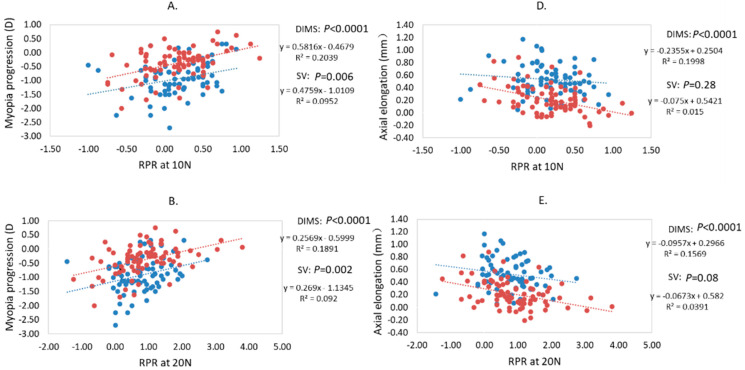
The aim of this study is to investigate if baseline relative peripheral refraction (RPR) influences the myopia control effects in Chinese myopic children wearing Defocus Incorporated Multiple Segments (DIMS) lenses. Peripheral refraction at 10°, 20°, and 30° nasal (10 N, 20 N, 30 N) and temporal (10 T, 20 T, 30 T) retina were measured at six-month intervals for children who participated in a 2-year randomized controlled trial. The relationship between the baseline peripheral refractions and myopia progression and axial length changes were analysed. A total of 79 children and 81 children in the DIMS and single vision (SV) group were investigated, respectively. In the DIMS group, more baseline myopic RPR spherical equivalent (SE) was associated with more myopic progression (10 N: r = 0.36, p = 0.001; 20 N: r = 0.35, p = 0.001) and greater axial elongation (10 N: r = −0.34, p = 0.001; 20 N: r = −0.29, p = 0.006) after adjusting for co-factors. In the SV group, baseline RPR had association with only myopia progression (10 N: r = 0.37, p = 0.001; 20 N: r = 0.36, p = 0.001; 30 N: r = 0.35, p = 0.002) but not with axial elongation after Bonferroni correction (p > 0.008). No statistically significant relationship was found between temporal retina and myopia progression or axial elongation in both groups. Children with baseline myopic RPR had statistically significant more myopia progression (mean difference around −0.40 D) and more axial elongation (mean difference 0.15 mm) when compared with the children having baseline hyperopic RPR in the DIMS group but not in the SV group. In conclusion, the baseline RPR profile may not influence future myopia progression or axial elongation for the SV lens wearers. However, DIMS lenses slowed down myopia progression and was better in myopia control for the children with baseline hyperopic RPR than the children with myopic RPR. This may partially explain why myopia control effects vary among myopic children. Customised myopic defocus for individuals may optimise myopia control effects, and further research to determine the optimal dosage, with consideration of peripheral retinal profile, is warranted.
本研究旨在调查基线相对周边屈光度(RPR)是否会影响佩戴离焦整合多区域(DIMS)镜片的中国近视儿童的近视控制效果。对于参与一项为期2年随机对照试验的儿童,每隔6个月测量鼻侧(10°、20°和30°,即10 N、20 N、30 N)和颞侧(10°、20°和30°,即10 T、20 T、30 T)视网膜处的周边屈光度。分析基线周边屈光度与近视进展和眼轴长度变化之间的关系。分别对DIMS组的79名儿童和单光(SV)组的81名儿童进行了调查。在DIMS组中,经协变量校正后,更多的基线近视性RPR球镜等效度(SE)与更多的近视进展相关(10 N:r = 0.36,p = 0.001;20 N:r = 0.35,p = 0.001)以及更大的眼轴伸长相关(10 N:r = -0.34,p = 0.001;20 N:r = -0.29,p = 0.006)。在SV组中,经Bonferroni校正后,基线RPR仅与近视进展相关(10 N:r = 0.37,p = 0.001;20 N:r = 0.36,p = 0.001;30 N:r = 0.35,p = 0.002),但与眼轴伸长无关(p > 0.008)。在两组中,未发现颞侧视网膜与近视进展或眼轴伸长之间存在统计学上的显著关系。与DIMS组中具有基线远视性RPR的儿童相比,具有基线近视性RPR的儿童近视进展在统计学上显著更多(平均差值约为-0.40 D)且眼轴伸长更多(平均差值0.15 mm),但在SV组中并非如此。总之,基线RPR特征可能不会影响SV镜片佩戴者未来的近视进展或眼轴伸长。然而,对于基线远视性RPR的儿童,DIMS镜片减缓了近视进展,在近视控制方面比基线近视性RPR的儿童更好。这可能部分解释了为什么近视控制效果在近视儿童中存在差异。针对个体定制近视性离焦可能会优化近视控制效果,有必要进一步研究以确定考虑周边视网膜特征的最佳剂量。