• 文献检索
  • 文档翻译
  • 深度研究
  • 学术资讯
  • Suppr Zotero 插件Zotero 插件
  • 邀请有礼
  • 套餐&价格
  • 历史记录
应用&插件
Suppr Zotero 插件Zotero 插件浏览器插件Mac 客户端Windows 客户端微信小程序
定价
高级版会员购买积分包购买API积分包
服务
文献检索文档翻译深度研究API 文档MCP 服务
关于我们
关于 Suppr公司介绍联系我们用户协议隐私条款
关注我们

Suppr 超能文献

核心技术专利:CN118964589B侵权必究
粤ICP备2023148730 号-1Suppr @ 2026

文献检索

告别复杂PubMed语法,用中文像聊天一样搜索,搜遍4000万医学文献。AI智能推荐,让科研检索更轻松。

立即免费搜索

文件翻译

保留排版,准确专业,支持PDF/Word/PPT等文件格式,支持 12+语言互译。

免费翻译文档

深度研究

AI帮你快速写综述,25分钟生成高质量综述,智能提取关键信息,辅助科研写作。

立即免费体验

心房颤动患者择期心脏电复律的结果分析:机器学习预后模型的开发与验证

Outcome Analysis in Elective Electrical Cardioversion of Atrial Fibrillation Patients: Development and Validation of a Machine Learning Prognostic Model.

作者信息

Nuñez-Garcia Jean C, Sánchez-Puente Antonio, Sampedro-Gómez Jesús, Vicente-Palacios Victor, Jiménez-Navarro Manuel, Oterino-Manzanas Armando, Jiménez-Candil Javier, Dorado-Diaz P Ignacio, Sánchez Pedro L

机构信息

Department of Cardiology, Hospital Universitario de Salamanca-IBSAL, 37007 Salamanca, Spain.

CIBERCV (Centro de Investigacion Biomedica en Red Enfermedades Cardiovasculares), Instituto de Salud Carlos III, C/Monforte de Lemos 3-5, Pabellón 11, Planta 0, 28029 Madrid, Spain.

出版信息

J Clin Med. 2022 May 7;11(9):2636. doi: 10.3390/jcm11092636.

DOI:10.3390/jcm11092636
PMID:35566761
原文链接:https://pmc.ncbi.nlm.nih.gov/articles/PMC9101912/
Abstract

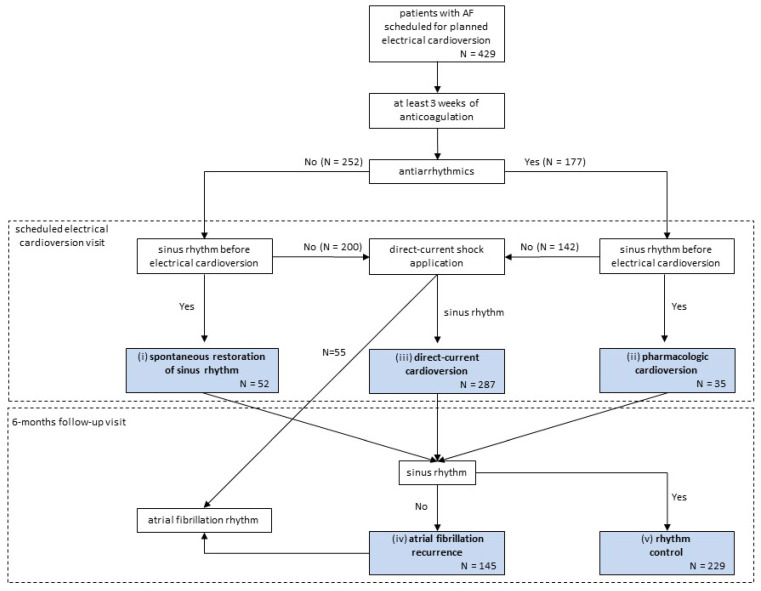
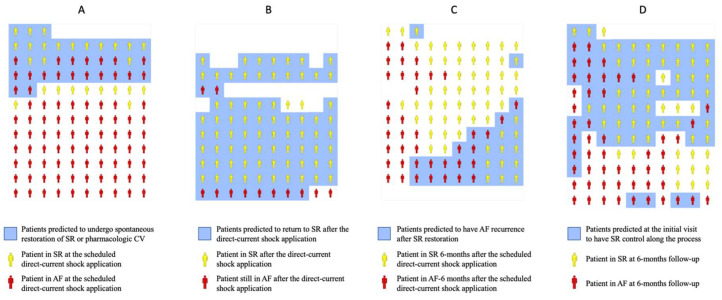
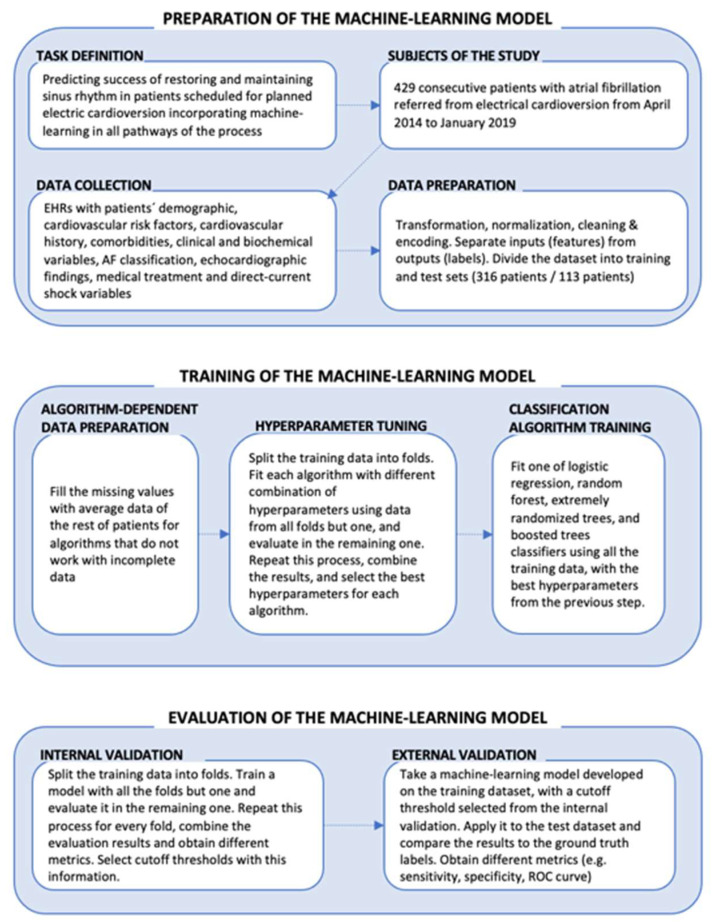
Background: The integrated approach to electrical cardioversion (EC) in atrial fibrillation (AF) is complex; candidates can resolve spontaneously while waiting for EC, and post-cardioversion recurrence is high. Thus, it is especially interesting to avoid the programming of EC in patients who would restore sinus rhythm (SR) spontaneously or present early recurrence. We have analyzed the whole elective EC of the AF process using machine-learning (ML) in order to enable a more realistic and detailed simulation of the patient flow for decision making purposes. Methods: The dataset consisted of electronic health records (EHRs) from 429 consecutive AF patients referred for EC. For analysis of the patient outcome, we considered five pathways according to restoring and maintaining SR: (i) spontaneous SR restoration, (ii) pharmacologic-cardioversion, (iii) direct-current cardioversion, (iv) 6-month AF recurrence, and (v) 6-month rhythm control. We applied ML classifiers for predicting outcomes at each pathway and compared them with the CHA2DS2-VASc and HATCH scores. Results: With the exception of pathway (iii), all ML models achieved improvements in comparison with CHA2DS2-VASc or HATCH scores (p < 0.01). Compared to the most competitive score, the area under the ROC curve (AUC-ROC) was: 0.80 vs. 0.66 for predicting (i); 0.71 vs. 0.55 for (ii); 0.64 vs. 0.52 for (iv); and 0.66 vs. 0.51 for (v). For a threshold considered optimal, the empirical net reclassification index was: +7.8%, +47.2%, +28.2%, and +34.3% in favor of our ML models for predicting outcomes for pathways (i), (ii), (iv), and (v), respectively. As an example tool of generalizability of ML models, we deployed our algorithms in an open-source calculator, where the model would personalize predictions. Conclusions: An ML model improves the accuracy of restoring and maintaining SR predictions over current discriminators. The proposed approach enables a detailed simulation of the patient flow through personalized predictions.

摘要

背景

心房颤动(AF)的电复律(EC)综合方法较为复杂;候选患者在等待电复律期间可能会自行恢复,且复律后复发率较高。因此,对于那些能自行恢复窦性心律(SR)或早期复发的患者,避免安排电复律尤其有意义。我们使用机器学习(ML)分析了整个AF过程的择期电复律,以便为决策目的更真实、详细地模拟患者流程。方法:数据集包括429例连续接受电复律的AF患者的电子健康记录(EHRs)。为分析患者结局,我们根据恢复和维持SR考虑了五种途径:(i)自发恢复SR,(ii)药物复律,(iii)直流电复律,(iv)6个月AF复发,以及(v)6个月心律控制。我们应用ML分类器预测各途径的结局,并将其与CHA2DS2-VASc和HATCH评分进行比较。结果:除途径(iii)外,所有ML模型与CHA2DS2-VASc或HATCH评分相比均有改善(p < 0.01)。与最具竞争力的评分相比,预测(i)时ROC曲线下面积(AUC-ROC)为:0.80对0.66;预测(ii)时为0.71对0.55;预测(iv)时为0.64对0.52;预测(v)时为0.66对0.51。对于认为最佳的阈值,经验性净重新分类指数分别为:支持我们的ML模型预测途径(i)、(ii)、(iv)和(v)结局的+7.8%、+47.2%、+28.2%和+34.3%。作为ML模型可推广性的一个示例工具,我们将算法部署在一个开源计算器中,该模型将进行个性化预测。结论:ML模型比当前的判别方法提高了恢复和维持SR预测的准确性。所提出的方法通过个性化预测实现了对患者流程的详细模拟。
https://cdn.ncbi.nlm.nih.gov/pmc/blobs/adb6/9101912/dabedceeb869/jcm-11-02636-g004.jpg
https://cdn.ncbi.nlm.nih.gov/pmc/blobs/adb6/9101912/bb61faa2c8fb/jcm-11-02636-g001.jpg
https://cdn.ncbi.nlm.nih.gov/pmc/blobs/adb6/9101912/0c35cff45429/jcm-11-02636-g002.jpg
https://cdn.ncbi.nlm.nih.gov/pmc/blobs/adb6/9101912/d7d5db1a99cc/jcm-11-02636-g003.jpg
https://cdn.ncbi.nlm.nih.gov/pmc/blobs/adb6/9101912/dabedceeb869/jcm-11-02636-g004.jpg
https://cdn.ncbi.nlm.nih.gov/pmc/blobs/adb6/9101912/bb61faa2c8fb/jcm-11-02636-g001.jpg
https://cdn.ncbi.nlm.nih.gov/pmc/blobs/adb6/9101912/0c35cff45429/jcm-11-02636-g002.jpg
https://cdn.ncbi.nlm.nih.gov/pmc/blobs/adb6/9101912/d7d5db1a99cc/jcm-11-02636-g003.jpg
https://cdn.ncbi.nlm.nih.gov/pmc/blobs/adb6/9101912/dabedceeb869/jcm-11-02636-g004.jpg

相似文献

1
Outcome Analysis in Elective Electrical Cardioversion of Atrial Fibrillation Patients: Development and Validation of a Machine Learning Prognostic Model.心房颤动患者择期心脏电复律的结果分析:机器学习预后模型的开发与验证
J Clin Med. 2022 May 7;11(9):2636. doi: 10.3390/jcm11092636.
2
CHA2DS2-VASc in the prediction of early atrial fibrillation relapses after electrical or pharmacological cardioversion.CHA2DS2-VASc评分在预测电复律或药物复律后早期房颤复发中的应用
J Cardiovasc Med (Hagerstown). 2014 Aug;15(8):636-41. doi: 10.2459/JCM.0000000000000139.
3
The role of HATCH score in predicting the success rate of sinus rhythm following electrical cardioversion of atrial fibrillation.HATCH评分在预测心房颤动电复律后窦性心律成功率中的作用。
Kardiol Pol. 2016;74(9):978-84. doi: 10.5603/KP.a2016.0044. Epub 2016 Apr 4.
4
Baseline NT-Pro-BNP levels and arrhythmia recurrence in outpatients undergoing elective cardioversion of persistent atrial fibrillation: a survival analysis.持续性心房颤动择期心脏复律门诊患者的基线NT - 前脑钠肽水平与心律失常复发:一项生存分析
Indian Pacing Electrophysiol J. 2009;9(1):15-24. Epub 2009 Jan 7.
5
Role for machine learning in sex-specific prediction of successful electrical cardioversion in atrial fibrillation?机器学习在心房颤动成功电复律的性别特异性预测中的作用?
Open Heart. 2020 Jun;7(1). doi: 10.1136/openhrt-2020-001297.
6
Predictors of sinus rhythm after electrical cardioversion of atrial fibrillation: results from a data mining project on the Flec-SL trial data set.电复律转复心房颤动后窦律维持的预测因素:Flec-SL 试验数据集的数据挖掘项目结果。
Europace. 2017 Jun 1;19(6):921-928. doi: 10.1093/europace/euw144.
7
Does flecainide regain its antiarrhythmic activity after electrical cardioversion of persistent atrial fibrillation?在持续性心房颤动电复律后,氟卡尼是否会恢复其抗心律失常活性?
Heart Rhythm. 2005 Mar;2(3):223-30. doi: 10.1016/j.hrthm.2004.11.014.
8
Role of left atrial speckle tracking echocardiography in predicting persistent atrial fibrillation electrical cardioversion success and sinus rhythm maintenance at 6 months.左心房斑点追踪超声心动图在预测持续性心房颤动电复律成功和 6 个月时维持窦性心律中的作用。
Adv Med Sci. 2014 Mar;59(1):120-5. doi: 10.1016/j.advms.2013.10.003. Epub 2014 Mar 24.
9
Atrial fibrillatory rate as predictor of recurrence of atrial fibrillation in horses treated medically or with electrical cardioversion.心房颤动频率预测药物治疗或电复律治疗的马心房颤动复发。
Equine Vet J. 2022 Nov;54(6):1013-1022. doi: 10.1111/evj.13551. Epub 2022 Jan 13.
10
Left atrial emptying fraction determined during atrial fibrillation predicts maintenance of sinus rhythm after direct current cardioversion in patients with persistent atrial fibrillation.在持续性心房颤动患者中,心房颤动期间测量的左心房排空分数可预测直流电复律后窦性节律的维持。
PLoS One. 2020 Aug 21;15(8):e0238002. doi: 10.1371/journal.pone.0238002. eCollection 2020.

引用本文的文献

1
Predicting the Outcomes of External Direct Current Cardioversion for Atrial Fibrillation: A Narrative Review of Current Evidence.预测心房颤动患者体外直流电复律的结果:当前证据的叙述性综述
J Cardiovasc Dev Dis. 2025 Apr 25;12(5):168. doi: 10.3390/jcdd12050168.
2
Artificial Intelligence in Atrial Fibrillation: From Early Detection to Precision Therapy.心房颤动中的人工智能:从早期检测到精准治疗
J Clin Med. 2025 Apr 11;14(8):2627. doi: 10.3390/jcm14082627.
3
The Application of Artificial Intelligence in Atrial Fibrillation Patients: From Detection to Treatment.

本文引用的文献

1
Anticoagulation in Atrial Fibrillation Cardioversion: What Is Crucial to Take into Account.心房颤动复律中的抗凝:需要考虑的关键因素
J Clin Med. 2021 Jul 21;10(15):3212. doi: 10.3390/jcm10153212.
2
Pharmacological Cardioversion after Pre-Treatment with Antiarrythmic Drugs Prior to Electrical Cardioversion in Persistent Atrial Fibrillation: Impact on Maintenance of Sinus Rhythm.持续性房颤患者在电复律前使用抗心律失常药物预处理后的药物复律:对窦性心律维持的影响
J Clin Med. 2021 Mar 3;10(5):1029. doi: 10.3390/jcm10051029.
3
Augmented Realities, Artificial Intelligence, and Machine Learning: Clinical Implications and How Technology Is Shaping the Future of Medicine.
人工智能在心房颤动患者中的应用:从检测到治疗
Rev Cardiovasc Med. 2024 Jul 10;25(7):257. doi: 10.31083/j.rcm2507257. eCollection 2024 Jul.
4
Longer and better lives for patients with atrial fibrillation: the 9th AFNET/EHRA consensus conference.心房颤动患者的更长更好的生命:第 9 届 AFNET/EHRA 共识会议。
Europace. 2024 Mar 30;26(4). doi: 10.1093/europace/euae070.
5
Machine Learning Prediction for the Recurrence After Electrical Cardioversion of Patients With Persistent Atrial Fibrillation.持续性心房颤动患者电复律后复发的机器学习预测
Korean Circ J. 2023 Oct;53(10):677-689. doi: 10.4070/kcj.2023.0012. Epub 2023 Jul 24.
6
Artificial Intelligence for the Detection and Treatment of Atrial Fibrillation.用于心房颤动检测与治疗的人工智能
Arrhythm Electrophysiol Rev. 2023 Apr 19;12:e12. doi: 10.15420/aer.2022.31. eCollection 2023.
7
Explainable machine learning model reveals its decision-making process in identifying patients with paroxysmal atrial fibrillation at high risk for recurrence after catheter ablation.可解释机器学习模型揭示了其在识别导管消融后阵发性心房颤动高复发风险患者时的决策过程。
BMC Cardiovasc Disord. 2023 Feb 17;23(1):91. doi: 10.1186/s12872-023-03087-0.
增强现实、人工智能与机器学习:临床意义以及技术如何塑造医学未来
J Clin Med. 2020 Nov 25;9(12):3811. doi: 10.3390/jcm9123811.
4
2020 ESC Guidelines for the diagnosis and management of atrial fibrillation developed in collaboration with the European Association for Cardio-Thoracic Surgery (EACTS): The Task Force for the diagnosis and management of atrial fibrillation of the European Society of Cardiology (ESC) Developed with the special contribution of the European Heart Rhythm Association (EHRA) of the ESC.2020年欧洲心脏病学会(ESC)与欧洲心胸外科学会(EACTS)合作制定的心房颤动诊断和管理指南:欧洲心脏病学会(ESC)心房颤动诊断和管理特别工作组,由ESC欧洲心律协会(EHRA)特别贡献制定。
Eur Heart J. 2021 Feb 1;42(5):373-498. doi: 10.1093/eurheartj/ehaa612.
5
Left atrial mechanical remodelling assessed as the velocity of left atrium appendage wall motion during atrial fibrillation is associated with maintenance of sinus rhythm after electrical cardioversion in patients with persistent atrial fibrillation.左心房机械重构评估为房颤期间左心耳壁运动速度与持续性心房颤动患者电复律后窦性节律的维持相关。
PLoS One. 2020 Jan 29;15(1):e0228239. doi: 10.1371/journal.pone.0228239. eCollection 2020.
6
Applications of Artificial Intelligence in Cardiology. The Future is Already Here.人工智能在心脏病学中的应用。未来已来。
Rev Esp Cardiol (Engl Ed). 2019 Dec;72(12):1065-1075. doi: 10.1016/j.rec.2019.05.014. Epub 2019 Oct 12.
7
Pre- and post-treatment with amiodarone for elective electrical cardioversion of atrial fibrillation: a systematic review and meta-analysis.胺碘酮在心房颤动择期电复律中的预治疗和后治疗:系统评价和荟萃分析。
Europace. 2019 Jun 1;21(6):856-863. doi: 10.1093/europace/euy310.
8
It Is Time for Us to Get Artificially Intelligent!是时候让我们拥有人工智能了!
JACC Clin Electrophysiol. 2019 Feb;5(2):263-265. doi: 10.1016/j.jacep.2018.12.003.
9
2019 AHA/ACC/HRS Focused Update of the 2014 AHA/ACC/HRS Guideline for the Management of Patients With Atrial Fibrillation: A Report of the American College of Cardiology/American Heart Association Task Force on Clinical Practice Guidelines and the Heart Rhythm Society.2019年美国心脏协会/美国心脏病学会/心律学会对2014年美国心脏协会/美国心脏病学会/心律学会心房颤动患者管理指南的聚焦更新:美国心脏病学会/美国心脏协会临床实践指南工作组和心律学会的报告
J Am Coll Cardiol. 2019 Jul 9;74(1):104-132. doi: 10.1016/j.jacc.2019.01.011. Epub 2019 Jan 28.
10
The PLOS ONE collection on machine learning in health and biomedicine: Towards open code and open data.PLOS ONE 机器学习在健康和生物医学中的应用特刊:迈向开放代码和开放数据。
PLoS One. 2019 Jan 15;14(1):e0210232. doi: 10.1371/journal.pone.0210232. eCollection 2019.