Department of Radiodiagnosis, Maulana Azad Medical College and Lok Nayak Hospital, New Delhi 110002, India.
Department of Radiodiagnosis, Maulana Azad Medical College and Lok Nayak Hospital, New Delhi 110002, India.
Eur J Radiol. 2022 Jul;152:110341. doi: 10.1016/j.ejrad.2022.110341. Epub 2022 May 6.
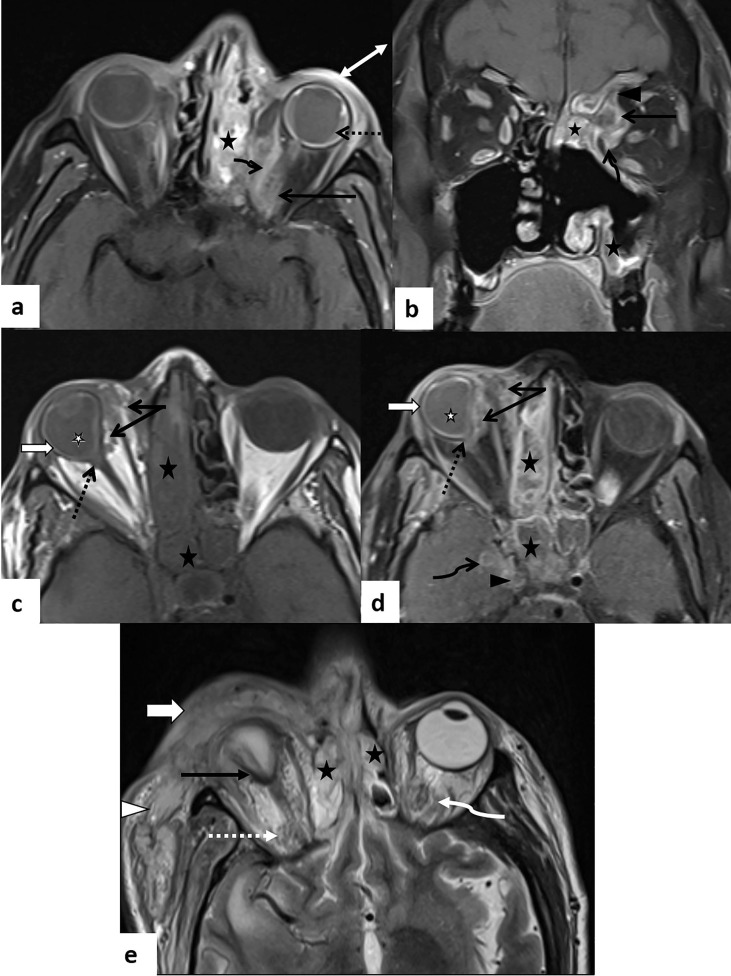
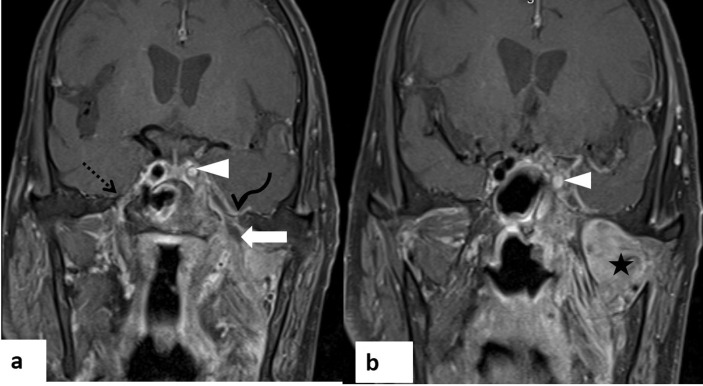
In the wake of the ongoing Coronavirus Disease 2019 (COVID-19) pandemic, a new epidemic of COVID associated mucormycosis (CAM) emerged in India. Early diagnosis and prompt treatment of this deadly disease are of paramount importance in improving patient survival. MRI is the cornerstone of diagnosis of early extrasinus disease, particularly intracranial complications which have traditionally been associated with a high mortality rate. In this review, we depict the sinonasal, perisinus, orbital and intracranial involvement in CAM. Special emphasis is laid on intracranial disease which is categorized into vascular, parenchymal, meningeal, bony involvement and perineural spread. Vascular complications are the most common form of intracranial involvement. Some unusual yet interesting imaging findings such as nerve abscesses involving the optic, trigeminal and mandibular nerves and long segment vasculitis of the internal carotid artery extending till its cervical segment are also illustrated. In our experience, patient outcome in CAM (survival rate of 88.5%) was better compared to the pre-pandemic era. Presence of intracranial disease also did not affect prognosis as poorly as traditionally expected (survival rate of 82.8%). Involvement of brain parenchyma was the only subset of intracranial involvement that was associated with higher mortality (p value 0.016). The aim of this review is to familiarise the reader with the MR imaging spectrum of CAM with special focus on intracranial complications and a brief account of their impact on patient prognosis in our experience.
在持续的 2019 年冠状病毒病(COVID-19)大流行之后,印度出现了一种新的 COVID 相关毛霉菌病(CAM)流行。早期诊断和及时治疗这种致命疾病对于提高患者生存率至关重要。MRI 是诊断早期鼻窦外疾病的基石,尤其是与高死亡率相关的颅内并发症。在这篇综述中,我们描述了 CAM 的鼻窦、鼻窦周围、眼眶和颅内受累。特别强调颅内疾病,可分为血管、实质、脑膜、骨受累和神经周围播散。血管并发症是颅内受累最常见的形式。还描述了一些不常见但有趣的影像学表现,如累及视神经、三叉神经和下颌神经的神经脓肿以及颈内动脉的长段血管炎延伸至其颈段。根据我们的经验,CAM(生存率为 88.5%)患者的预后优于大流行前。颅内疾病的存在也不像传统预期那样对预后产生不利影响(生存率为 82.8%)。脑实质受累是颅内受累中唯一与死亡率较高相关的亚组(p 值 0.016)。本综述的目的是使读者熟悉 CAM 的磁共振成像谱,特别关注颅内并发症,并简要说明它们对我们经验中患者预后的影响。