Public Health, Department of Social Medicine, Osaka University Graduate School of Medicine.
Department of Public Health, Juntendo University Graduate School of Medicine.
J Epidemiol. 2023 Sep 5;33(9):456-463. doi: 10.2188/jea.JE20210489. Epub 2022 Aug 10.
The association between hobby engagement and risk of dementia reported from a short-term follow-up study for individuals aged ≥65 years may be susceptible to reverse causation. We examined the association between hobby engagement in age of 40-69 years and risk of dementia in a long-term follow-up study among Japanese, including individuals in mid-life, when the majority of individuals have normal cognitive function.
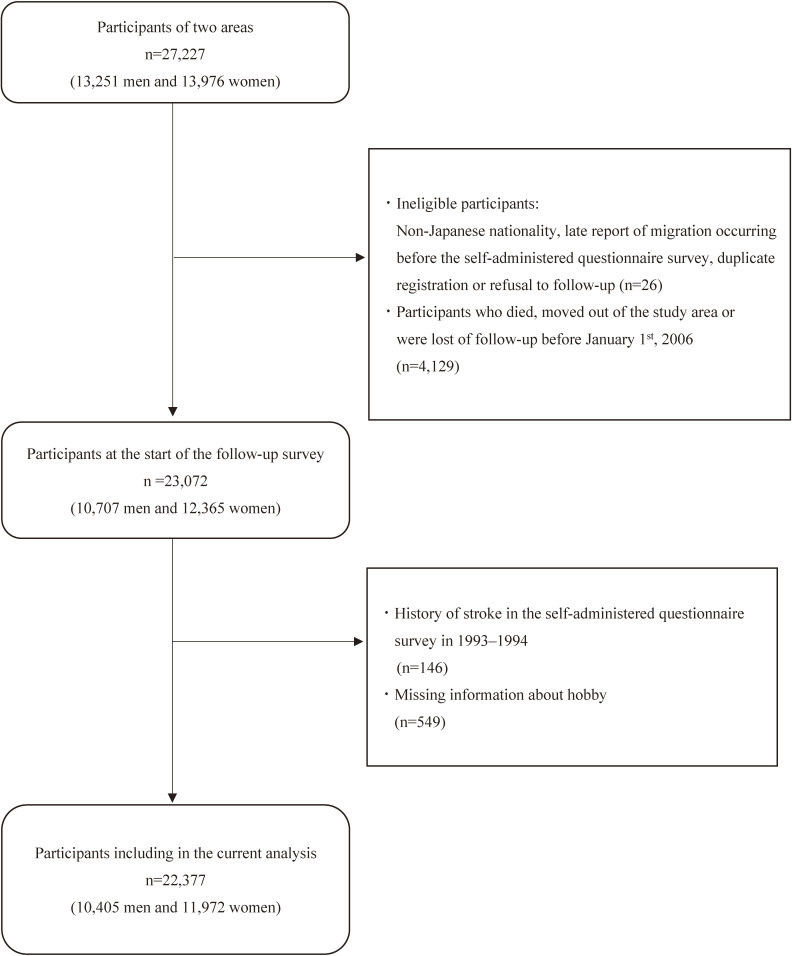
A total of 22,377 individuals aged 40-69 years completed a self-administered questionnaire in 1993-1994. The participants answered whether they had hobbies according to the three following responses: having no hobbies, having a hobby, and having many hobbies. Follow-up for incident disabling dementia was conducted with long-term care insurance data from 2006 to 2016.
During a median of 11.0 years of follow-up, 3,095 participants developed disabling dementia. Adjusting for the demographic, behavioral, and psychosocial factors, the multivariable hazard ratios of incident disabling dementia compared with "having no hobbies" were 0.82 (95% confidence interval [CI], 0.75-0.89) for "having a hobby" and 0.78 (95% CI, 0.67-0.91) for "having many hobbies". The inverse association was similarly observed in both middle (40-64 years) and older ages (65-69 years). For disabling dementia subtypes, hobby engagement was inversely associated with the risk of dementia without a history of stroke (probably non-vascular type dementia), but not with that of post-stroke dementia (probably vascular type dementia).
Hobby engagement in both mid-life and late life was associated with a lower risk of disabling dementia without a history of stroke.
短期随访研究发现,65 岁以上人群的业余爱好与痴呆风险之间存在关联,但这种关联可能易受反向因果关系的影响。我们在一项针对日本人群的长期随访研究中,对 40-69 岁时的业余爱好与痴呆风险之间的关系进行了研究,该研究纳入了中年人群,此时大多数人的认知功能正常。
共有 22377 名 40-69 岁的参与者在 1993-1994 年完成了一份自我管理的问卷。参与者根据以下三种回答方式回答他们是否有业余爱好:没有爱好、有一个爱好、有多个爱好。从 2006 年至 2016 年,通过长期护理保险数据对事件性失能性痴呆进行了随访。
在中位数为 11.0 年的随访期间,3095 名参与者发生了失能性痴呆。在校正人口统计学、行为和心理社会因素后,与“没有爱好”相比,“有一个爱好”和“有多个爱好”发生事件性失能性痴呆的多变量风险比分别为 0.82(95%置信区间[CI],0.75-0.89)和 0.78(95%CI,0.67-0.91)。这种负相关在中年(40-64 岁)和老年(65-69 岁)人群中也同样存在。对于失能性痴呆的亚型,业余爱好与无卒中史的痴呆风险呈负相关(可能是非血管性痴呆),但与卒中后痴呆(可能是血管性痴呆)的风险无关。
中年和晚年的业余爱好与无卒中史的失能性痴呆风险降低有关。