Cai Yi-Hui, Wang Zi, Feng Le-Yi, Ni Guo-Xin
School of Sports Medicine and Rehabilitation, Beijing Sport University, Beijing, China.
School of Sport Science, Beijing Sport University, Beijing, China.
Front Hum Neurosci. 2022 Apr 28;16:876935. doi: 10.3389/fnhum.2022.876935. eCollection 2022.
Aging and type 2 diabetes mellitus (T2DM) are important risk factors for the development of cognitive deterioration and dementia. The objective of this research was to investigate the effects of an exercise intervention on cognitive function in older T2DM patients.
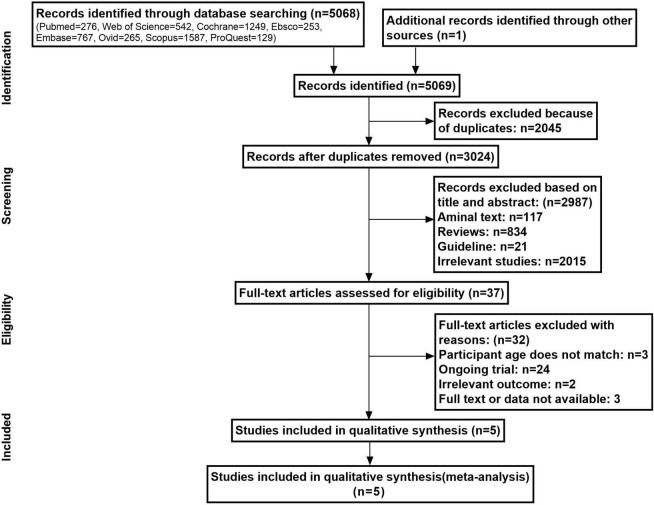
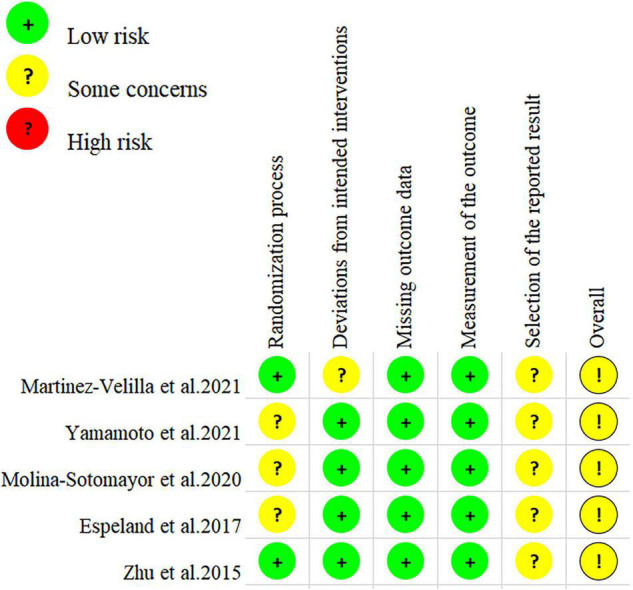
Eight literature databases (PubMed, EBSCO, Scopus, Embase, The Cochrane Library, Web of Science, Ovid, and ProQuest) were searched from inception to 20 January 2022. The researchers examined randomized controlled trials (RCTs) that evaluated the impact of exercise on the cognitive performance of older T2DM patients. The Cochrane risk-of-bias tool (ROB 2) for RCTs was used to assess each study. The quality of evidence was assessed using the GRADE (grading of recommendations, assessment, development, and evaluations) approach. The mini-mental state examination (MMSE), Modified MMSE (3MSE), and Montreal cognitive assessment (MoCA) were used to evaluate the cognitive outcomes. We performed a subgroup analysis with stratification according to exercise intervention modality, duration, and cognitive impairment.
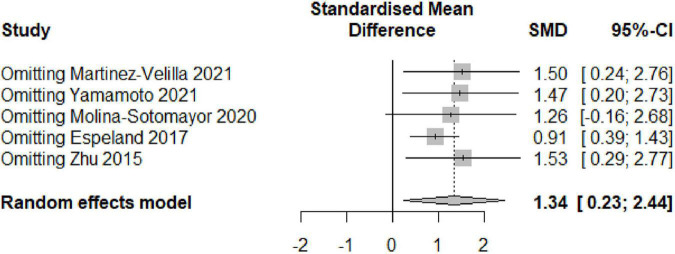
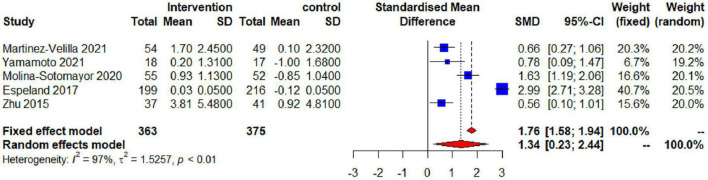
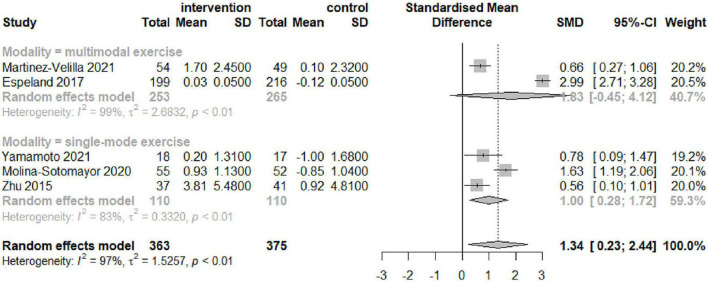
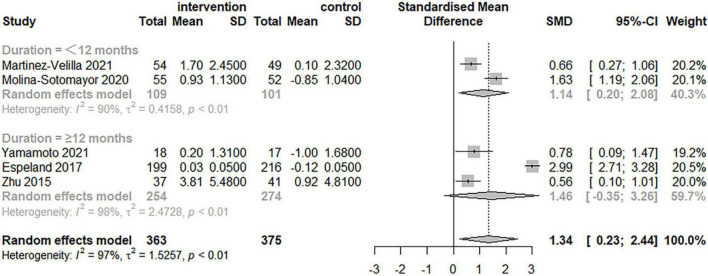
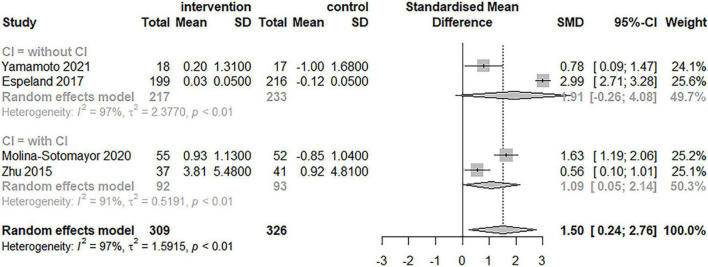
Five trials were eligible, with a total of 738 T2DM patients. The combined findings revealed that exercise improved global cognitive function significantly (standardized mean difference: 1.34, 95% confidence interval: 0.23-2.44, < 0.01). The effect of exercise on global cognitive performance was not significantly influenced by intervention modality, intervention duration, or cognitive impairment in the sub-group analysis ( > 0.05). In the studies that were included, no relevant adverse events were reported.
Exercise is beneficial in improving global cognitive function in older adults with T2DM. Studies with bigger sample sizes and higher quality are additionally expected to draw more definite conclusions.
[https://www.crd.york.ac.uk/PROSPERO/#recordDetails], identifier [CRD42022296049].
衰老和2型糖尿病(T2DM)是认知功能衰退和痴呆症发生的重要风险因素。本研究的目的是调查运动干预对老年T2DM患者认知功能的影响。
检索了8个文献数据库(PubMed、EBSCO、Scopus、Embase、Cochrane图书馆、科学网、Ovid和ProQuest),检索时间从建库至2022年1月20日。研究人员审查了评估运动对老年T2DM患者认知表现影响的随机对照试验(RCT)。使用RCT的Cochrane偏倚风险工具(ROB 2)评估每项研究。采用GRADE(推荐分级、评估、制定和评价)方法评估证据质量。使用简易精神状态检查表(MMSE)、改良MMSE(3MSE)和蒙特利尔认知评估量表(MoCA)评估认知结果。我们根据运动干预方式、持续时间和认知障碍进行分层亚组分析。
5项试验符合条件,共有738例T2DM患者。综合研究结果显示,运动显著改善了整体认知功能(标准化均值差:1.34,95%置信区间:0.23 - 2.44,P < 0.01)。亚组分析中,运动对整体认知表现的影响不受干预方式、干预持续时间或认知障碍的显著影响(P > 0.05)。在纳入的研究中,未报告相关不良事件。
运动有助于改善老年T2DM患者的整体认知功能。此外,预计样本量更大、质量更高的研究将得出更明确的结论。
[https://www.crd.york.ac.uk/PROSPERO/#recordDetails],标识符[CRD42022296049]