Department of Strength and Conditioning Assessment and Monitoring, Beijing Sport University, Beijing, China.
School of Physical Education, Xihua University, Chengdu, China.
Front Endocrinol (Lausanne). 2024 Mar 26;15:1347399. doi: 10.3389/fendo.2024.1347399. eCollection 2024.
An increasing number of studies have investigated the effect of exercise on flow-mediated dilation (FMD) in people with type 2 diabetes mellitus (T2DM), while the findings were controversial. The primary aim of this systematic review and meta-analysis was to investigate the effect of exercise on FMD in T2DM patients, and the secondary aim was to investigate the optimal type, frequency, session duration, and weekly time of exercise for T2DM patients.
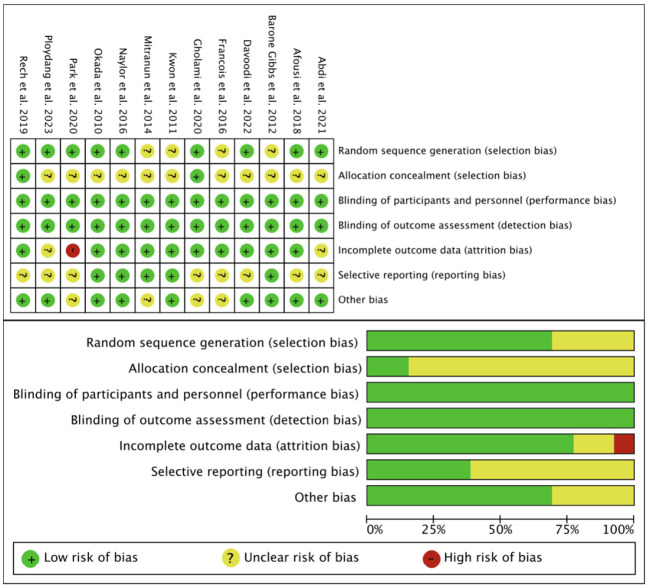
Searches were conducted in PubMed, Cochrane Library, Scopus, Web of Science, Embase and EBSCO databases. The Cochrane risk of bias tool (RoB2) in randomized trial and Physiotherapy Evidence Database (PEDro) scale were used to assess the methodological quality of the included studies.
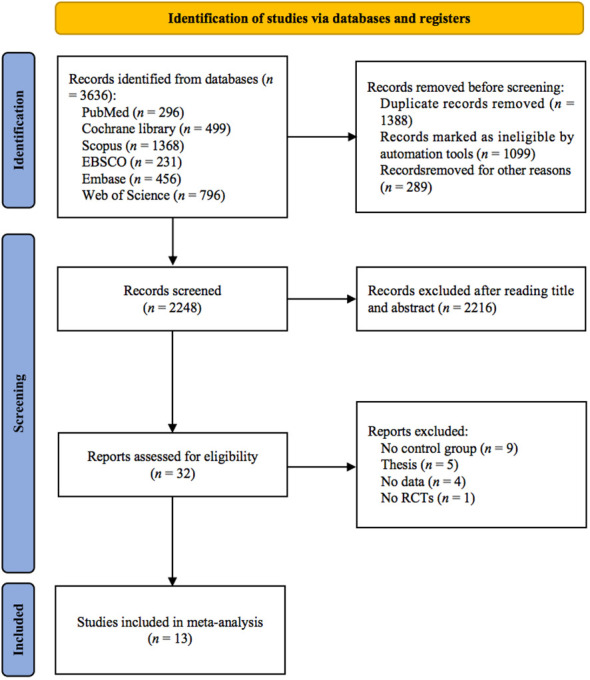
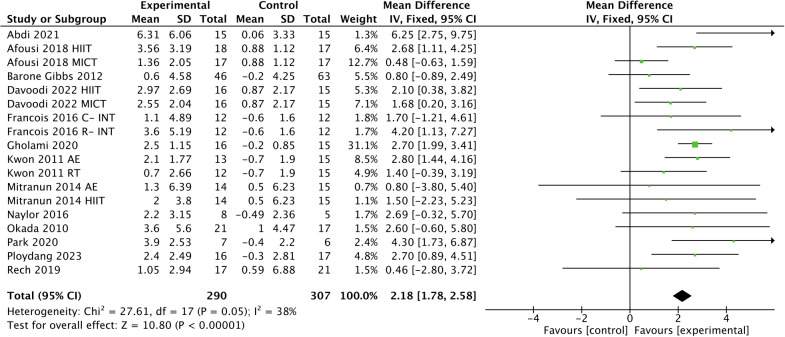
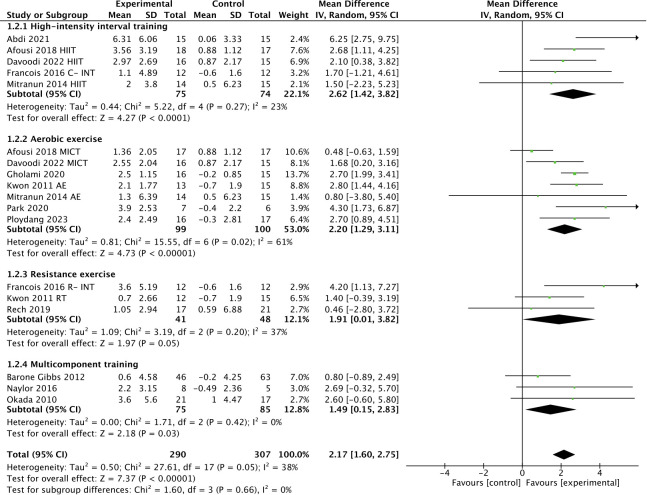
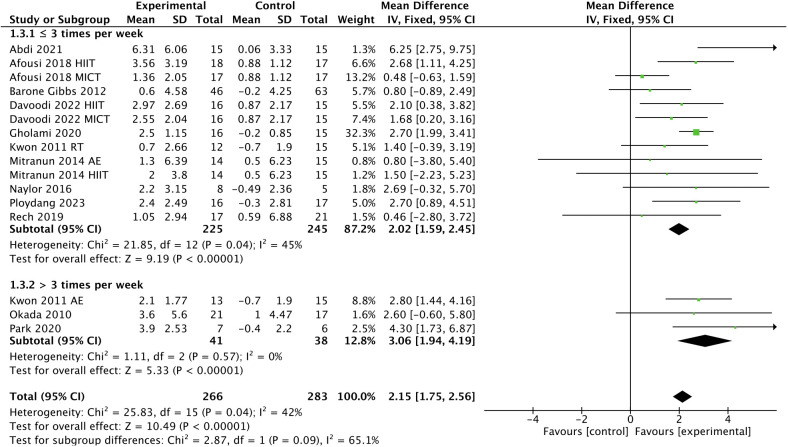
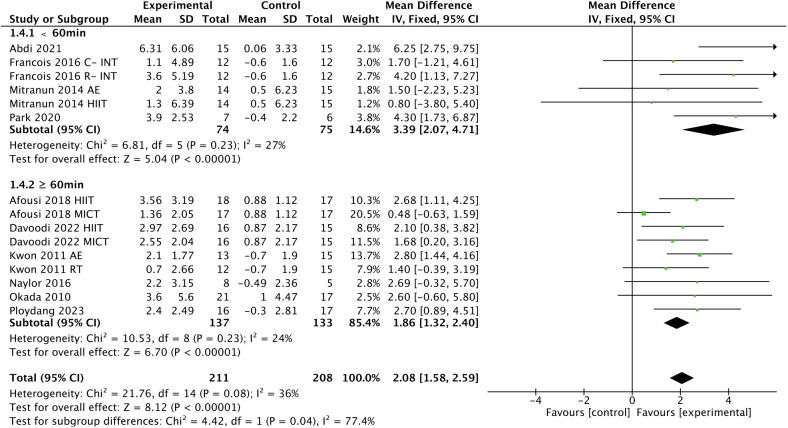
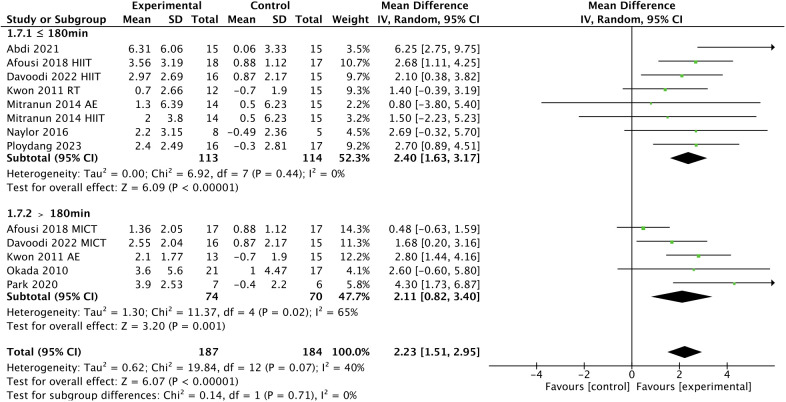
From the 3636 search records initially retrieved, 13 studies met the inclusion criteria. Our meta-analysis revealed that exercise had a significant effect on improving FMD in T2DM patients [WMD, 2.18 (95% CI, 1.78-2.58), < 0.00001, = 38%], with high-intensity interval training (HIIT) being the most effective intervention type [HIIT, 2.62 (1.42-3.82); < 0.0001; aerobic exercise, 2.20 (1.29-3.11), < 0.00001; resistance exercise, 1.91 (0.01-3.82), = 0.05; multicomponent training, 1.49 (0.15-2.83), = 0.03]. In addition, a higher frequency [> 3 times, 3.06 (1.94-4.19), < 0.00001; ≤ 3 times, 2.02 (1.59-2.45), < 0.00001], a shorter session duration [< 60 min, 3.39 (2.07-4.71), < 0.00001; ≥ 60 min, 1.86 (1.32-2.40), < 0.00001], and a shorter weekly time [≤ 180 min, 2.40 (1.63-3.17), < 0.00001; > 180 min, 2.11 (0.82-3.40), = 0.001] were associated with larger improvements in FMD.
This meta-analysis provides clinicians with evidence to recommended that T2DM patients participate in exercise, especially HIIT, more than 3 times per week for less than 60 min, with a target of 180 min per week being reached by increasing the frequency of exercise.
https://www.crd.york.ac.uk/prospero, identifier CRD42023466575.
越来越多的研究探讨了运动对 2 型糖尿病患者血流介导的舒张功能(FMD)的影响,但结果存在争议。本系统评价和荟萃分析的主要目的是研究运动对 2 型糖尿病患者 FMD 的影响,次要目的是研究运动对 2 型糖尿病患者的最佳类型、频率、单次疗程持续时间和每周时间。
在 PubMed、Cochrane 图书馆、Scopus、Web of Science、Embase 和 EBSCO 数据库中进行检索。使用 Cochrane 偏倚风险工具(RoB2)评估随机试验和物理治疗证据数据库(PEDro)量表评估纳入研究的方法学质量。
从最初检索到的 3636 条记录中,有 13 项研究符合纳入标准。我们的荟萃分析表明,运动对改善 2 型糖尿病患者的 FMD 有显著影响[WMD,2.18(95%CI,1.78-2.58), < 0.00001, = 38%],高强度间歇训练(HIIT)是最有效的干预类型[HIIT,2.62(1.42-3.82);< 0.0001;有氧运动,2.20(1.29-3.11), < 0.00001;抗阻运动,1.91(0.01-3.82), = 0.05;多组分训练,1.49(0.15-2.83), = 0.03]。此外,较高的频率[>3 次,3.06(1.94-4.19), < 0.00001;≤3 次,2.02(1.59-2.45), < 0.00001]、较短的单次疗程持续时间[<60 分钟,3.39(2.07-4.71), < 0.00001;≥60 分钟,1.86(1.32-2.40), < 0.00001]和较短的每周时间[≤180 分钟,2.40(1.63-3.17), < 0.00001;>180 分钟,2.11(0.82-3.40), = 0.001]与 FMD 的更大改善相关。
本荟萃分析为临床医生提供了证据,建议 2 型糖尿病患者每周进行超过 3 次、每次少于 60 分钟、每周少于 180 分钟的运动,通过增加运动频率,将每周运动时间目标设定为 180 分钟,以获得更大的改善。
https://www.crd.york.ac.uk/prospero,标识符 CRD42023466575。