Department of Laboratory Medicine, Ren Ji Hospital, School of Medicine, Shanghai Jiao Tong University, Shanghai, China.
Clinical Laboratory, Urumqi Maternal and Child Health Care Hospital, Urumqi, Xinjiang, China.
mSystems. 2022 Jun 28;7(3):e0129721. doi: 10.1128/msystems.01297-21. Epub 2022 May 16.
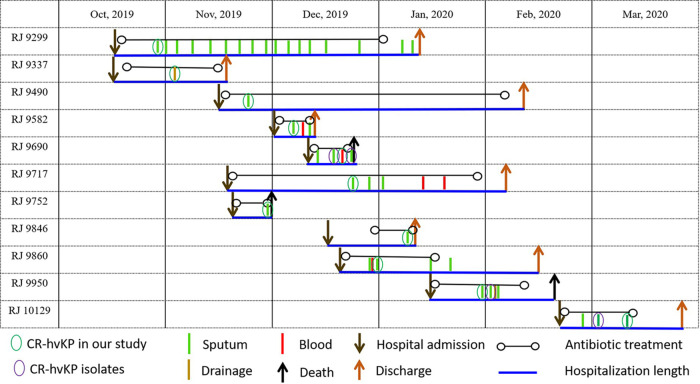
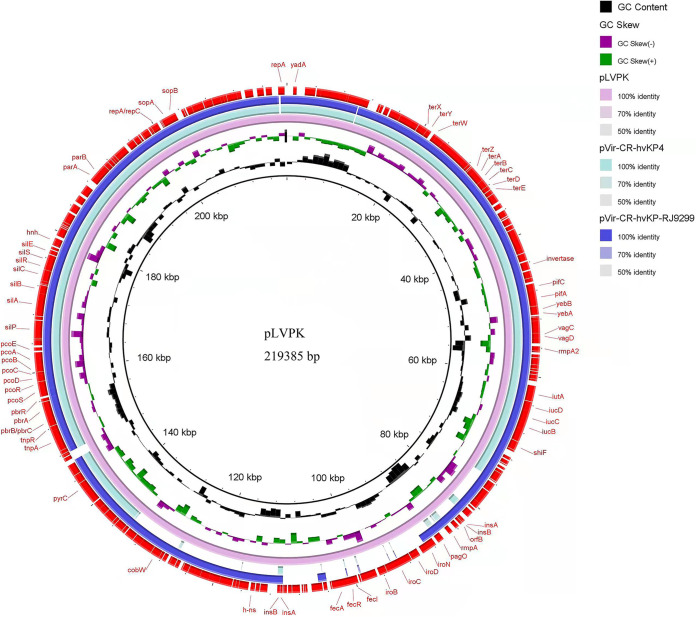
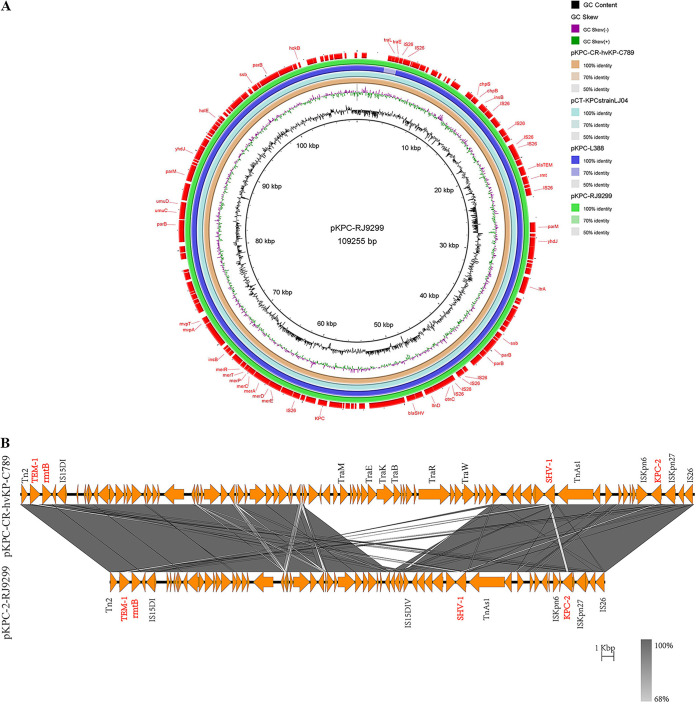
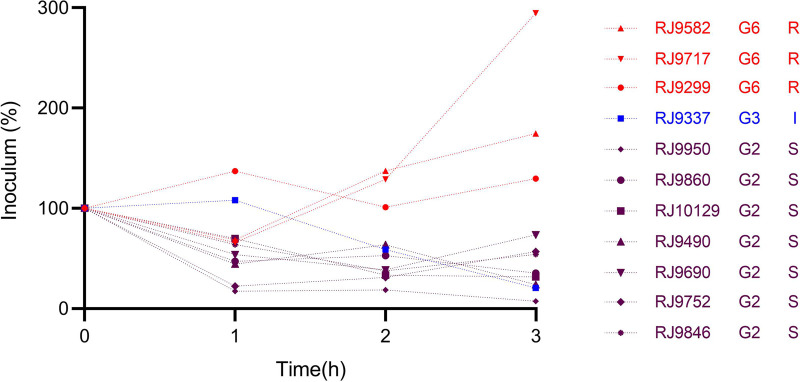
Carbapenem-resistant hypervirulent Klebsiella pneumoniae (CR-hvKP) has been increasingly reported worldwide. Here, we report an outbreak caused by sequence type 859-K19 (ST859-K19) CR-hvKP isolates in a teaching hospital in China. Interestingly, K. pneumoniae ST859 was a single-locus variant of ST11 but has never been reported before. A total of 11 nonrepetitive ST859 CR-hvKP isolates were collected from 11 patients, 3 of which died of severe CR-hvKP infection. Antimicrobial susceptibility assay results showed that all the 11 CR-hvKP isolates exhibited high-level resistance to commonly used antibiotics, only remaining susceptible to colistin, tigecycline, and ceftazidime/avibactam. Whole-genome sequencing (WGS) was performed using the Illumina platform for the 11 CR-hvKP isolates, and RJ9299 was further sequenced using the PacBio platform. A phylogram tree using WGS data revealed that all the 11 CR-hvKP isolates were clustered in 1 clade, which probably indicated clone transmission. Determinants of resistance and virulence gene analysis using WGS data confirmed the 11 isolates had almost identical resistance gene profiles (, , , , ) and virulence gene (, , ) profiles, which hint at clone spread again. The complete genome size of RJ9299 was 5,875 kb, including a 5,445-kb chromosome, a 215-kb virulence plasmid (pVir-CR-hvKP-RJ9299), a 109-kb -harboring plasmid (pKPC-2-RJ9299), and three circular plasmids. Comparative genomics showed pVir-RJ9299 (IncHI1B type) and pKPC-2-RJ9299 (IncFII-IncR) possessed over 99% similarity to pLVPK and pKPC-CR-hvKP-C789, respectively. Serum resistance assays and a Galleria mellonella infection model showed the 11 isolates exhibited different levels of virulence. This is the first report of an outbreak caused by ST859 CR-hvKP isolates. The emergence of carbapenem-resistant hypervirulent Klebsiella pneumoniae (CR-hvKP) in China has posed a great threat to public health, especially in the highly transmissible ST11 clone. With the transmission of virulence and resistance determinants, CR-hvKP isolates have been reported in an increasing number of sequence types (STs), including ST23, ST65, ST1797, ST43, ST231, ST147, ST15, ST383, ST268, ST595, ST375, ST48, and ST307. Here, we report an outbreak caused by ST859-K19 CR-hvKP isolates in a teaching hospital in China. ST859 is a single-locus variant of ST11. There is no literature on ST859 K. pneumoniae in public databases, let alone ST859 CR-hvKP isolates. To our knowledge, this is the first report to depict the molecular and genomic characteristics of ST859 CR-hvKP isolates. Active surveillance approaches should be implemented to promptly find the spread of CR-hvKP isolates in health care settings.
耐碳青霉烯类超毒力肺炎克雷伯菌 (CR-hvKP) 在全球范围内的报道日益增多。在这里,我们报告了在中国一家教学医院发生的由 859-K19 (ST859-K19) CR-hvKP 分离株引起的暴发。有趣的是,肺炎克雷伯菌 ST859 是 ST11 的单一位点变异株,但以前从未有过报道。从 11 名患者中收集了 11 个非重复的 ST859 CR-hvKP 分离株,其中 3 例死于严重的 CR-hvKP 感染。药敏试验结果显示,所有 11 株 CR-hvKP 分离株对常用抗生素表现出高水平耐药,仅对黏菌素、替加环素和头孢他啶/阿维巴坦敏感。对 11 株 CR-hvKP 分离株进行了 Illumina 平台的全基因组测序 (WGS),并进一步使用 PacBio 平台对 RJ9299 进行了测序。使用 WGS 数据构建的系统发育树显示,所有 11 株 CR-hvKP 分离株都聚集在 1 个分支中,这可能表明存在克隆传播。使用 WGS 数据进行的耐药性和毒力基因分析确定,11 株分离株具有几乎相同的耐药基因谱(、、、、)和毒力基因谱(、、),这暗示着克隆再次传播。RJ9299 的完整基因组大小为 5875 kb,包括一个 5445 kb 的染色体、一个 215 kb 的毒力质粒 (pVir-CR-hvKP-RJ9299)、一个 109 kb 的 - 携带质粒 (pKPC-2-RJ9299) 和三个圆形质粒。比较基因组学显示 pVir-RJ9299(IncHI1B 型)和 pKPC-2-RJ9299(IncFII-IncR)与 pLVPK 和 pKPC-CR-hvKP-C789 分别具有超过 99%的相似性。血清抗性试验和大蜡螟感染模型表明,11 株分离株表现出不同程度的毒力。这是首例由 ST859 CR-hvKP 分离株引起的暴发的报告。耐碳青霉烯类超毒力肺炎克雷伯菌 (CR-hvKP) 在我国的出现对公共卫生构成了巨大威胁,尤其是在高传染性的 ST11 克隆中。随着毒力和耐药性决定因素的传播,CR-hvKP 分离株在越来越多的序列类型 (ST) 中被报道,包括 ST23、ST65、ST1797、ST43、ST231、ST147、ST15、ST383、ST268、ST595、ST375、ST48 和 ST307。在这里,我们报告了在中国一家教学医院由 859-K19 (ST859-K19) CR-hvKP 分离株引起的暴发。ST859 是 ST11 的单一位点变异株。公共数据库中没有关于 ST859 肺炎克雷伯菌的文献,更不用说 ST859 CR-hvKP 分离株了。据我们所知,这是首次描述 ST859 CR-hvKP 分离株的分子和基因组特征。应采取主动监测措施,以便及时发现 CR-hvKP 分离株在医疗机构中的传播。