GenPhySE, Université de Toulouse, INRAE, ENVT, 31320 Castanet Tolosan, France.
France Génétique Porc, 35651 Le Rheu Cedex, France.
J Anim Sci. 2022 Jun 1;100(6). doi: 10.1093/jas/skac183.
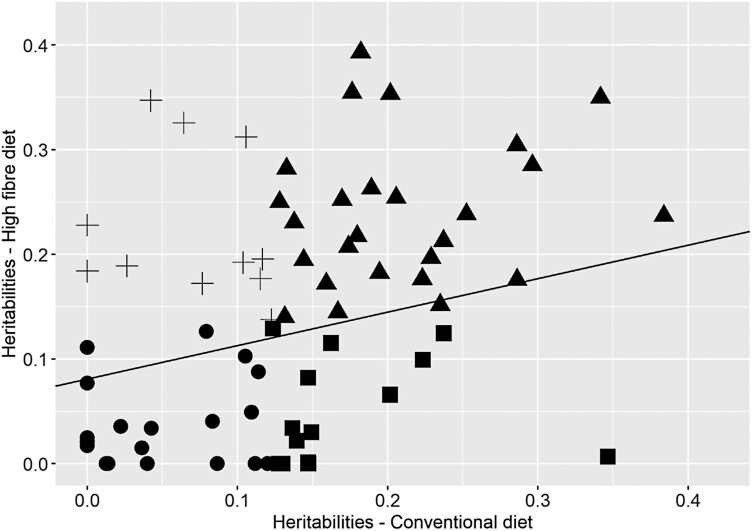
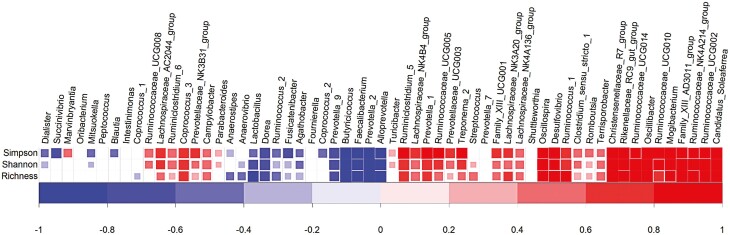
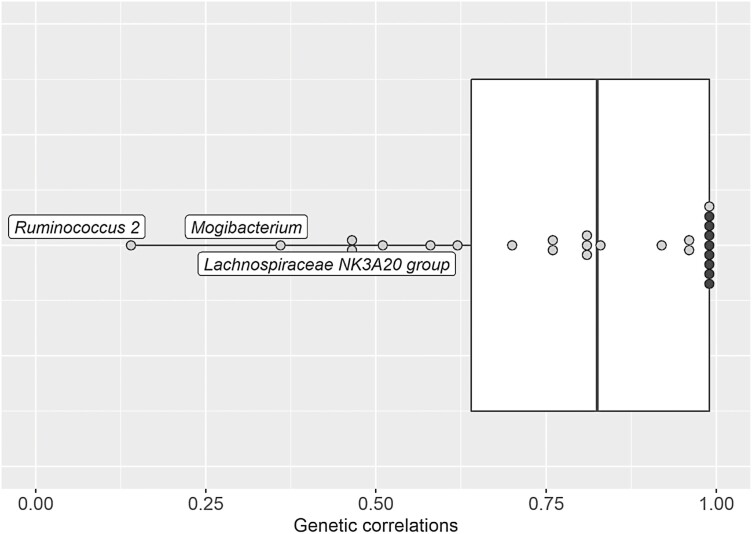
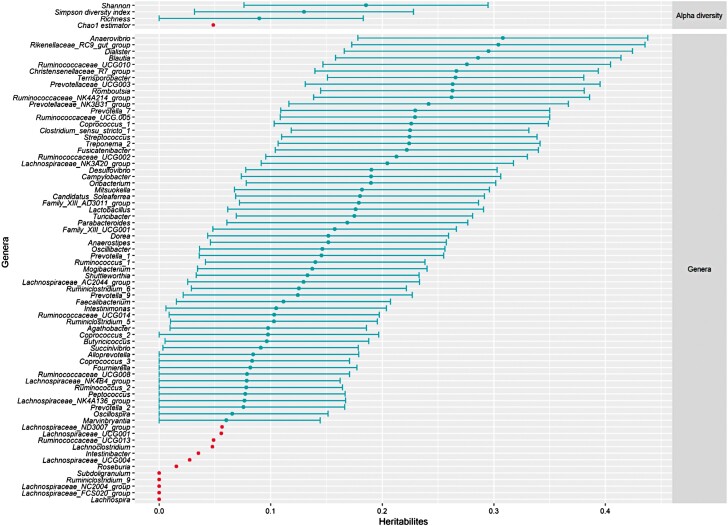
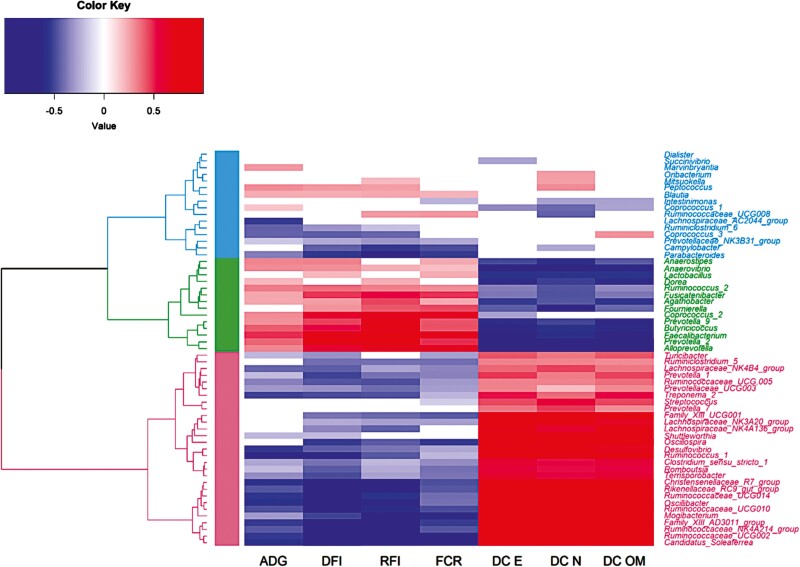
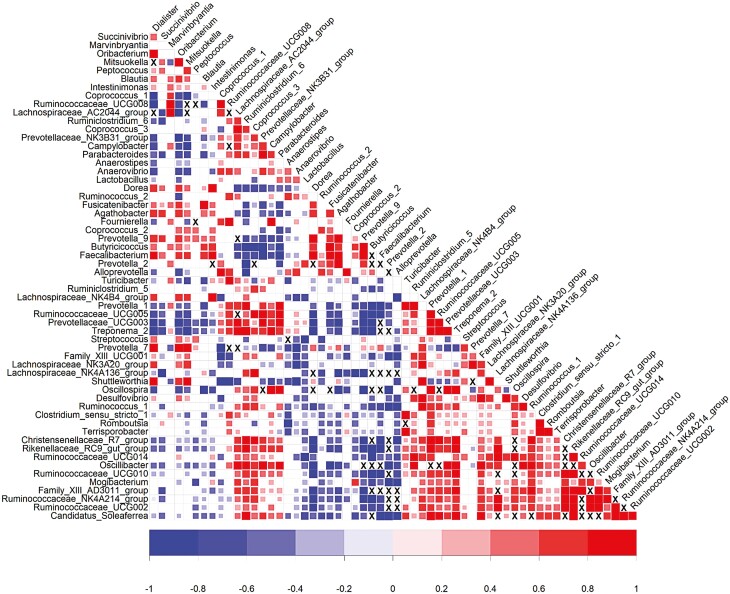
In pigs, the gut microbiota composition plays a major role in the process of digestion, but is influenced by many external factors, especially diet. To be used in breeding applications, genotype by diet interactions on microbiota composition have to be quantified, as well as their impact on genetic covariances with feed efficiency (FE) and digestive efficiency (DE) traits. This study aimed at determining the impact of an alternative diet on variance components of microbiota traits (genera and alpha diversity indices) and estimating genetic correlations between microbiota and efficiency traits for pigs fed a conventional (CO) or a high-fiber (HF) diet. Fecal microbes of 812 full-siblings fed a CO diet and 752 pigs fed the HF diet were characterized at 16 weeks of age by sequencing the V3-V4 region of the 16S rRNA gene. A total of 231 genera were identified. Digestibility coefficients of nitrogen, organic matter, and energy were predicted analyzing the same fecal samples with near infrared spectrometry. Daily feed intake, feed conversion ratio, residual feed intake and average daily gain (ADG) were also recorded. The 71 genera present in more than 20% of individuals were retained for genetic analyses. Heritability (h²) of microbiota traits were similar between diets (from null to 0.38 ± 0.12 in the CO diet and to 0.39 ± 0.12 in the HF diet). Only three out of the 24 genera and two alpha diversity indices with significant h² in both diets had genetic correlations across diets significantly different from 0.99 (P < 0.05), indicating limited genetic by diet interactions for these traits. When both diets were analyzed jointly, 59 genera had h² significantly different from zero. Based on the genetic correlations between these genera and ADG, FE, and DE traits, three groups of genera could be identified. A group of 29 genera had abundances favorably correlated with DE and FE traits, 14 genera were unfavorably correlated with DE traits, and the last group of 16 genera had abundances with correlations close to zero with production traits. However, genera abundances favorably correlated with DE and FE traits were unfavorably correlated with ADG, and vice versa. Alpha diversity indices had correlation patterns similar to the first group. In the end, genetic by diet interactions on gut microbiota composition of growing pigs were limited in this study. Based on this study, microbiota-based traits could be used as proxies to improve FE and DE in growing pigs.
在猪中,肠道微生物群落组成在消化过程中起着重要作用,但受许多外部因素的影响,尤其是饮食。为了将其应用于繁殖,必须量化基因型与饮食相互作用对微生物群落组成的影响,以及它们对饲料效率 (FE) 和消化效率 (DE) 性状的遗传协方差的影响。本研究旨在确定替代饮食对微生物群落特征(属和 alpha 多样性指数)的方差分量的影响,并估计在饲喂常规 (CO) 或高纤维 (HF) 饮食的猪中,微生物组与效率性状之间的遗传相关性。在 16 周龄时,通过对 16S rRNA 基因的 V3-V4 区域进行测序,对 812 只全同胞饲喂 CO 饮食和 752 只饲喂 HF 饮食的猪的粪便微生物进行了表征。共鉴定出 231 个属。用近红外光谱分析相同的粪便样本预测氮、有机物和能量的消化系数。还记录了每日采食量、饲料转化率、剩余采食量和平均日增重 (ADG)。保留了在 20%以上个体中存在的 71 个属用于遗传分析。在 CO 饮食中,微生物特征的遗传力 (h²) 从接近零到 0.38±0.12,在 HF 饮食中为 0.39±0.12,在两种饮食中相似。只有三种属和两种在两种饮食中都具有显著 h² 的 alpha 多样性指数的遗传相关性与 0.99(P<0.05)显著不同,表明这些特征的基因型与饮食的相互作用有限。当联合分析两种饮食时,有 59 个属的 h² 与零显著不同。基于这些属与 ADG、FE 和 DE 性状之间的遗传相关性,可将这些属分为三组。一组 29 个属的丰度与 DE 和 FE 性状呈有利相关,14 个属与 DE 性状呈不利相关,最后一组 16 个属的丰度与生产性状的相关性接近零。然而,与 DE 和 FE 性状呈有利相关的属与 ADG 呈不利相关,反之亦然。alpha 多样性指数的相关模式与第一组相似。最终,本研究中生长猪肠道微生物群落组成的基因型与饮食相互作用有限。基于本研究,基于微生物组的特征可以作为提高生长猪 FE 和 DE 的替代指标。