Cao Li, Chongsuvivatwong Virasakdi, McNeil Edward B
Information Technology Department, Inner Mongolia Medical University, Hohhot, China.
Department of Epidemiology, Faculty of Medicine, Prince of Songkla University, Songkhla, Thailand.
JMIR Hum Factors. 2022 May 19;9(2):e36962. doi: 10.2196/36962.
Mobile health (mHealth) apps have become part of the infrastructure for access to health care in hospitals, especially during the COVID-19 pandemic. However, little is known about the effects of sociodemographic characteristics on the digital divide regarding the use of hospital-based mHealth apps and their benefits to patients and caregivers.
The aim of this study was to document the cascade of potential influences from digital access to digital use and then to mHealth use, as well as the potential influence of sociodemographic variables on elements of the cascade.
A cross-sectional survey was conducted from January to February 2021 among adult clients at outpatient departments in 12 tertiary hospitals of Inner Mongolia, China. Structural equation modeling was conducted after the construct comprising digital access, digital use, and mHealth use was validated.
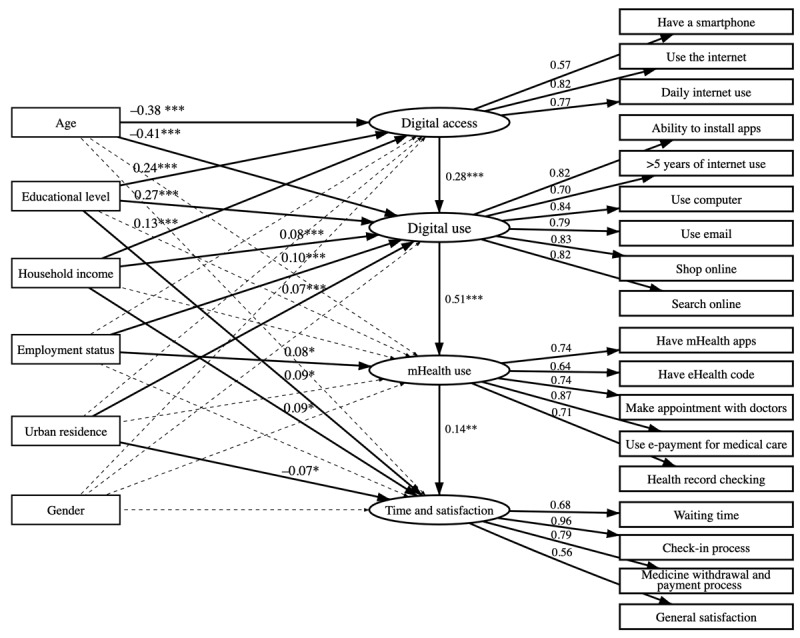
Of 2115 participants, the β coefficients (95% CI) of potential influence of digital access on digital use, and potential influence of digital use on mHealth use, were 0.28 (95% CI 0.22-0.34) and 0.51 (95% CI 0.38-0.64), respectively. Older adults were disadvantaged with regard to mHealth access and use (β=-0.38 and β=-0.41), as were less educated subgroups (β=-0.24 and β=-0.27), and these two factors had nonsignificant direct effects on mHealth use.
To overcome the mHealth use divide, it is important to improve digital access and digital use among older adults and less educated groups.
移动健康(mHealth)应用程序已成为医院医疗保健基础设施的一部分,尤其是在新冠疫情期间。然而,关于社会人口统计学特征对基于医院的移动健康应用程序使用方面的数字鸿沟及其对患者和护理人员的益处的影响,我们知之甚少。
本研究的目的是记录从数字接入到数字使用再到移动健康使用的潜在影响级联,以及社会人口统计学变量对该级联各要素的潜在影响。
2021年1月至2月在中国内蒙古12家三级医院的门诊对成年患者进行了横断面调查。在验证了包括数字接入、数字使用和移动健康使用的结构后,进行了结构方程建模。
在2115名参与者中,数字接入对数字使用的潜在影响的β系数(95%CI)以及数字使用对移动健康使用的潜在影响的β系数分别为0.28(95%CI 0.22 - 0.34)和0.51(95%CI 0.38 - 0.64)。老年人在移动健康接入和使用方面处于劣势(β = -0.38和β = -0.41),受教育程度较低的亚组也是如此(β = -0.24和β = -0.27),并且这两个因素对移动健康使用没有显著的直接影响。
为了克服移动健康使用方面的差距,改善老年人和受教育程度较低群体的数字接入和数字使用非常重要。