Patel Tejal, Ivo Jessica, Pitre Teresa, Faisal Sadaf, Antunes Kristen, Oda Kasumi
School of Pharmacy, University of Waterloo, Kitchener, ON, Canada.
Centre for Family Medicine Family Health Team, Kitchener, ON, Canada.
JMIR Form Res. 2022 May 19;6(5):e34906. doi: 10.2196/34906.
Innovative digital technology systems that support and monitor real-time medication intake are now available commercially; however, there is limited knowledge of the use of such technology in patients' homes. One such smart medication dispenser, spencer, provides alerts to patients to take their medications and allows for tracking and reporting real-time medication adherence data.
The objectives of this study were to examine the use of a smart medication dispenser as a medication adherence and self-management support tool for community dwelling adults over a 6-month period, in addition to usability, usefulness, satisfaction, and impact on caregiver support.
This prospective, observational study invited community-dwelling adults aged 45 years and older taking at least one chronic medication and their caregivers to use this smart medication dispenser for their medication administration for 6 months. Adherence was defined as a dose intake within 2 hours post scheduled time. Real-time adherence data were collected using the smart medication dispenser and the AdhereNet platform. Usability, usefulness, and satisfaction were measured using the System Usability Scale and the Usefulness, Satisfaction, and Ease of Use questionnaire, respectively. Caregiver burden was measured on a visual analog scale at baseline and at the end of the 6-month study period.
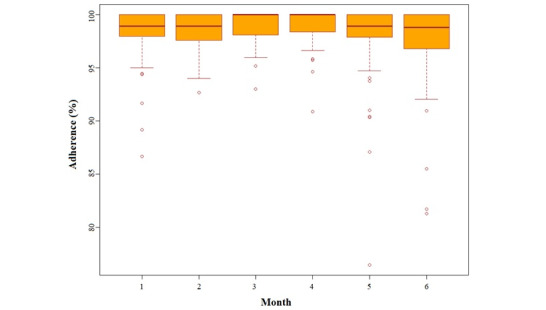
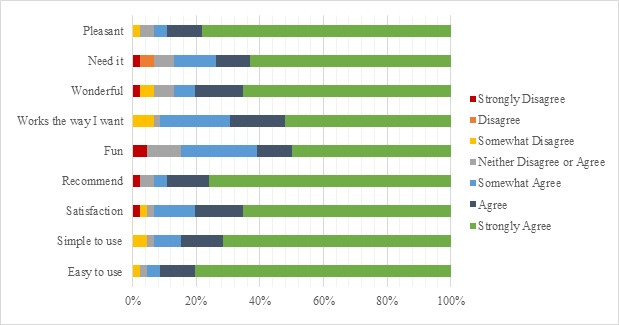
A total of 58 participants were recruited, of which 55% (32/58) were female with a mean age of 66.36 (SD 11.28; range 48-90) years. Eleven caregiver participants were recruited, of whom 91% (10/11) were female. The average monthly adherence over 6 months was 98% (SD 3.1%; range 76.5%-100%). The average System Usability score was 85.74 (n=47; SD 12.7; range 47.5-100). Of the 46 participants who provided data, 44 (96%) rated the product as easy, 43 (93%) as simple to use, and 43 (93%) were satisfied with the product. Caregiver burden prior to and following smart medication dispenser use for 6 months was found to be statistically significantly different (P<.001; CI 2.11-5.98).
Smart medication adherence products such as spencer, when connected and clinically monitored, can be a useful solution for medication management and have the potential to improve caregiver burden.
支持并监测实时药物摄入的创新数字技术系统目前已在市场上有售;然而,对于此类技术在患者家中的使用情况了解有限。一种名为spencer的智能药物分配器可向患者发出服药提醒,并能追踪和报告实时用药依从性数据。
本研究的目的是在6个月的时间内,考察一种智能药物分配器作为社区居住成年人用药依从性及自我管理支持工具的使用情况,此外还要评估其可用性、有用性、满意度以及对照顾者支持的影响。
这项前瞻性观察性研究邀请年龄在45岁及以上、正在服用至少一种慢性药物的社区居住成年人及其照顾者使用这种智能药物分配器进行药物管理,为期6个月。依从性定义为在预定时间后2小时内服药。使用智能药物分配器和AdhereNet平台收集实时依从性数据。分别使用系统可用性量表以及有用性、满意度和易用性问卷来测量可用性、有用性和满意度。在基线和6个月研究期结束时,使用视觉模拟量表测量照顾者负担。
共招募了58名参与者,其中55%(32/58)为女性,平均年龄为66.36岁(标准差11.28;范围48 - 90岁)。招募了11名照顾者参与者,其中91%(10/11)为女性。6个月内的平均每月依从率为98%(标准差3.1%;范围76.5% - 100%)。系统可用性平均得分为85.74(n = 47;标准差12.7;范围47.5 - 100)。在提供数据的46名参与者中,44名(96%)认为该产品使用方便,43名(93%)认为操作简单,43名(93%)对该产品满意。发现使用智能药物分配器6个月前后照顾者负担在统计学上有显著差异(P <.001;可信区间2.11 - 5.98)。
像spencer这样的智能用药依从性产品,在连接并进行临床监测时,可成为药物管理的有用解决方案,并有减轻照顾者负担的潜力。