Programa de pós-graduação em Neurologia/Neurociências, Universidade Federal de São Paulo, São Paulo, SP, Brasil.
Faculdade de Educação Física, Faculdade do Clube Náutico Mogiano, Mogi das Cruzes, SP, Brasil.
Braz J Med Biol Res. 2022 Apr 27;55:e11917. doi: 10.1590/1414-431X2022e11917. eCollection 2022.
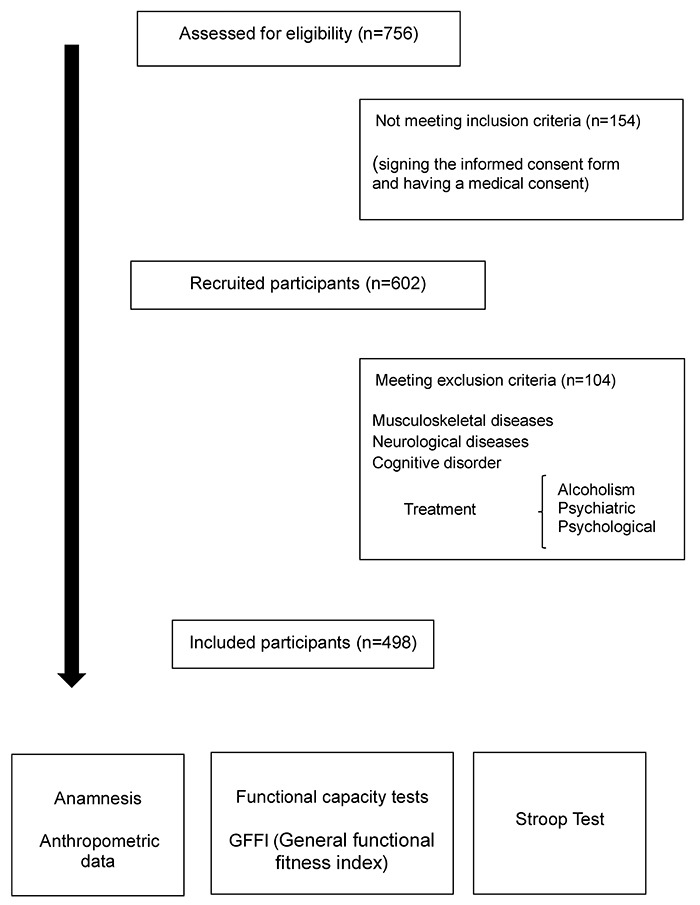
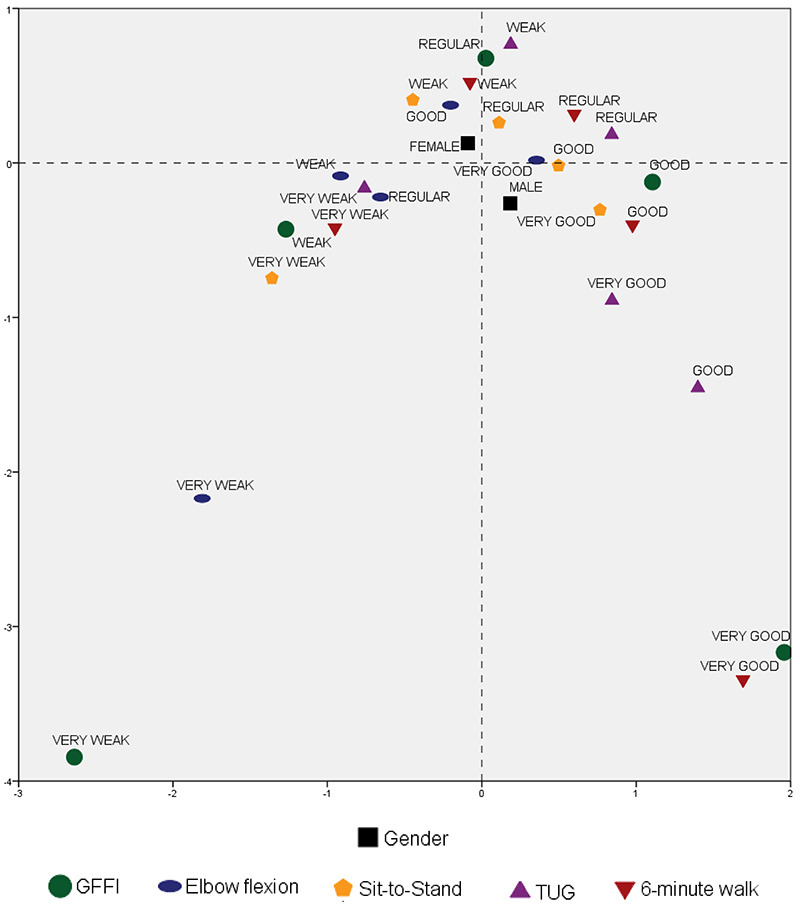
Aging is related to a decrease in physiological abilities, especially cognitive functions. To unravel further evidence of age-related cognitive decline, we analyzed which physical and functional variables are predictors of cognitive performance in a sample of 498 Brazilian elderly (67.26% women). To do so, we used the Stroop test as a tool to evaluate executive functions and the General functional fitness index (GFFI) to evaluate the functional fitness of the participants. A linear regression analysis revealed that female sex (β=-0.097; t=-2.286; P=0.023), younger age (β=0.205; t=4.606; P<0.0001), more years of education (β=-0.280; t=-6.358; P<0.0001), and higher GFFI (β=-0.101; t=-2.347; P<0.02) were predictors of better cognitive performance. Body mass index (kg/m2) and nutritional status (underweight, eutrophic, overweight, or obese) were not predictors of cognitive performance. Interestingly, among the GFFI tasks, muscle strength influenced the test execution time, both in upper and lower limbs (elbow flexion: β=-0.201; t=-4.672; P<0.0001; sit-to-stand: β=-0.125; t=-2.580; P<0.01). Our findings showed that: 1) women performed the Stroop test faster than men; 2) the older the person, the lower was the cognitive performance; 3) the higher the education, the better the test execution time; and 4) higher scores in the GFFI were associated with a better performance in the Stroop test. Therefore, gender, age, education, and functional fitness and capacity were predictors of cognitive performance in the elderly.
衰老是与生理能力下降有关,尤其是认知功能。为了进一步揭示与年龄相关的认知能力下降的证据,我们分析了在 498 名巴西老年人(67.26%为女性)样本中,哪些身体和功能变量是认知表现的预测指标。为此,我们使用 Stroop 测试作为评估执行功能的工具,使用一般功能健身指数(GFFI)来评估参与者的功能健身水平。线性回归分析显示,女性(β=-0.097;t=-2.286;P=0.023)、年龄较小(β=0.205;t=4.606;P<0.0001)、受教育年限较长(β=-0.280;t=-6.358;P<0.0001)和 GFFI 较高(β=-0.101;t=-2.347;P<0.02)是认知表现较好的预测指标。身体质量指数(kg/m2)和营养状况(体重不足、正常、超重或肥胖)不是认知表现的预测指标。有趣的是,在 GFFI 任务中,肌肉力量影响上肢和下肢的测试执行时间(肘屈伸:β=-0.201;t=-4.672;P<0.0001;坐站起:β=-0.125;t=-2.580;P<0.01)。我们的研究结果表明:1)女性在 Stroop 测试中比男性完成得更快;2)年龄越大,认知表现越低;3)受教育程度越高,测试执行时间越好;4)GFFI 得分越高,Stroop 测试表现越好。因此,性别、年龄、教育、功能健身和能力是老年人认知表现的预测指标。