School of Public Health, Guangdong Pharmaceutical University, Guangzhou, 510310, China.
School of Public Health, Sun Yat-Sen University, Guangzhou, 510080, China.
BMC Public Health. 2022 May 20;22(1):1017. doi: 10.1186/s12889-022-13420-5.
Childhood is a critical period for brain development. However, it remains unknown whether the behaviors in a typical 24-h day are related to children's executive function (EF). This study aimed to investigate the relationship between the 24-h movement guidelines and children's EF.
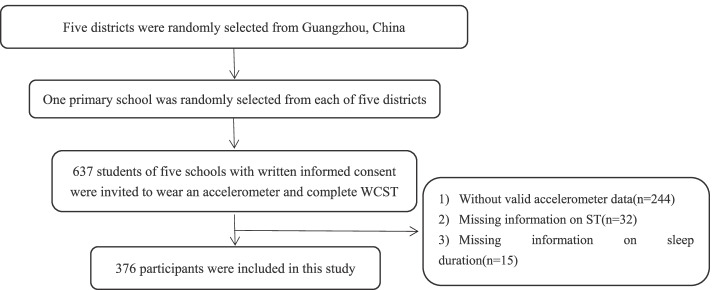
Children aged 7-12 years (n = 376) were studied in 2017 in China. Physical activity (PA) was accelerometer-derived, while screen time (ST) and sleep duration were self-reported. Meeting the 24-h movement guidelines was defined as: 1) ≥ 60 min/day of moderate-to-vigorous PA; 2) ≤ 2 h/day of recreational ST; 3) 9-11 h/night of sleep. EF was assessed by the Wisconsin Card Sorting Test (WCST). Number of completed categories (CC), shifting efficiency (SE), non-perseverative errors (NPE), and failure to maintain set (FMS) were used to measure four processes of EF, respectively represented global performance, cognitive flexibility, efficiency in rule discovery, and sustained attention. Generalized linear mixed models (GLMM) were completed to explore the associations of meeting the PA, ST, and sleep duration recommendations with four processes of EF.
Statistically significant positive associations were observed between the number of guidelines met, regarded as a continuous variable, with CC [β = 0.343 (95% confidence interval [CI]: 0.125, 0.561)] and SE [β = 4.028 (95% CI: 0.328, 7.727)], while number of guidelines met negatively related to NPE [β = - 4.377 (95% CI:-7.952,-0.802)]. Participants not meeting the two recommendations for PA and sleep duration had lower scores in CC [β = -0.636(95% CI:-1.125,-0.147)] and SE [β = -10.610 (95% CI:-18.794,-2.425)] compared with those meeting the two, suggesting inferior global performance and worse efficiency in rule discovery. However, ST recommendation had no significant association with any processes of EF.
Meeting more recommendations of the 24-h movement guidelines was associated with superior EF in children. Specifically, more PA and healthy sleep duration should be encouraged to promote children's EF.
儿童期是大脑发育的关键时期。然而,目前尚不清楚典型 24 小时日常生活中的行为是否与儿童的执行功能(EF)有关。本研究旨在探讨 24 小时运动指南与儿童 EF 之间的关系。
2017 年在中国对 7-12 岁儿童(n=376)进行了研究。体力活动(PA)是通过加速度计得出的,而屏幕时间(ST)和睡眠时间则是自我报告的。满足 24 小时运动指南的定义为:1)每天至少进行 60 分钟的中等到剧烈的 PA;2)每天娱乐性 ST 不超过 2 小时;3)每晚睡眠时间为 9-11 小时。执行功能(EF)通过威斯康星卡片分类测试(WCST)进行评估。完成的类别数(CC)、转换效率(SE)、非持续错误(NPE)和未能保持设定(FMS)分别用于衡量 EF 的四个过程,分别代表整体表现、认知灵活性、规则发现效率和持续注意力。采用广义线性混合模型(GLMM)探讨满足 PA、ST 和睡眠时间建议与 EF 四个过程之间的关系。
作为连续变量,与满足的指南数量呈正相关,与 CC[β=0.343(95%置信区间[CI]:0.125,0.561)]和 SE[β=4.028(95%CI:0.328,7.727)]有关,而满足的指南数量与 NPE 呈负相关[β=-4.377(95%CI:-7.952,-0.802)]。未满足 PA 和睡眠时长两项建议的参与者 CC[β=-0.636(95%CI:-1.125,-0.147)]和 SE[β=-10.610(95%CI:-18.794,-2.425)]得分低于两项均满足的参与者,提示整体表现和规则发现效率较差。然而,ST 建议与 EF 的任何一个过程均无显著关联。
满足 24 小时运动指南的建议越多,儿童的 EF 越好。具体而言,应鼓励更多的 PA 和健康的睡眠时间,以促进儿童的 EF。