Peters Birte, Keller Alexander, Leonhardt Sara Diana
Department for Animal Ecology and Tropical Biology University of Würzburg Biocenter Würzburg Germany.
Department of Bioinformatics University of Würzburg Biocenter Würzburg Germany.
Ecol Evol. 2022 May 15;12(5):e8919. doi: 10.1002/ece3.8919. eCollection 2022 May.
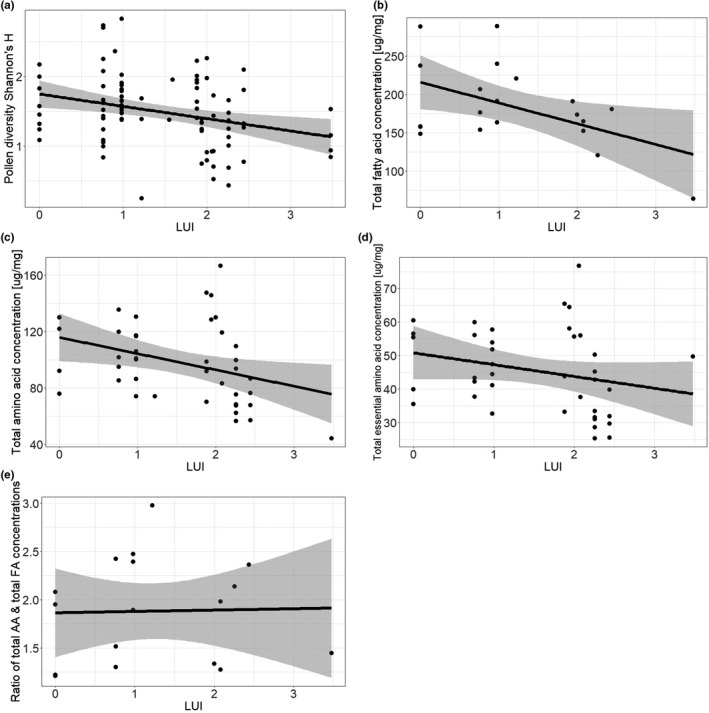
Biodiversity loss, as often found in intensively managed agricultural landscapes, correlates with reduced ecosystem functioning, for example, pollination by insects, and with altered plant composition, diversity, and abundance. But how does this change in floral resource diversity and composition relate to occurrence and resource use patterns of trap-nesting solitary bees? To better understand the impact of land-use intensification on communities of trap-nesting solitary bees in managed grasslands, we investigated their pollen foraging, reproductive fitness, and the nutritional quality of larval food along a land-use intensity gradient in Germany. We found bee species diversity to decrease with increasing land-use intensity irrespective of region-specific community compositions and interaction networks. Land use also strongly affected the diversity and composition of pollen collected by bees. Lack of suitable pollen sources likely explains the absence of several bee species at sites of high land-use intensity. The only species present throughout, (red mason bee), foraged on largely different pollen sources across sites. In doing so, it maintained a relatively stable, albeit variable nutritional quality of larval diets (i.e., protein to lipid (P:L) ratio). The observed changes in bee-plant pollen interaction patterns indicate that only the flexible generalists, such as . , may be able to compensate the strong alterations in floral resource landscapes and to obtain food of sufficient quality through readily shifting to alternative plant sources. In contrast, other, less flexible, bee species disappear.
生物多样性丧失常见于集约化管理的农业景观中,它与生态系统功能的降低相关,例如昆虫传粉,还与植物组成、多样性和丰度的改变有关。但是,花卉资源多样性和组成的这种变化如何与筑巢独居蜜蜂的出现和资源利用模式相关呢?为了更好地理解土地利用集约化对管理草地上筑巢独居蜜蜂群落的影响,我们沿着德国的土地利用强度梯度,研究了它们的花粉采集、繁殖适应性以及幼虫食物的营养质量。我们发现,无论特定区域的群落组成和相互作用网络如何,蜜蜂物种多样性都会随着土地利用强度的增加而降低。土地利用也强烈影响了蜜蜂采集的花粉的多样性和组成。缺乏合适的花粉来源可能解释了在土地利用强度高的地点几种蜜蜂物种缺失的原因。唯一在各个地点都存在的物种(红壁蜂),在不同地点采集的花粉来源有很大差异。尽管如此,它维持了幼虫食物相对稳定但有所变化的营养质量(即蛋白质与脂质(P:L)比率)。观察到的蜜蜂与植物花粉相互作用模式的变化表明,只有像红壁蜂这样灵活的泛化种,才可能能够补偿花卉资源景观的强烈变化,并通过迅速转向替代植物来源来获取足够质量的食物。相比之下,其他不太灵活的蜜蜂物种则消失了。