Vázquez-Aristizabal Paula, Perumal Govindaraj, García-Astrain Clara, Liz-Marzán Luis M, Izeta Ander
CIC biomaGUNE, Basque Research and Technology Alliance (BRTA), 20014 Donostia-San Sebastián, Spain.
Tissue Engineering Group, Biodonostia Health Research Institute, 20014 Donostia-San, Sebastián, Spain.
ACS Omega. 2022 May 4;7(19):16236-16243. doi: 10.1021/acsomega.2c01398. eCollection 2022 May 17.
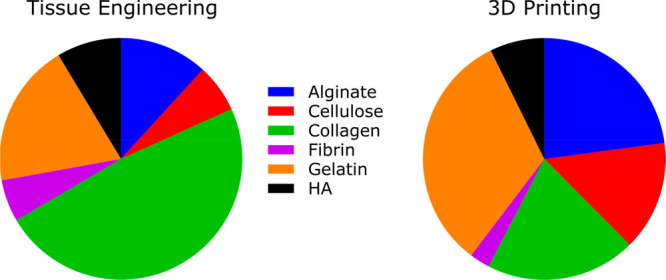
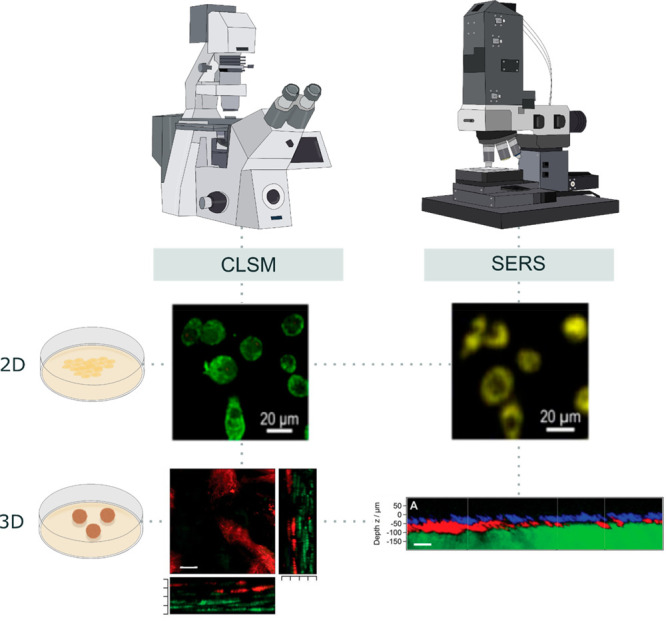
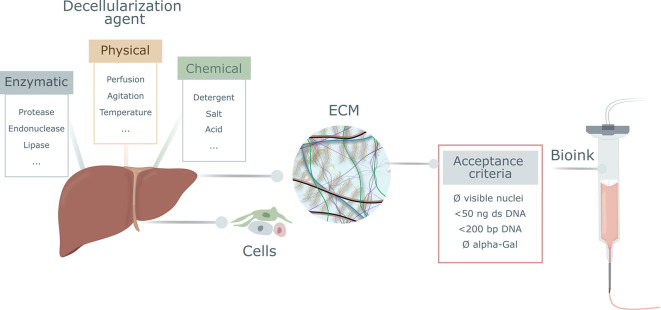
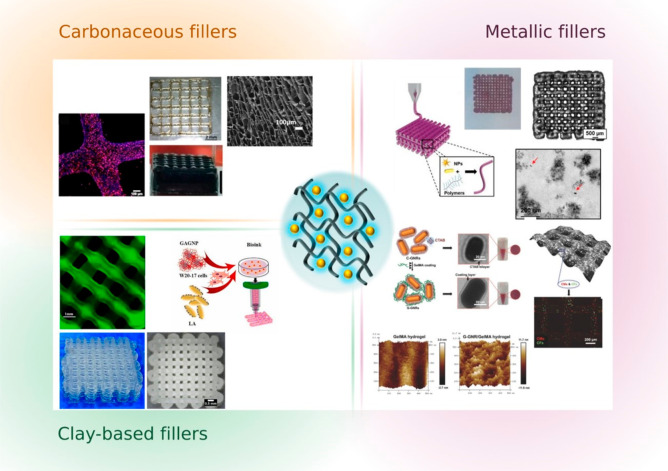
Use of three-dimensional bioprinting for the engineering of tissues has boomed during the past five years. An increasing number of commercial bioinks are available, with suitable mechanical and rheological characteristics and excellent biocompatibility. However, cell-laden bioinks based on a single polymer do not properly mimic the complex extracellular environment needed to tune cell behavior, as required for tissue and organ formation. Processes such as cell aggregation, migration, and tissue patterning should be dynamically monitored, and progress is being made in these areas, most prominently derived from nanoscience. We review recent developments in tissue bioprinting, cellularized bioink formulation, and cell tracking, from both chemistry and cell biology perspectives. We conclude that an interdisciplinary approach including expertise in polymer science, nanoscience, and cell biology/tissue engineering is required to drive further advancements in this field toward clinical application.
在过去五年中,三维生物打印用于组织工程的应用蓬勃发展。市面上有越来越多具有合适机械和流变特性以及出色生物相容性的商用生物墨水。然而,基于单一聚合物的载细胞生物墨水无法恰当地模拟组织和器官形成所需的、用于调节细胞行为的复杂细胞外环境。细胞聚集、迁移和组织图案形成等过程应进行动态监测,并且在这些领域正在取得进展,其中最显著的进展源自纳米科学。我们从化学和细胞生物学角度综述了组织生物打印、细胞化生物墨水配方和细胞追踪方面的最新进展。我们得出结论,需要一种跨学科方法,包括聚合物科学、纳米科学以及细胞生物学/组织工程方面的专业知识,以推动该领域在临床应用方面取得进一步进展。