Xu Jia, Gao Tiange, Sheng Lingjie, Wang Yan, Lou Chenxi, Wang Haifang, Liu Yuanfang, Cao Aoneng
Institute of Nanochemistry and Nanobiology, Shanghai University, Shanghai 200444, China.
Beijing National Laboratory for Molecular Sciences, College of Chemistry and Molecular Engineering, Peking University, Beijing 100871, China.
iScience. 2022 May 4;25(6):104324. doi: 10.1016/j.isci.2022.104324. eCollection 2022 Jun 17.
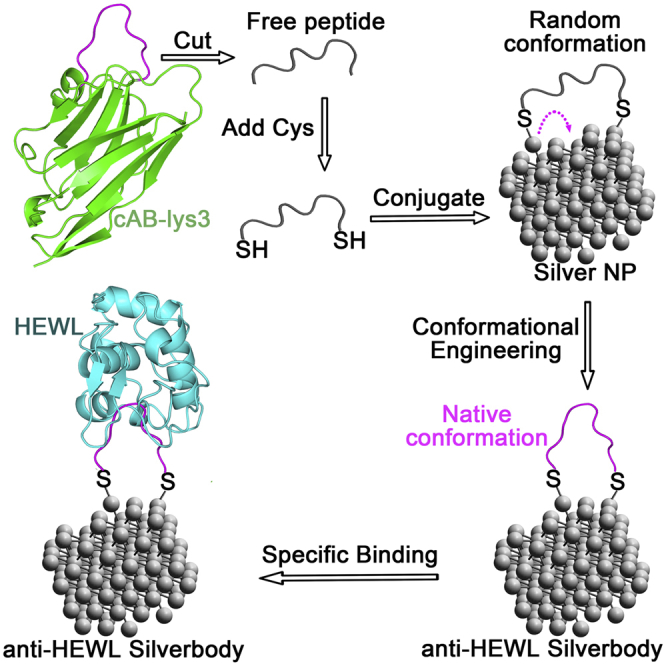
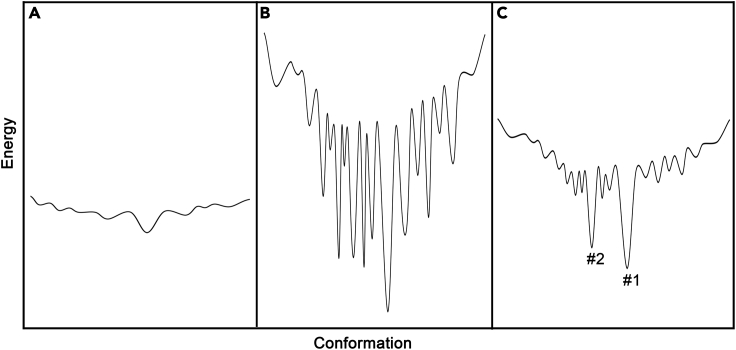
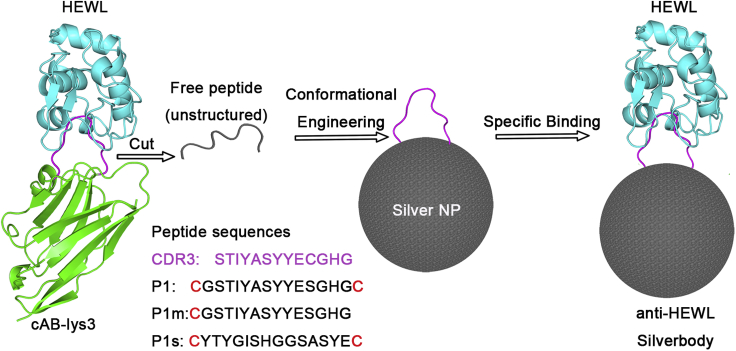
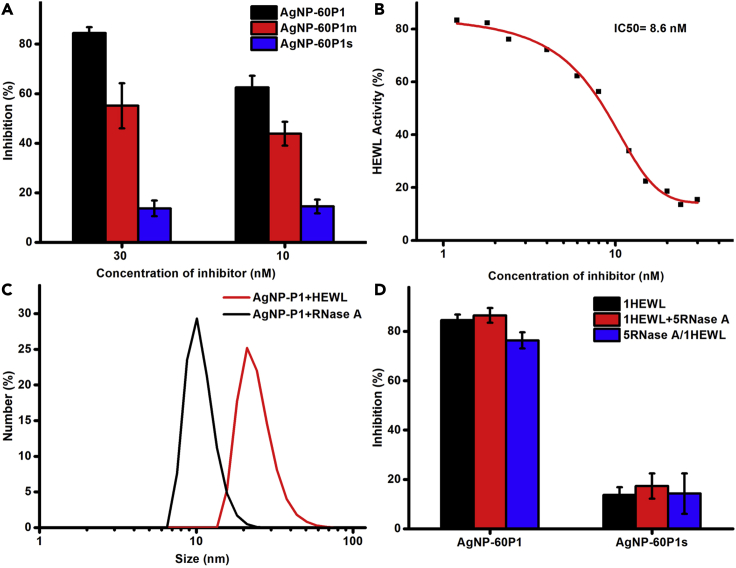
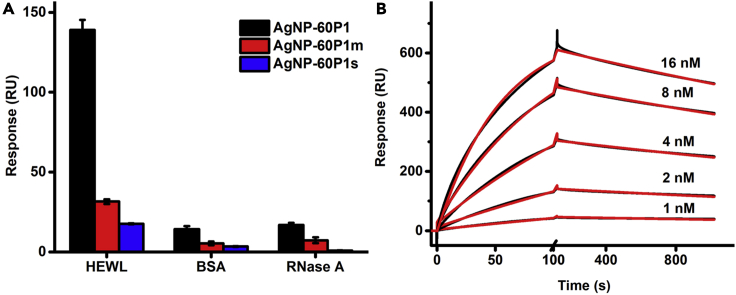
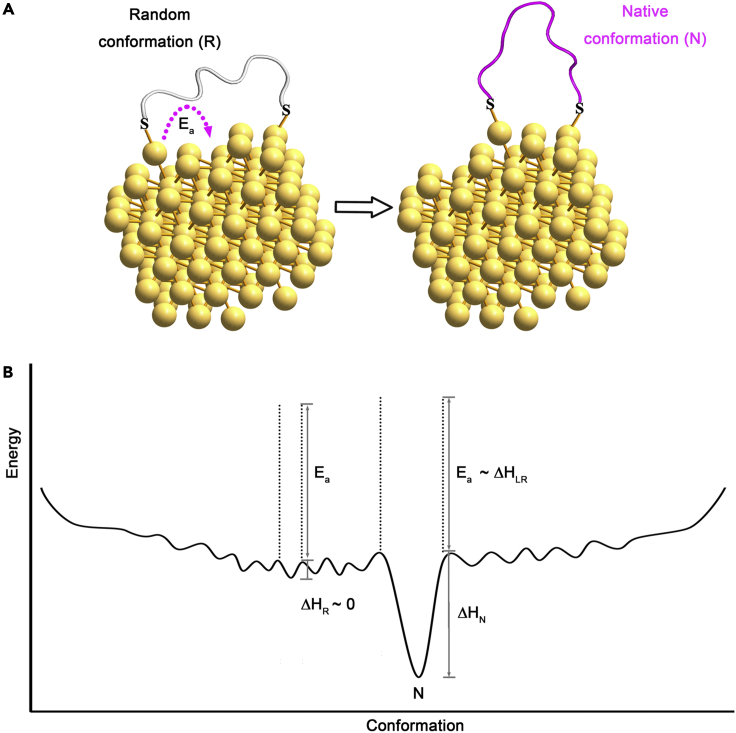
Molecular conformational engineering is to engineer flexible non-functional molecules into unique conformations to create novel functions just like natural proteins fold. Obviously, it is a grand challenge with tremendous opportunities. Based on the facts that natural proteins are only marginally stable with a net stabilizing energy roughly equivalent to the energy of two hydrogen bonds, and the energy barriers for the adatom diffusion of some metals are within a similar range, we propose that metal nanoparticles can serve as a general replacement of protein scaffolds to conformationally engineer protein fragments on the surface of nanoparticles. To prove this hypothesis, herein, we successfully restore the antigen-recognizing function of the flexible peptide fragment of a natural anti-lysozyme antibody on the surface of silver nanoparticles, creating a silver nanoparticle-base artificial antibody (Silverbody). A plausible mechanism is proposed, and some general principles for conformational engineering are summarized to guide future studies in this area.
分子构象工程是将柔性无功能分子构建成独特的构象,以创造新功能,就像天然蛋白质折叠一样。显然,这是一个机遇巨大但挑战艰巨的任务。基于天然蛋白质仅具有微弱稳定性且其净稳定能量大致相当于两个氢键的能量这一事实,以及某些金属的吸附原子扩散的能量势垒也在类似范围内,我们提出金属纳米颗粒可作为蛋白质支架的通用替代品,用于在纳米颗粒表面对蛋白质片段进行构象工程。为证明这一假设,在此我们成功地在银纳米颗粒表面恢复了天然抗溶菌酶抗体柔性肽片段的抗原识别功能,构建了一种基于银纳米颗粒的人工抗体(银体)。我们提出了一种合理的机制,并总结了一些构象工程的一般原则,以指导该领域未来的研究。