Dutch Institute for Rational Use of Medicine, Utrecht, and PhD student, Department of PharmacoTherapy, Epidemiology & Economics, Groningen Research Institute of Pharmacy, Faculty of Science and Engineering, University of Groningen, Groningen.
Nivel, Netherlands Institute for Health Services Research, Utrecht.
Br J Gen Pract. 2022 May 26;72(719):e430-e436. doi: 10.3399/BJGP.2021.0581. Print 2022 Jun.
Little is known about prescription patterns of expensive non-recommended newer long-acting insulins (glargine 300 U/mL and degludec) for patients with type 2 diabetes mellitus (T2DM).
To identify practice variation in, and practice- and patient-related characteristics associated with, the prescription of newer long-acting insulins to patients with T2DM in primary care.
A retrospective cohort study in Dutch general practices (Nivel Primary Care Database).
A first prescription for intermediate or long-acting insulins in 2018 was identified in patients aged ≥40 years using other T2DM drugs. Per practice, the median percentage and interquartile range (IQR) of patients with newer insulin prescriptions were calculated. Multilevel logistic regression models were constructed to calculate intraclass correlation coefficients (ICCs) and quantify the association of patient and practice characteristics with prescriptions for newer insulins (odds ratios [ORs] and 95% confidence intervals [CIs]).
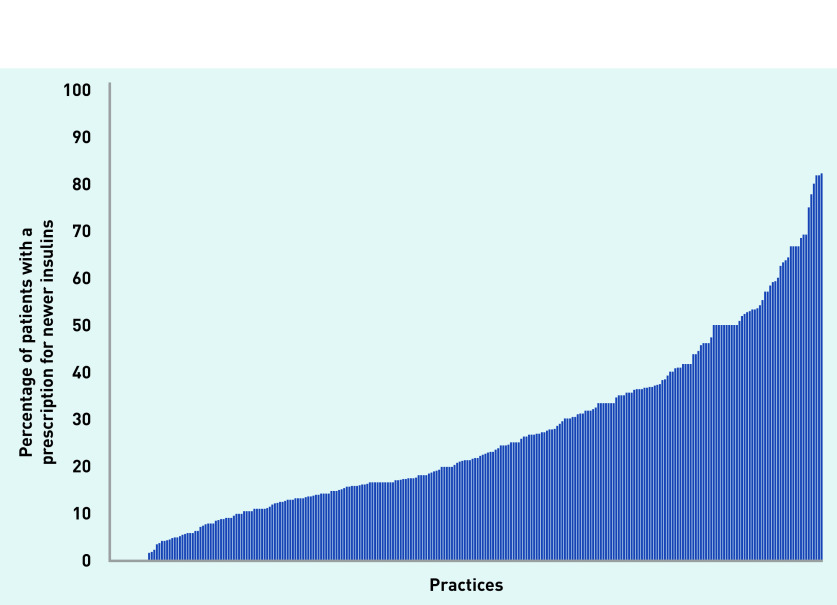
In total, 7757 patients with prescriptions for intermediate or long-acting insulins from 282 general practices were identified. A median percentage of 21.2% (IQR 12.5-36.4%) of all patients prescribed intermediate or long-acting insulins per practice received a prescription for newer insulins. After multilevel modelling, the ICC decreased from 20% to 19%. Female sex (OR 0.77, 95% CI = 0.69 to 0.87), age ≥86 years compared with 40-55 years (OR 0.22, 95% CI = 0.15 to 0.34), prescriptions for metformin (OR 0.66, 95% CI = 0.53 to 0.82), sulfonylurea (OR 0.58, 95% CI = 0.51 to 0.66), or other newer T2DM drugs (OR 3.10, 95% CI = 2.63 to 3.66), and dispensing practices (OR 1.78, 95% CI = 1.03 to 3.10) were associated with the prescription of newer insulins.
The inter-practice variation in the prescription of newer insulins is large and could only be partially explained by patient- and practice-related differences. This indicates substantial opportunities for improvement.
对于 2 型糖尿病(T2DM)患者,我们对昂贵的非推荐新型长效胰岛素(甘精胰岛素 300U/ml 和地特胰岛素)的处方模式知之甚少。
确定初级保健中新型长效胰岛素治疗 T2DM 患者的处方实践差异,以及与实践和患者相关的特征。
荷兰普通诊所的回顾性队列研究(Nivel 初级保健数据库)。
使用其他 T2DM 药物,在 2018 年确定年龄≥40 岁的患者中首次使用中效或长效胰岛素的处方。根据每个实践,计算新型胰岛素处方患者的中位数百分比和四分位距(IQR)。构建多水平逻辑回归模型,计算患者和实践特征与新型胰岛素处方的关联(比值比[OR]和 95%置信区间[CI])。
共确定了 282 家普通诊所中 7757 例接受中效或长效胰岛素处方的患者。每个实践中,所有接受中效或长效胰岛素处方的患者中,有 21.2%(IQR 12.5-36.4%)接受了新型胰岛素处方。经过多水平建模,ICC 从 20%下降到 19%。与女性(OR 0.77,95%CI = 0.69 至 0.87)、年龄≥86 岁(与 40-55 岁相比,OR 0.22,95%CI = 0.15 至 0.34)、二甲双胍(OR 0.66,95%CI = 0.53 至 0.82)、磺脲类(OR 0.58,95%CI = 0.51 至 0.66)或其他新型 T2DM 药物(OR 3.10,95%CI = 2.63 至 3.66)处方和配药实践(OR 1.78,95%CI = 1.03 至 3.10)相关。
新型胰岛素处方的实践差异很大,只能部分解释为患者和实践相关的差异。这表明有很大的改进空间。