Normandie Univ, UNICAEN, INSERM, U1237, PhIND "Physiopathology and Imaging of Neurological Disorders", Institut Blood and Brain @ Caen-Normandie, Cyceron, 14000, Caen, France.
Neurology Department, University Hospital, Caen, France.
Alzheimers Res Ther. 2022 May 23;14(1):72. doi: 10.1186/s13195-022-01006-7.
This study assesses the relationships between dynamic functional network connectivity (DFNC) and dementia risk.
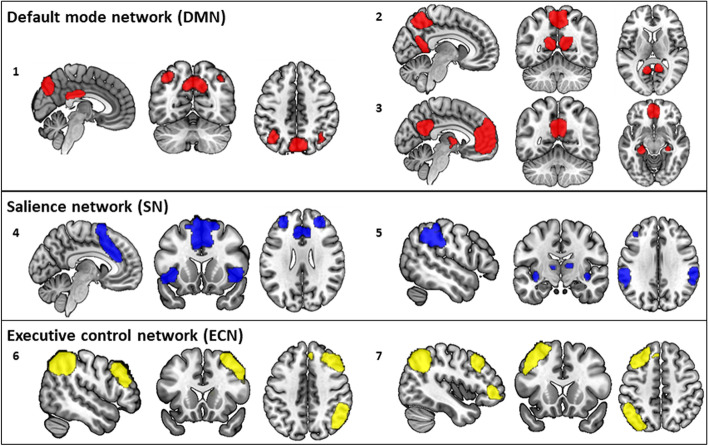
DFNC of the default mode (DMN), salience (SN), and executive control networks was assessed in 127 cognitively unimpaired older adults. Stepwise regressions were performed with dementia risk and protective factors and biomarkers as predictors of DFNC.
Associations were found between times spent in (i) a "weakly connected" state and lower self-reported engagement in early- and mid-life cognitive activity and higher LDL cholesterol; (ii) a "SN-negatively connected" state and higher blood pressure, higher depression score, and lower body mass index (BMI); (iii) a "strongly connected" state and higher self-reported engagement in early-life cognitive activity, Preclinical Alzheimer's cognitive composite-5 score, and BMI; and (iv) a "DMN-negatively connected" state and higher self-reported engagement in early- and mid-life stimulating activities and lower LDL cholesterol and blood pressure. The lower number of state transitions was associated with lower brain perfusion.
DFNC states are differentially associated with dementia risk and could underlie reserve.
本研究评估了动态功能网络连接(DFNC)与痴呆风险之间的关系。
对 127 名认知正常的老年人的默认模式(DMN)、突显(SN)和执行控制网络的 DFNC 进行评估。使用痴呆风险和保护因素以及生物标志物作为 DFNC 的预测因子进行逐步回归。
发现与以下因素之间存在关联:(i)处于“弱连接”状态的时间与较低的自我报告的早中期认知活动参与度和较高的 LDL 胆固醇有关;(ii)处于“SN 负连接”状态的时间与较高的血压、较高的抑郁评分和较低的体重指数(BMI)有关;(iii)处于“强连接”状态的时间与较高的自我报告的早中期认知活动参与度、临床前阿尔茨海默病认知综合 5 分和 BMI 有关;(iv)处于“DMN 负连接”状态的时间与较高的早中期生活刺激活动参与度和较低的 LDL 胆固醇和血压有关。状态转换次数减少与脑灌注减少有关。
DFNC 状态与痴呆风险有差异关联,可能是储备的基础。