Division of Oncology 2, Istituto Oncologico Veneto IRCCS, Padova, Italy.
Department of Surgery, Oncology and Gastroenterology, University of Padova, Padova, Italy.
Neuro Oncol. 2022 Dec 1;24(12):2146-2158. doi: 10.1093/neuonc/noac136.
Despite potential clinical implications, the complexity of breast cancer (BC) brain metastases (BM) immune microenvironment is poorly understood. Through multiplex immunofluorescence, we here describe the main features of BCBM immune microenvironment (density and spatial distribution) and evaluate its prognostic impact.
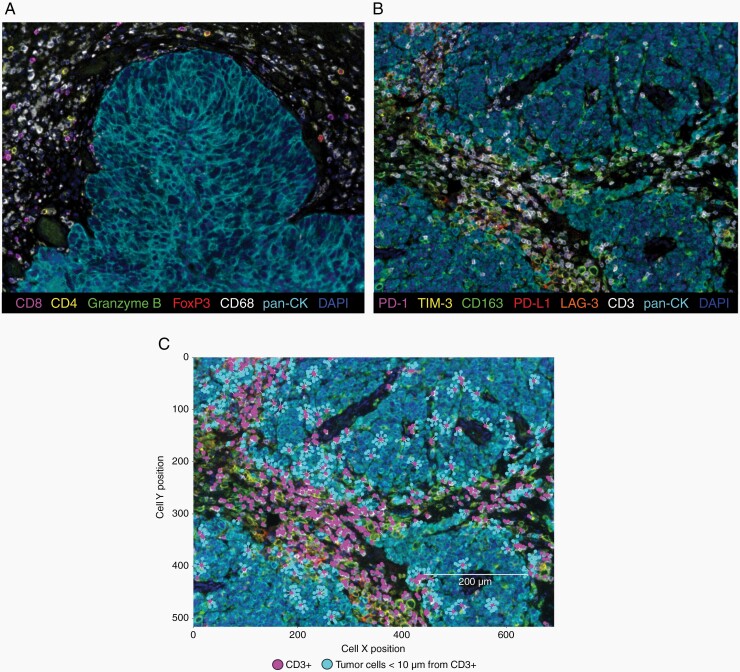
Sixty BCBM from patients undergoing neurosurgery at three institutions (2003-2018) were comprehensively assessed using two multiplex immunofluorescence panels (CD4, CD8, Granzyme B, FoxP3, CD68, pan-cytokeratin, DAPI; CD3, PD-1, PD-L1, LAG-3, TIM-3, CD163, pan-cytokeratin, DAPI). The prognostic impact of immune subpopulations and cell-to-cell spatial interactions was evaluated.
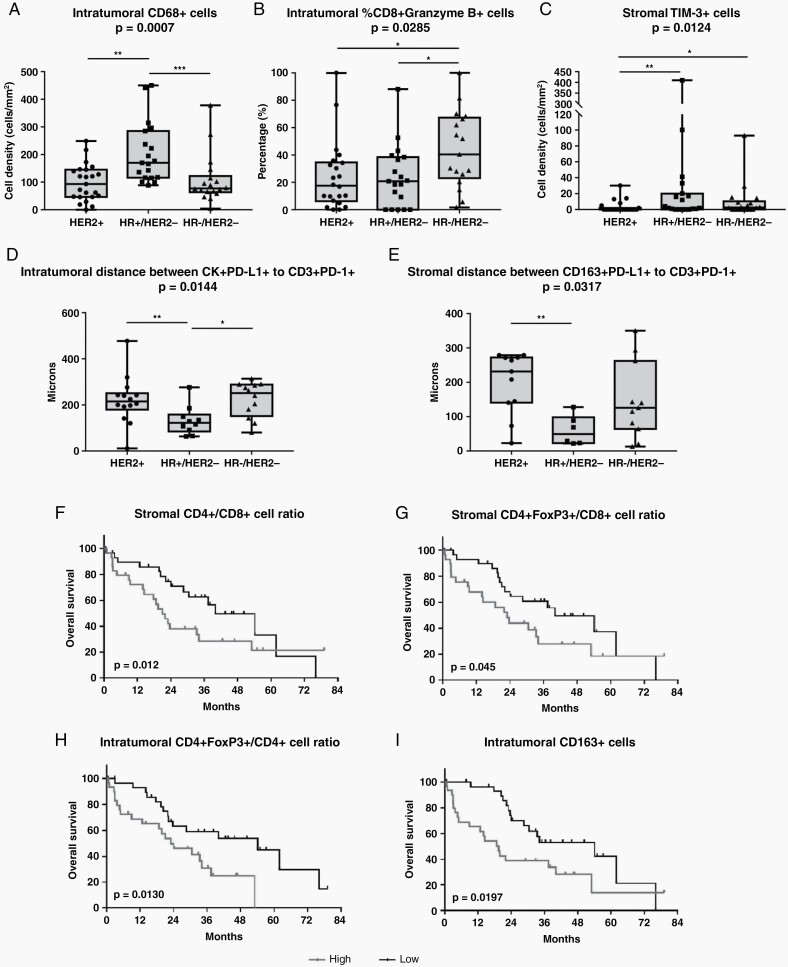
Subtype-related differences in BCBM immune microenvironment and its prognostic impact were observed. While in HR-/HER2- BM and HER2+ BM, higher densities of intra-tumoral CD8+ lymphocytes were associated with significantly longer OS (HR 0.16 and 0.20, respectively), in HR+/HER2- BCBMs a higher CD4+FoxP3+/CD8+ cell ratio in the stroma was associated with worse OS (HR 5.4). Moreover, a higher density of intra-tumoral CD163+ M2-polarized microglia/macrophages in BCBMs was significantly associated with worse OS in HR-/HER2- and HR+/HER2- BCBMs (HR 6.56 and 4.68, respectively), but not in HER2+ BCBMs. In HER2+ BCBMs, multiplex immunofluorescence highlighted a negative prognostic role of PD-1/PD-L1 interaction: patients with a higher percentage of PD-L1+ cells spatially interacting with (within a 20 µm radius) PD-1+ cells presented a significantly worse OS (HR 4.60).
Our results highlight subtype-related differences in BCBM immune microenvironment and identify two potential therapeutic targets, M2 microglia/macrophage polarization in HER2- and PD-1/PD-L1 interaction in HER2+ BCBMs, which warrant future exploration in clinical trials.
尽管具有潜在的临床意义,但乳腺癌脑转移(BCBM)免疫微环境的复杂性仍知之甚少。通过多重免疫荧光,我们在这里描述了 BCBM 免疫微环境的主要特征(密度和空间分布),并评估了其预后影响。
对三家机构(2003-2018 年)接受神经外科手术的 60 例 BCBM 患者进行了全面评估,使用了两个多重免疫荧光试剂盒(CD4、CD8、Granzyme B、FoxP3、CD68、泛细胞角蛋白、DAPI;CD3、PD-1、PD-L1、LAG-3、TIM-3、CD163、泛细胞角蛋白、DAPI)。评估了免疫亚群和细胞间空间相互作用的预后影响。
观察到 BCBM 免疫微环境的亚型相关差异及其预后影响。在 HR-/HER2- BM 和 HER2+ BM 中,肿瘤内 CD8+淋巴细胞的密度较高与显著延长的 OS 相关(HR 分别为 0.16 和 0.20),而在 HR+/HER2- BCBM 中,基质中较高的 CD4+FoxP3+/CD8+细胞比例与较差的 OS 相关(HR 为 5.4)。此外,BCBM 中肿瘤内 CD163+M2 极化的小胶质细胞/巨噬细胞的密度较高与 HR-/HER2- 和 HR+/HER2- BCBM 中的 OS 较差显著相关(HR 分别为 6.56 和 4.68),但在 HER2+ BCBM 中则不然。在 HER2+ BCBM 中,多重免疫荧光强调了 PD-1/PD-L1 相互作用的负预后作用:具有较高百分比的 PD-L1+细胞与 PD-1+细胞在(20 µm 半径内)空间相互作用的患者 OS 显著更差(HR 为 4.60)。
我们的结果突出了 BCBM 免疫微环境的亚型相关差异,并确定了两个潜在的治疗靶点,即 HER2-中的 M2 小胶质细胞/巨噬细胞极化和 HER2+中的 PD-1/PD-L1 相互作用,这在临床试验中值得进一步探索。