Department of Intensive Care Medicine, Radboud Institute for Health Sciences, Radboud University Medical Center, Nijmegen, The Netherlands.
Scientific Center for Quality of Healthcare (IQ healthcare), Radboud Institute for Health Sciences, Radboud University Medical Center, Nijmegen, The Netherlands.
J Antimicrob Chemother. 2022 Jul 28;77(8):2105-2119. doi: 10.1093/jac/dkac162.
In daily hospital practice, antibiotic therapy is commonly prescribed for longer than recommended in guidelines. Understanding the key drivers of prescribing behaviour is crucial to generate meaningful interventions to bridge this evidence-to-practice gap.
To identify behavioural determinants that might prevent or enable improvements in duration of antibiotic therapy in daily practice.
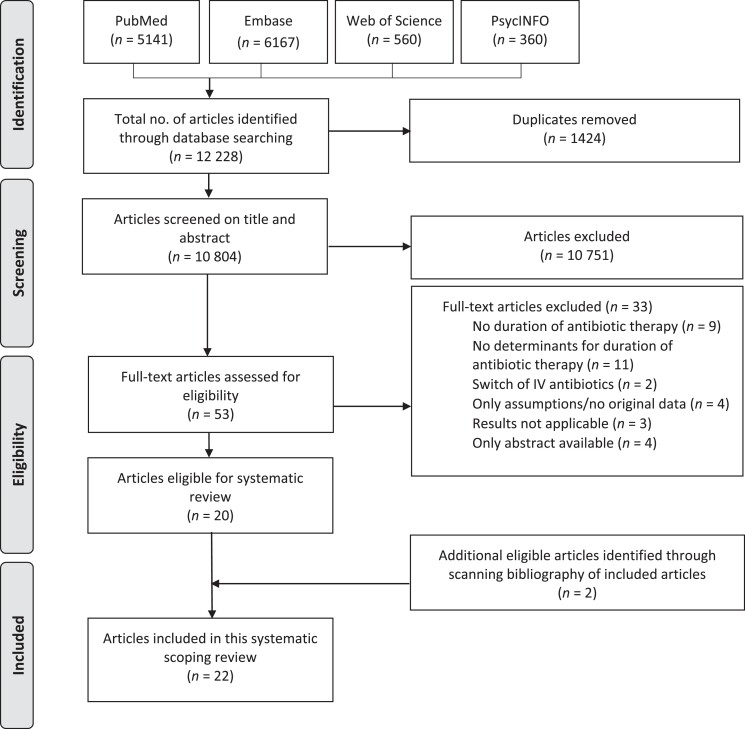
We systematically searched PubMed, Embase, PsycINFO and Web of Science for relevant studies that were published between January 2000 and August 2021. All qualitative, quantitative and mixed-method studies in adults in a hospital setting that reported determinants of antibiotic therapy duration were included.
Twenty-two papers were included in this review. A first set of studies provided 82 behavioural determinants that shape how health professionals make decisions about duration; most of these were related to individual health professionals' knowledge, skills and cognitions, and to professionals' interactions. A second set of studies provided 17 determinants that point to differences in duration regarding various pathogens, diseases, or patient, professional or hospital department characteristics, but do not explain why or how these differences occur.
Limited literature is available describing a wide range of determinants that influence duration of antibiotic therapy in daily practice. This review provides a stepping stone for the development of stewardship interventions to optimize antibiotic therapy duration, but more research is warranted. Stewardship teams must develop complex improvement interventions to address the wide variety of behavioural determinants, adapted to the specific pathogen, disease, patient, professional and/or hospital department involved.
在日常医院实践中,抗生素治疗的疗程通常比指南推荐的时间长。了解处方行为的关键驱动因素对于制定有意义的干预措施以缩小这一证据与实践之间的差距至关重要。
确定可能预防或促进日常实践中抗生素治疗疗程改善的行为决定因素。
我们系统地检索了 PubMed、Embase、PsycINFO 和 Web of Science 中 2000 年 1 月至 2021 年 8 月期间发表的相关研究。所有纳入的研究均为在医院环境中针对成年人开展的定性、定量和混合方法研究,报告了抗生素治疗持续时间的决定因素。
本综述共纳入 22 篇论文。一组研究提供了 82 个影响卫生专业人员决策疗程的行为决定因素;其中大多数与个体卫生专业人员的知识、技能和认知有关,以及与专业人员的互动有关。第二组研究提供了 17 个决定因素,这些因素指出了不同病原体、疾病或患者、专业人员或医院科室特征之间的疗程差异,但没有解释为什么或如何发生这些差异。
目前描述影响日常实践中抗生素治疗疗程的广泛决定因素的文献有限。本综述为制定优化抗生素治疗疗程的管理干预措施提供了一个起点,但需要开展更多的研究。管理团队必须制定复杂的改进干预措施,以解决各种行为决定因素,这些干预措施需要适应特定的病原体、疾病、患者、专业人员和/或医院科室。