Department of Internal Medicine 3, Rheumatology and Immunology Friedrich-Alexander University Erlangen-Nürnberg and Universitätsklinikum Erlangen, Erlangen, Germany.
Deutsches Zentrum für Immuntherapie, Friedrich-Alexander University Erlangen-Nürnberg and Universitätsklinikum Erlangen, Erlangen, Germany.
Arthritis Res Ther. 2022 May 25;24(1):125. doi: 10.1186/s13075-022-02809-7.
Rheumatoid arthritis (RA) requires early diagnosis and tight surveillance of disease activity. Remote self-collection of blood for the analysis of inflammation markers and autoantibodies could improve the monitoring of RA and facilitate the identification of individuals at-risk for RA.
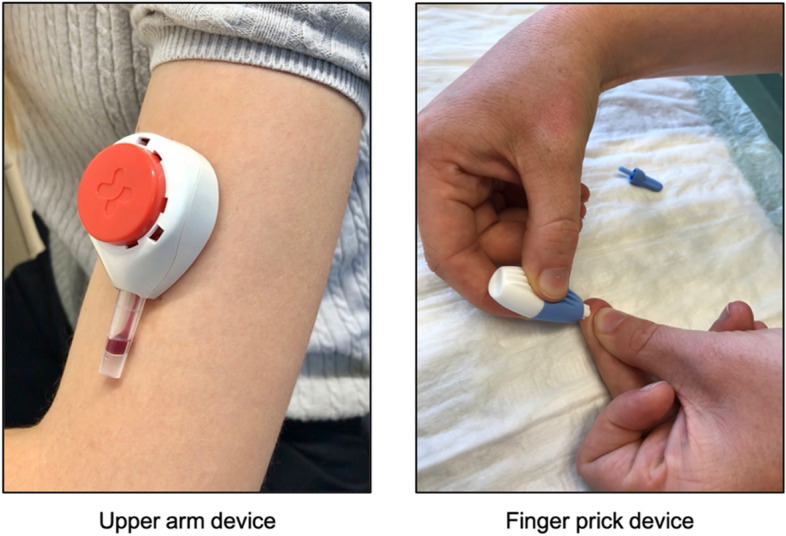
Randomized, controlled trial to evaluate the accuracy, feasibility, and acceptability of an upper arm self-sampling device (UA) and finger prick-test (FP) to measure capillary blood from RA patients for C-reactive protein (CRP) levels and the presence of IgM rheumatoid factor (RF IgM) and anti-cyclic citrullinated protein antibodies (anti-CCP IgG).
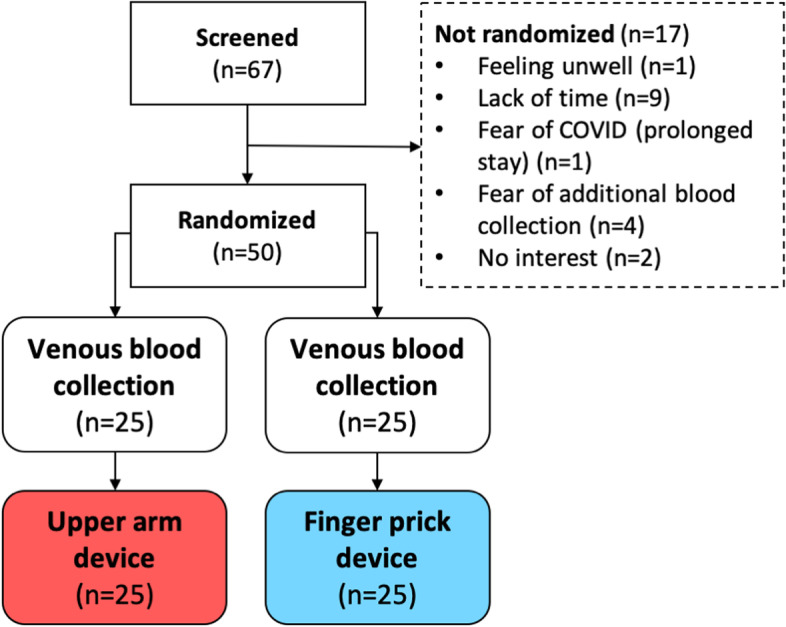
RA patients were randomly assigned in a 1:1 ratio to self-collection of capillary blood via UA or FP. Venous blood sampling (VBS) was performed as a gold standard in both groups to assess the concordance of CRP levels as well as RF IgM and CCP IgG. General acceptability and pain during sampling were measured and compared between UA, FP, and VBS. The number of attempts for successful sampling, requests for assistance, volume, and duration of sample collection were also assessed.
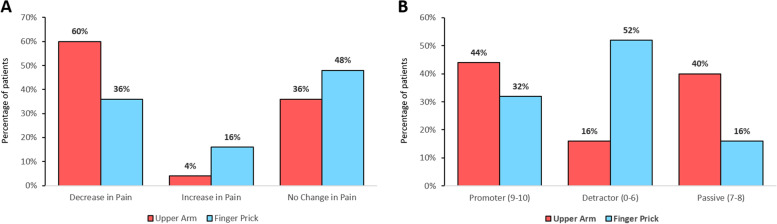
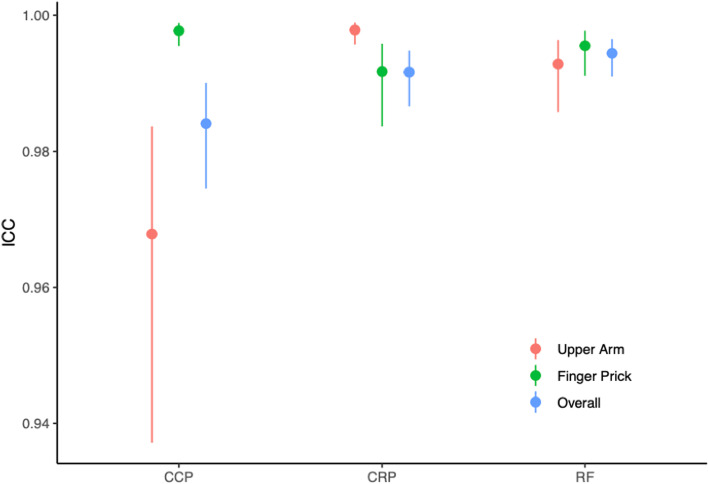
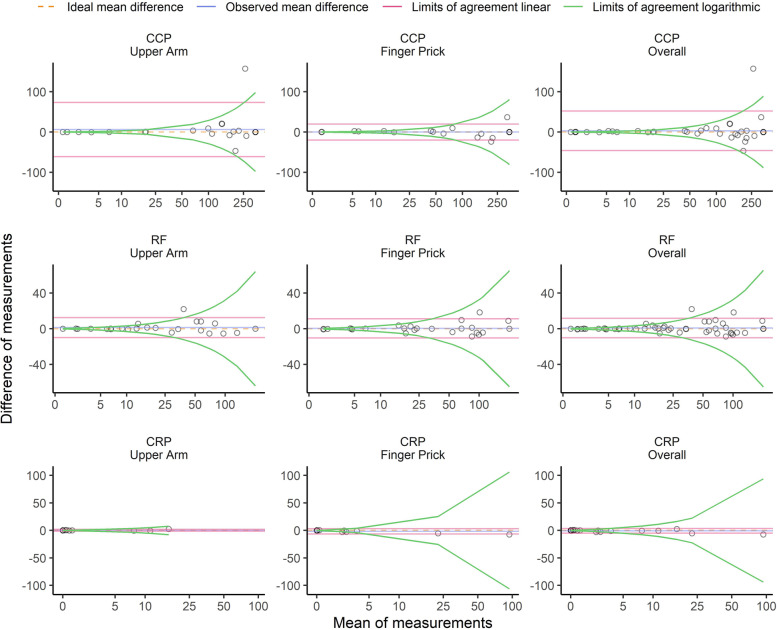
Fifty seropositive RA patients were included. 49/50 (98%) patients were able to successfully collect capillary blood. The overall agreement between capillary and venous analyses for CRP (0.992), CCP IgG (0.984), and RF IgM (0.994) were good. In both groups, 4/25 (16%) needed a second attempt and 8/25 (32%) in the UA and 7/25 (28%) in the FP group requested assistance. Mean pain scores for capillary self-sampling (1.7/10 ± 1.1 (UA) and 1.9/10 ± 1.9 (FP)) were significantly lower on a numeric rating scale compared to venous blood collection (UA: 2.8/10 ± 1.7; FP: 2.1 ± 2.0) (p=0.003). UA patients were more likely to promote the use of capillary blood sampling (net promoter score: +28% vs. -20% for FP) and were more willing to perform blood collection at home (60% vs. 32% for FP).
These data show that self-sampling is accurate and feasible within one attempt by the majority of patients without assistance, allowing tight monitoring of RA disease activity as well as identifying individuals at-risk for RA. RA patients seem to prefer upper arm-based self-sampling to traditional finger pricking.
DRKS.de Identifier: DRKS00023526 . Registered on November 6, 2020.
类风湿关节炎(RA)需要早期诊断和密切监测疾病活动。远程自我采集血液进行炎症标志物和自身抗体分析,可以改善 RA 的监测并有助于识别有 RA 风险的个体。
评价一种上臂自采血设备(UA)和指尖采血(FP)用于测量 RA 患者毛细血管血中 C 反应蛋白(CRP)水平以及 IgM 类风湿因子(RF IgM)和抗环瓜氨酸肽抗体(抗 CCP IgG)的准确性、可行性和可接受性的随机对照试验。
将 RA 患者随机按 1:1 比例分配至 UA 或 FP 进行毛细血管血自我采集。两组均进行静脉血采样(VBS)作为金标准,以评估 CRP 水平以及 RF IgM 和 CCP IgG 的一致性。测量并比较 UA、FP 和 VBS 之间的一般可接受性和采样时的疼痛程度。还评估了成功采样的尝试次数、协助请求、样本量和采集时间。
共纳入 50 例血清阳性 RA 患者。50 例患者均能成功采集到毛细血管血。CRP(0.992)、CCP IgG(0.984)和 RF IgM(0.994)的毛细血管和静脉分析的总体一致性良好。两组均有 4/25(16%)例需要进行第二次尝试,UA 组有 8/25(32%)例和 FP 组有 7/25(28%)例请求协助。毛细血管自我采样的平均疼痛评分(UA:1.7/10±1.1;FP:1.9/10±1.9)在数字评分量表上显著低于静脉血采集(UA:2.8/10±1.7;FP:2.1±2.0)(p=0.003)。UA 患者更有可能推广使用毛细血管血采样(净推广者评分:+28%比 FP 组的-20%),且更愿意在家中进行采血(60%比 FP 组的 32%)。
这些数据表明,自我采样在没有协助的情况下大多数患者一次即可完成,且准确、可行,可实现对 RA 疾病活动的严密监测,还可识别有 RA 风险的个体。RA 患者似乎更喜欢基于上臂的自我采样而非传统的指尖采血。
DRKS.de 标识符:DRKS00023526。于 2020 年 11 月 6 日注册。