Memory and Aging Center, Department of Neurology, University of California, San Francisco, San Francisco, United States.
Department of Radiology and Biomedical Imaging, University of California, San Francisco, San Francisco, United States.
Elife. 2022 May 26;11:e77850. doi: 10.7554/eLife.77850.
Neuronal- and circuit-level abnormalities of excitation and inhibition are shown to be associated with tau and amyloid-beta (Aβ) in preclinical models of Alzheimer's disease (AD). These relationships remain poorly understood in patients with AD.
Using empirical spectra from magnetoencephalography and computational modeling (neural mass model), we examined excitatory and inhibitory parameters of neuronal subpopulations and investigated their specific associations to regional tau and Aβ, measured by positron emission tomography, in patients with AD.
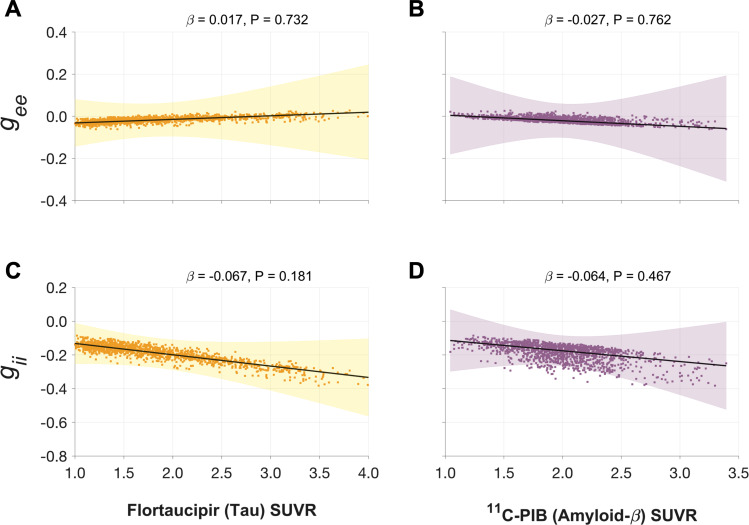
Patients with AD showed abnormal excitatory and inhibitory time-constants and neural gains compared to age-matched controls. Increased excitatory time-constants distinctly correlated with higher tau depositions while increased inhibitory time-constants distinctly correlated with higher Aβ depositions.
Our results provide critical insights about potential mechanistic links between abnormal neural oscillations and cellular correlates of impaired excitatory and inhibitory synaptic functions associated with tau and Aβ in patients with AD.
This study was supported by the National Institutes of Health grants: K08AG058749 (KGR), F32AG050434-01A1 (KGR), K23 AG038357 (KAV), P50 AG023501, P01 AG19724 (BLM), P50-AG023501 (BLM and GDR), R01 AG045611 (GDR); AG034570, AG062542 (WJ); NS100440 (SSN), DC176960 (SSN), DC017091 (SSN), AG062196 (SSN); a grant from John Douglas French Alzheimer's Foundation (KAV); grants from Larry L. Hillblom Foundation: 2015-A-034-FEL (KGR), 2019-A-013-SUP (KGR); grants from the Alzheimer's Association: AARG-21-849773 (KGR); PCTRB-13-288476 (KAV), and made possible by Part the CloudTM (ETAC-09-133596); a grant from Tau Consortium (GDR and WJJ), and a gift from the S. D. Bechtel Jr. Foundation.
在阿尔茨海默病(AD)的临床前模型中,已显示出神经元和回路水平的兴奋和抑制异常与 tau 和淀粉样β(Aβ)有关。这些关系在 AD 患者中仍知之甚少。
使用脑磁图的经验谱和计算模型(神经质量模型),我们检查了 AD 患者的神经元亚群的兴奋性和抑制性参数,并研究了它们与正电子发射断层扫描测量的区域 tau 和 Aβ的特定关联。
与年龄匹配的对照组相比,AD 患者的兴奋性和抑制性时常数和神经增益异常。兴奋性时常数的增加与 tau 沉积的增加明显相关,而抑制性时常数的增加与 Aβ 沉积的增加明显相关。
我们的研究结果提供了关于异常神经振荡与 AD 患者中与 tau 和 Aβ 相关的兴奋性和抑制性突触功能受损的细胞相关性之间潜在机制联系的关键见解。
本研究得到美国国立卫生研究院资助:K08AG058749(KGR)、F32AG050434-01A1(KGR)、K23AG038357(KAV)、P50AG023501、P01AG19724(BLM)、P50-AG023501(BLM 和 GDR)、R01AG045611(GDR);AG034570、AG062542(WJ);NS100440(SSN)、DC176960(SSN)、DC017091(SSN)、AG062196(SSN);John Douglas French 阿尔茨海默病基金会(KAV)的赠款;Larry L. Hillblom 基金会:2015-A-034-FEL(KGR)、2019-A-013-SUP(KGR);阿尔茨海默病协会的赠款:AARG-21-849773(KGR);PCTRB-13-288476(KAV),并由 Part the CloudTM(ETAC-09-133596)促成;Tau 联盟(GDR 和 WJJ)的赠款和 S. D. Bechtel Jr. 基金会的礼物。