Department of Health Sciences, Graduate School, Korea University, Seoul, Republic of Korea.
Department of Biobehavioral Health, The Pennsylvania State University, University Park, PA, United States of America.
PLoS One. 2022 May 26;17(5):e0269033. doi: 10.1371/journal.pone.0269033. eCollection 2022.
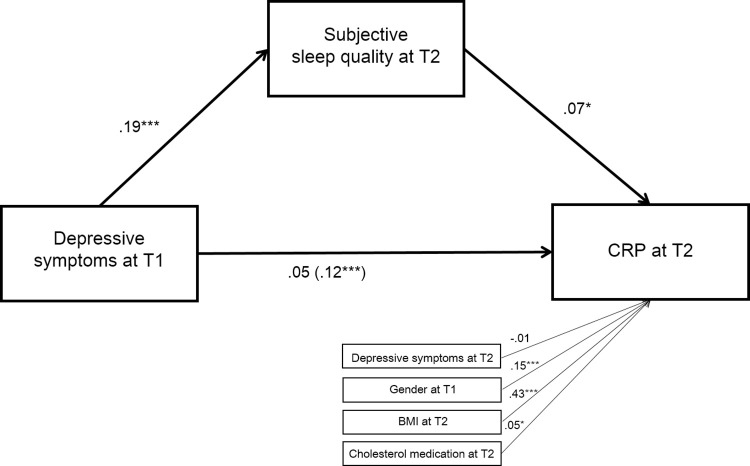
Although there is a strong association between depressive symptoms and markers of inflammation, it remains unclear whether depressive symptoms at one point in life may predict inflammation later in life. Moreover, despite extant literature linking sleep with both depressive symptoms and inflammation, there is little research investigating poor sleep as a mechanism linking depressive symptoms with later inflammation. The links between depression and physical health can also vary by gender. In longitudinal analyses with data from the Midlife in the United States (MIDUS) study, we examined whether depressive symptoms were associated with inflammatory markers 11 years later and whether these associations were mediated by sleep disturbances or moderated by gender. Participants reported depressive symptoms and demographic information at baseline. At 11-year follow-up, the same participants (n = 968) reported depressive symptoms, sleep quality and duration using validated scale items, and provided a blood sample from which inflammatory markers interleukin-6 (IL-6) and C-reactive protein (CRP) were quantified. Actigraphy assessment of sleep was obtained in a subsample (n = 276). After adjusting for concurrent depressive symptoms and other relevant covariates, baseline depressive symptoms were associated with CRP 11 years later in the full sample, and with IL-6 among women. Subjective sleep quality mediated the association between depressive symptoms and CRP. Results suggest that depressive symptoms may be longitudinally associated with inflammation; however, directionality issues cannot be determined from the present work, particularly as inflammation markers (which might have been associated with baseline depressive symptoms) were not available at baseline. Findings further suggest that longitudinal associations between depressive symptoms and inflammation may potentially be explained by sleep and may reflect gender specific patterns.
尽管抑郁症状与炎症标志物之间存在很强的关联,但目前尚不清楚一个人在生命中的某个时刻是否会出现抑郁症状,而这些症状是否会预测其以后的生活中是否会出现炎症。此外,尽管现有的文献将睡眠与抑郁症状和炎症联系起来,但很少有研究调查睡眠质量差是否是将抑郁症状与以后的炎症联系起来的机制。抑郁与身体健康之间的联系也可能因性别而异。在使用美国中期生活(MIDUS)研究数据进行的纵向分析中,我们研究了抑郁症状是否与 11 年后的炎症标志物相关,以及这些关联是否通过睡眠障碍来介导,或者是否受到性别的调节。参与者在基线时报告了抑郁症状和人口统计学信息。在 11 年的随访中,相同的参与者(n = 968)使用经过验证的量表项目报告了抑郁症状、睡眠质量和持续时间,并提供了血液样本,从中定量了炎症标志物白细胞介素-6(IL-6)和 C 反应蛋白(CRP)。在一个子样本(n = 276)中,还对睡眠进行了活动记录仪评估。在调整了同期的抑郁症状和其他相关协变量后,基线时的抑郁症状与全样本中 11 年后的 CRP 相关,与女性的 IL-6 相关。主观睡眠质量介导了抑郁症状与 CRP 之间的关联。结果表明,抑郁症状可能与炎症呈纵向相关;但是,从目前的研究中无法确定方向性问题,尤其是因为在基线时没有炎症标志物(可能与基线时的抑郁症状相关)。研究结果进一步表明,抑郁症状与炎症之间的纵向关联可能是由睡眠引起的,并且可能反映了性别特异性模式。