Department of Animal Science, School of Animal Science and Food Engineering, University of São Paulo, Rua Duque de Caxias Norte, Pirassununga, SP, Brazil.
Animal Science Institute, Avenida Bandeirantes, Ribeirão Preto, Brazil.
PLoS One. 2022 May 26;17(5):e0258629. doi: 10.1371/journal.pone.0258629. eCollection 2022.
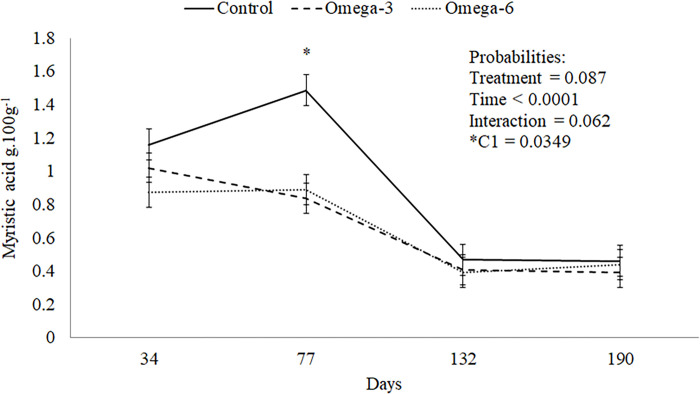
The concern with human health has increased the interest in producing foods enriched with polyunsaturated fatty acids (PUFA), directly or naturally, by inclusion in the animals' diet. The positive effects such as antithrombotic, anti-inflammatory, and hypolipidemic have been observed in pigs and rats, used as human models for study. The present study evaluated the effect of cow's milk with different lipid profiles on performance, serum fatty acid profile, biochemical analysis, and a complete blood count of gilts used as a human model. At 34 days, thirty gilts were equally distributed in three treatments. Experimental treatments were milk from cows without the oil supplementation (C), milk from cows fed an enriched diet with linseed oil (n-3), and milk from cows fed an enriched diet with soybean oil (n-6). Milk supplementation was performed until 190 days old, provided once in the morning. The n-3 and n-6 milk reduced the concentration of myristic acid in the blood and increased the leukocytes. Milk enriched with n-3 compared to n-6 reduced the stearic acid. In conclusion, milk with a better PUFA profile can reduce saturated fatty acids in the blood and alter the concentration of cells in the defense system.
人们越来越关注人类健康,因此增加了通过直接或自然方式在动物饮食中添加多不饱和脂肪酸(PUFA)来生产富含多不饱和脂肪酸的食品的兴趣。在作为人类研究模型的猪和大鼠中观察到了抗血栓、抗炎和降血脂等积极作用。本研究评估了具有不同脂质谱的牛奶对用作人类模型的后备母猪的生产性能、血清脂肪酸谱、生化分析和全血细胞计数的影响。在 34 天时,将 30 头后备母猪等分为 3 个处理组。实验组为未添加油脂的奶牛奶(C)、添加亚麻籽油(n-3)的富油奶牛奶和添加豆油(n-6)的富油奶牛奶。在 190 天龄前每天早上提供一次牛奶补充。n-3 和 n-6 牛奶降低了血液中肉豆蔻酸的浓度,并增加了白细胞。与 n-6 相比,富含 n-3 的牛奶降低了硬脂酸。总之,具有更好的 PUFA 谱的牛奶可以减少血液中的饱和脂肪酸,并改变防御系统中细胞的浓度。