Food Safety and Enteric Pathogens Research Unit, National Animal Disease Center, Agricultural Research Service, U.S. Department of Agriculture, Ames, Iowa.
Oak Ridge Institute for Science and Education (ORISE), ARS Research Participation Program, Oak Ridge, Tennessee.
PLoS One. 2022 May 26;17(5):e0268645. doi: 10.1371/journal.pone.0268645. eCollection 2022.
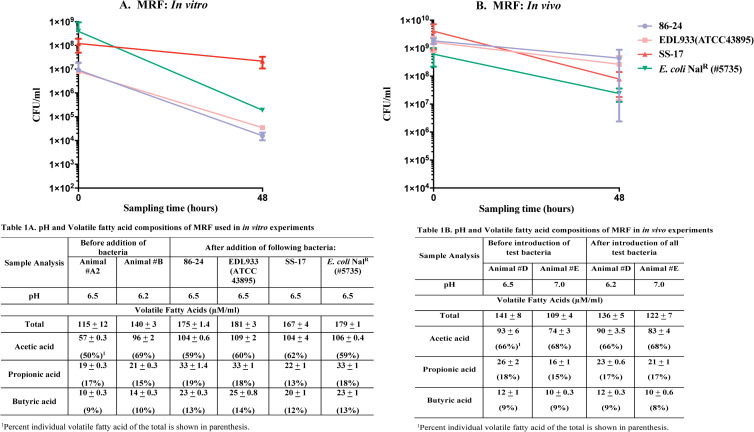
Previously, we had demonstrated that Escherichia coli O157:H7 (O157) strain 86-24 expresses proteins involved in survival rather than virulence in vitro in rumen fluid from dairy cattle limit fed a maintenance diet. Here, we verified if this observation would be true for different O157 strains grown in vitro in rumen fluid from, and in vivo in the rumen of, animals on contrasting maintenance (high fiber) and lactation (high energy-protein) diets usually limit fed to dairy cattle. For the in vivo studies, an economical, novel, reusable and non-terminal rumen-fistulated animal model permitting simultaneous evaluation of multiple bacterial strains in the bovine rumen was developed. All experiments were conducted in duplicate using different animals to account for host-related variations. The O157 strains included, 86-24, EDL933 and the super shed SS-17. E. coli NalR (#5735), derived from a bovine intestinal commensal E. coli, was included as a control. As expected, diet influenced ruminal pH and volatile fatty acid (VFA) composition. The pH ranged from 6.2-7.0 and total VFA concentrations from 109-141 μM/ml, in animals fed the maintenance diet. In comparison, animals fed the lactation diet had a ruminal pH ranging between 5.18-6.0, and total VFA of 125-219 μM/ml. Strain dependent differences in O157 recovery from the rumen fluid of cattle fed either diet was observed, both in vitro and in vivo, with O157 strains 86-24 and EDL933 demonstrating similar survival patterns. Analysis of the O157 proteomes expressed in the rumen fluid/rumen verified previous observations of adaptive responses. Any difference in the adaptive response was mainly influenced by the animal's diet and growth conditions (in vitro and in vivo) and not the O157 strain. These new insights into the O157 responses could help formulate modalities to control O157 across strains in cattle at all stages of husbandry.
先前,我们已经证明,在限制饲喂维持日粮的奶牛瘤胃液中,大肠杆菌 O157:H7(O157)菌株 86-24 表达的蛋白参与生存而非毒力。在这里,我们验证了这一观察结果是否适用于在不同的 O157 菌株在瘤胃液中体外生长,以及在动物体内在不同的维持(高纤维)和泌乳(高能量-蛋白质)日粮中生长的情况,这些动物通常限制饲喂奶牛。对于体内研究,开发了一种经济、新颖、可重复使用且非终末的瘤胃瘘管动物模型,允许同时评估牛瘤胃中的多个细菌菌株。所有实验均使用不同的动物进行重复,以考虑宿主相关的变异性。O157 菌株包括 86-24、EDL933 和超级脱落 SS-17。大肠杆菌 NalR(#5735),源自牛肠道共生大肠杆菌,被用作对照。正如预期的那样,饮食会影响瘤胃 pH 值和挥发性脂肪酸(VFA)组成。在饲喂维持日粮的动物中,pH 值范围为 6.2-7.0,总 VFA 浓度为 109-141 μM/ml。相比之下,饲喂泌乳日粮的动物的瘤胃 pH 值范围为 5.18-6.0,总 VFA 为 125-219 μM/ml。在两种日粮饲养的牛的瘤胃液中,观察到 O157 从瘤胃液中的回收存在菌株依赖性差异,无论是在体外还是在体内,O157 菌株 86-24 和 EDL933 均表现出相似的生存模式。对瘤胃液中表达的 O157 蛋白质组的分析验证了先前对适应性反应的观察结果。适应性反应的任何差异主要受动物的饮食和生长条件(体外和体内)的影响,而不是 O157 菌株的影响。这些对 O157 反应的新见解可以帮助制定控制牛在养殖各个阶段的所有 O157 菌株的模式。