Bioengineering, California Institute of Technology, Pasadena, California 91125, United States.
Computer Science, California Institute of Technology, Pasadena, California 91125, United States.
J Am Chem Soc. 2022 Jun 8;144(22):10075-10079. doi: 10.1021/jacs.2c03853. Epub 2022 May 26.
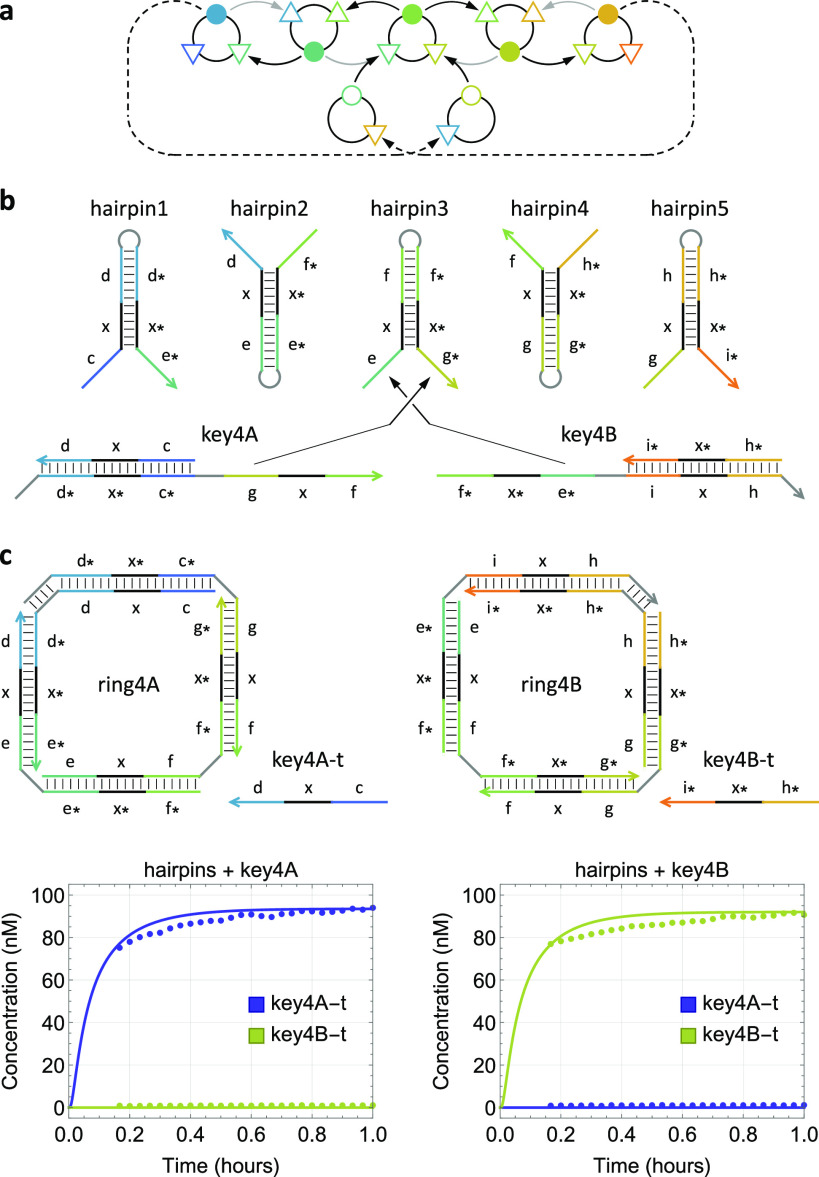
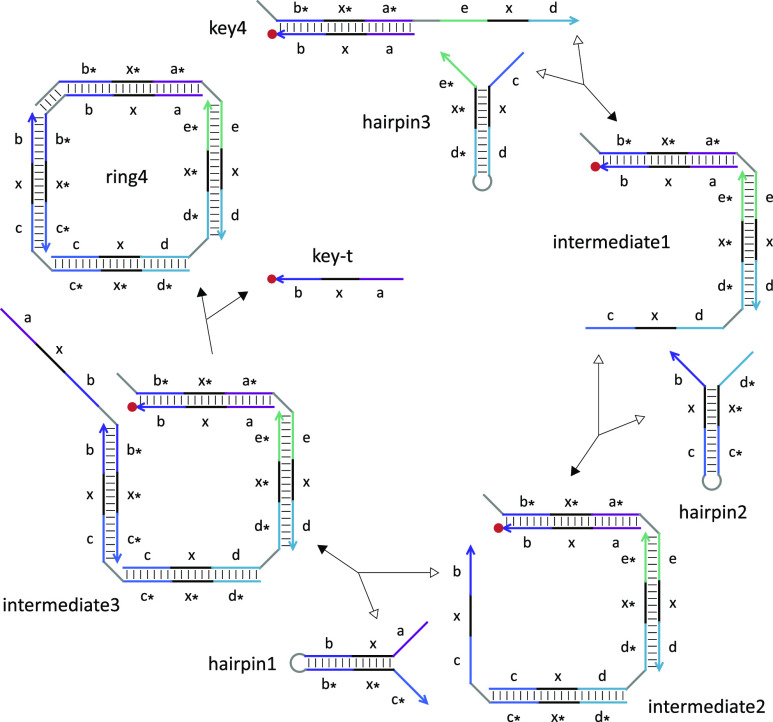
Developmental self-assembly of DNA nanostructures provides an ideal platform for studying the power and programmability of kinetically controlled structural growth in engineered molecular systems. Triggered initiation and designated sequencing of assembly and disassembly steps have been demonstrated in structures with branches and loops. Here we introduce a new strategy for selectively activating distinct subroutines in a developmental self-assembly program, allowing structures with distinct properties to be created in response to various molecular signals. We demonstrate this strategy in triggered self-assembly of a DNA ring, the size and growth direction of which are responsive to a key molecule. We articulate that reversible assembly steps with slow kinetics at appropriate locations in a reaction pathway could enable multiple populations of structures with stimulus-responsive properties to be simultaneously created in one developmental program. These results open up a broad design space for the self-assembly of molecules with adaptive behaviors toward advanced control in synthetic materials and molecular motors.
DNA 纳米结构的发育自组装为研究动力学控制的结构生长在工程分子系统中的功能和可编程性提供了理想的平台。在具有分支和环的结构中已经证明了组装和拆卸步骤的触发启动和指定排序。在这里,我们引入了一种新的策略,用于选择性地激活发育自组装程序中的不同子程序,从而可以根据各种分子信号创建具有不同特性的结构。我们在 DNA 环的触发自组装中证明了这一策略,该环的大小和生长方向对关键分子有响应。我们阐明,在反应途径的适当位置具有缓慢动力学的可逆组装步骤可以使具有刺激响应特性的多个结构群体能够同时在一个发育程序中创建。这些结果为分子的自组装开辟了广阔的设计空间,这些分子对合成材料和分子马达中的高级控制具有自适应行为。