Biomedical Research Institute, National Institute of Advanced Industrial Science and Technology (AIST), Tsukuba, Ibaraki, 305-8566, Japan.
Section of Behavior Patterns, Center for Genetic Analysis of Behavior, National Institute for Physical Sciences (NIPS), Okazaki, Aichi, 444-8585, Japan.
Neuropsychopharmacology. 2022 Nov;47(12):2150-2159. doi: 10.1038/s41386-022-01347-9. Epub 2022 May 26.
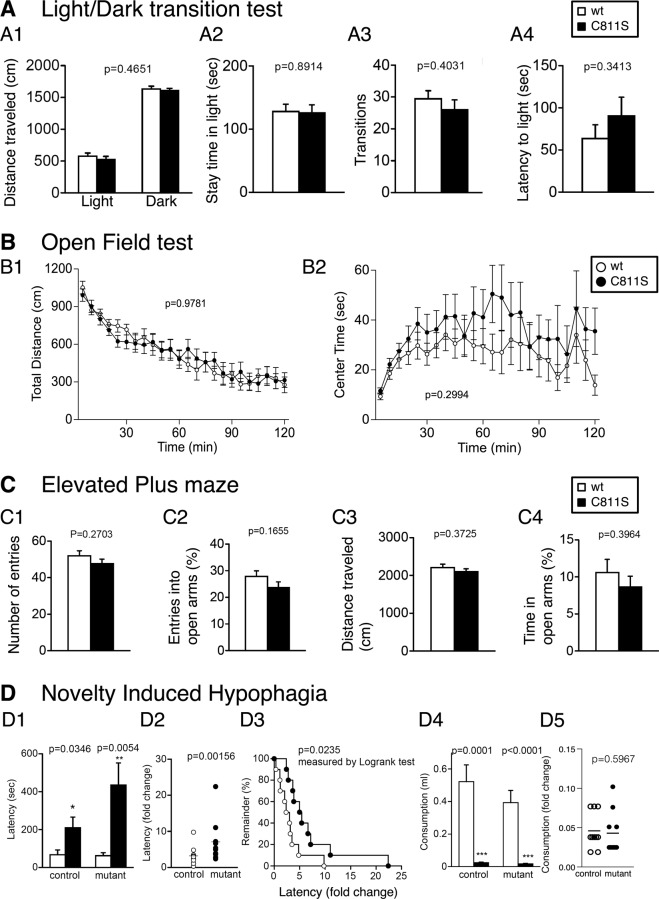
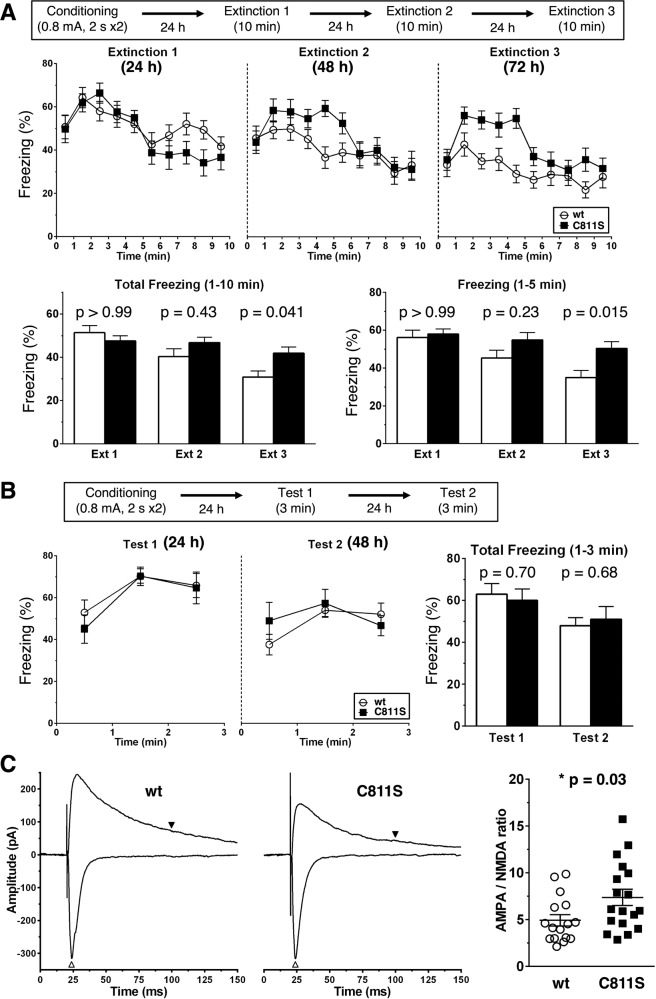
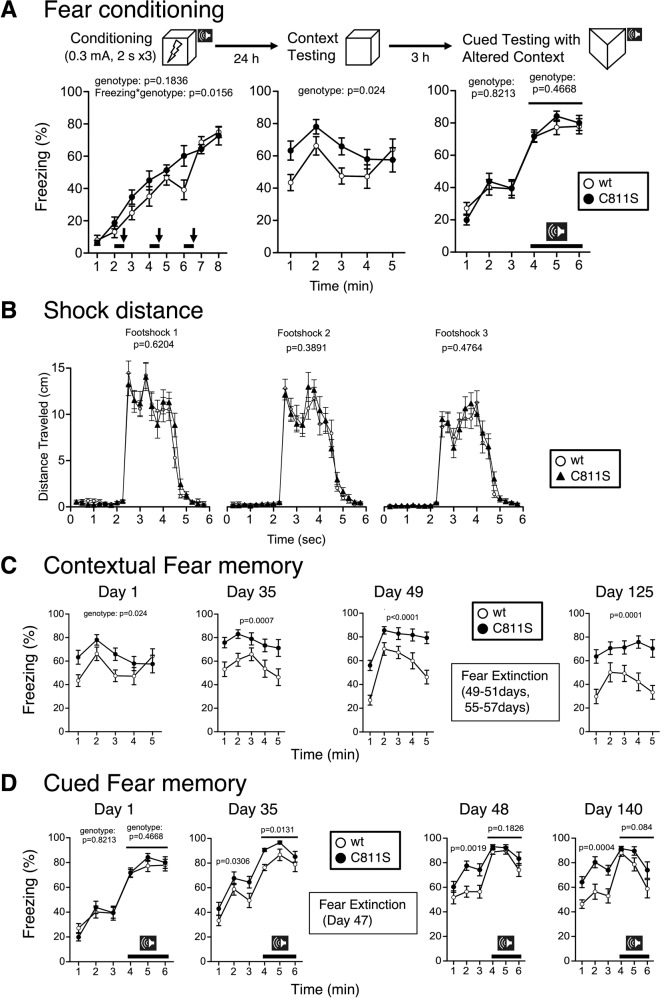
Long-lasting fear-related disorders depend on the excessive retention of traumatic fear memory. We previously showed that the palmitoylation-dependent removal of synaptic α-amino-3-hydroxy-5-methyl-4-isoxazole propionate (AMPA) receptors prevents hyperexcitation-based epileptic seizures and that AMPA receptor palmitoylation maintains neural network stability. In this study, AMPA receptor subunit GluA1 C-terminal palmitoylation-deficient (GluA1C811S) mice were subjected to comprehensive behavioral battery tests to further examine whether the mutation causes other neuropsychiatric disease-like symptoms. The behavioral analyses revealed that palmitoylation-deficiency in GluA1 is responsible for characteristic prolonged contextual fear memory formation, whereas GluA1C811S mice showed no impairment of anxiety-like behaviors at the basal state. In addition, fear generalization gradually increased in these mutant mice without affecting their cued fear. Furthermore, fear extinction training by repeated exposure of mice to conditioned stimuli had little effect on GluA1C811S mice, which is in line with augmentation of synaptic transmission in pyramidal neurons in the basolateral amygdala. In contrast, locomotion, sociability, depression-related behaviors, and spatial learning and memory were unaffected by the GluA1 non-palmitoylation mutation. These results indicate that impairment of AMPA receptor palmitoylation specifically causes posttraumatic stress disorder (PTSD)-like symptoms.
长期存在的与恐惧相关的障碍取决于创伤性恐惧记忆的过度保留。我们之前曾表明,依赖于棕榈酰化的突触α-氨基-3-羟基-5-甲基-4-异恶唑丙酸(AMPA)受体的去除可防止基于过度兴奋的癫痫发作,并且 AMPA 受体棕榈酰化可维持神经网络稳定性。在这项研究中,对 AMPA 受体亚基 GluA1 C 端棕榈酰化缺陷(GluA1C811S)小鼠进行了综合行为电池测试,以进一步检查该突变是否导致其他神经精神疾病样症状。行为分析表明,GluA1 的棕榈酰化缺陷导致特征性的持久情境恐惧记忆形成,而 GluA1C811S 小鼠在基础状态下没有焦虑样行为的损害。此外,这些突变小鼠的恐惧泛化逐渐增加,而不会影响其条件恐惧。此外,通过反复暴露于条件刺激来进行恐惧消退训练对 GluA1C811S 小鼠几乎没有影响,这与基底外侧杏仁核中的锥体神经元中突触传递的增强一致。相比之下,运动、社交、抑郁相关行为以及空间学习和记忆不受 GluA1 非棕榈酰化突变的影响。这些结果表明,AMPA 受体棕榈酰化的损害特异性地导致创伤后应激障碍(PTSD)样症状。