University Hospital Cologne, Cologne, Germany.
Medical Laser Center Lübeck GmbH, Lübeck, Germany.
Transl Vis Sci Technol. 2022 May 2;11(5):28. doi: 10.1167/tvst.11.5.28.
Microscopic optical coherence tomography (mOCT) has an imaging resolution of 1 µm in all voxel dimensions, but individual epithelial cells are difficult to resolve due to lack of scattering contrast. Adding dynamic contrast processing to mOCT (dmOCT) results in color images that enable visualization of individual cells and possibly give information on cellular function via the calculation of a motility coefficient. We propose this technique as a novel method of evaluating the ocular surface after exposure to a toxic chemical, benzalkonium chloride (BAK).
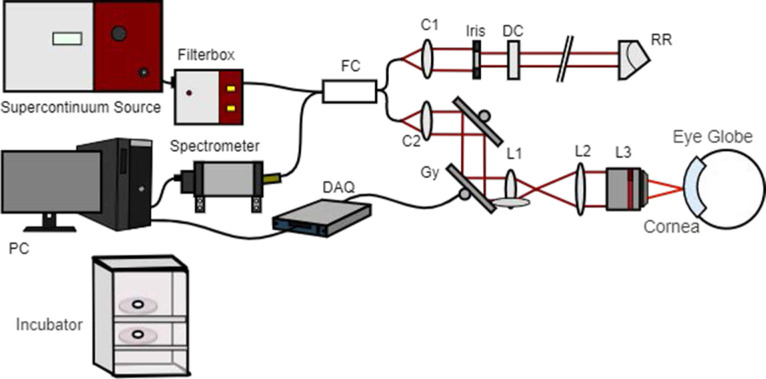
Ex vivo cross-section images were acquired with a custom-built, frequency-domain mOCT system. Eyes were explanted from healthy adult C57BL/6 mice and imaged every 30 minutes with five sets of dmOCT scans at each imaging time. Total epithelium and stroma thicknesses were measured from a single mOCT B-scan, and measures of color changes (hue) and the motility coefficient were acquired from dmOCT scans.
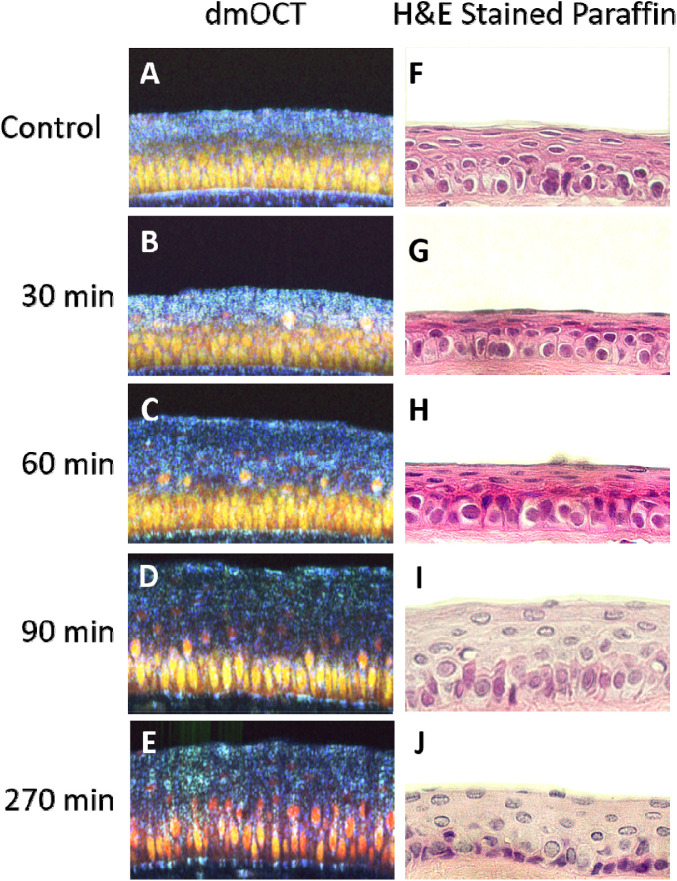
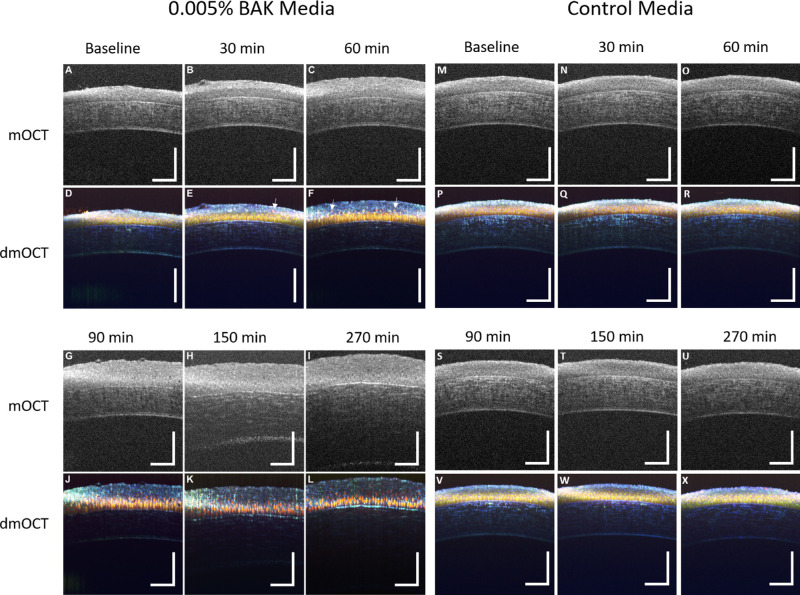
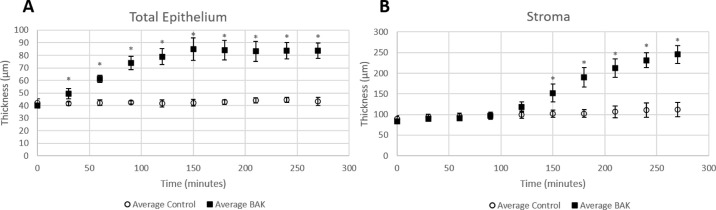
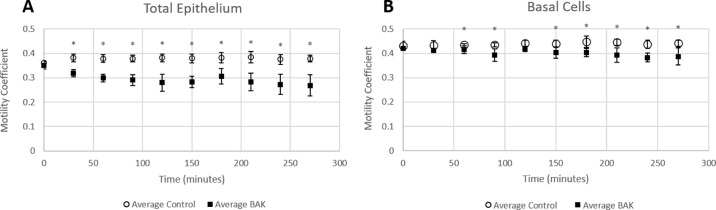
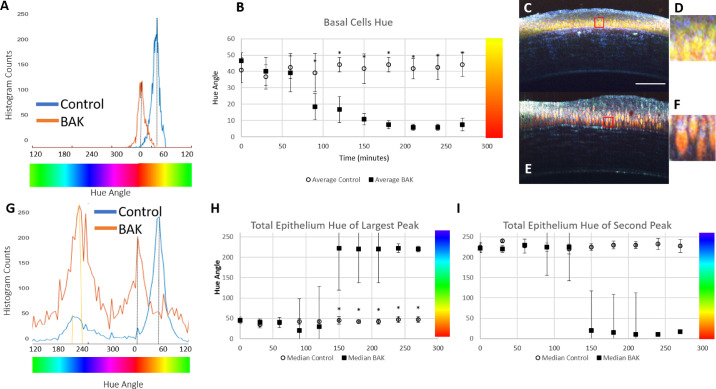
After 30-minute exposures to 0.005% BAK, local motility decreased and total epithelium thickness increased compared to controls. For basal epithelium cells, local motility decreased after 60-minute exposures, and the hue shifted red after 90-minute exposures. Stroma thickness did not significantly swell until 150-minute exposures to BAK.
dmOCT allows us to view the behavior of the cornea epithelium under toxic stress due to BAK, revealing parallel swelling of the extracellular matrix and changes in local subcellular motion.
The evaluation of the cornea epithelium using dmOCT is helpful to our understanding of the toxic effects of BAK.
微观光学相干断层扫描(mOCT)在所有体素维度上的成像分辨率为 1 µm,但由于缺乏散射对比,单个上皮细胞难以分辨。在 mOCT(dmOCT)中添加动态对比处理会产生彩色图像,使单个细胞可视化,并通过计算运动系数提供有关细胞功能的信息。我们提出该技术作为评估暴露于有毒化学物质苯扎氯铵(BAK)后的眼表面的新方法。
使用定制的频域 mOCT 系统获取离体横截面图像。从健康成年 C57BL/6 小鼠中取出眼睛,并每隔 30 分钟进行 5 组 dmOCT 扫描,每次成像时进行一次扫描。从单个 mOCT B 扫描中测量总上皮和基质厚度,并从 dmOCT 扫描中获取颜色变化(色调)和运动系数的测量值。
暴露于 0.005% BAK 30 分钟后,与对照组相比,局部运动性降低,总上皮厚度增加。对于基底上皮细胞,暴露于 60 分钟后局部运动性降低,暴露于 90 分钟后色调变红。基质厚度直到暴露于 BAK 150 分钟后才明显肿胀。
dmOCT 使我们能够观察到 BAK 引起的角膜上皮在有毒应激下的行为,揭示了细胞外基质的平行肿胀和局部亚细胞运动的变化。
田颖