Sumpter John P, Margiotta-Casaluci Luigi
Department of Life Sciences, College of Health, Medicine and Life Sciences, Brunel University London, London UB8 3PH, UK.
Department of Analytical, Environmental and Forensic Sciences, School of Cancer and Pharmaceutical Sciences, King's College London, London SE1 9NQ, UK.
Toxics. 2022 May 3;10(5):233. doi: 10.3390/toxics10050233.
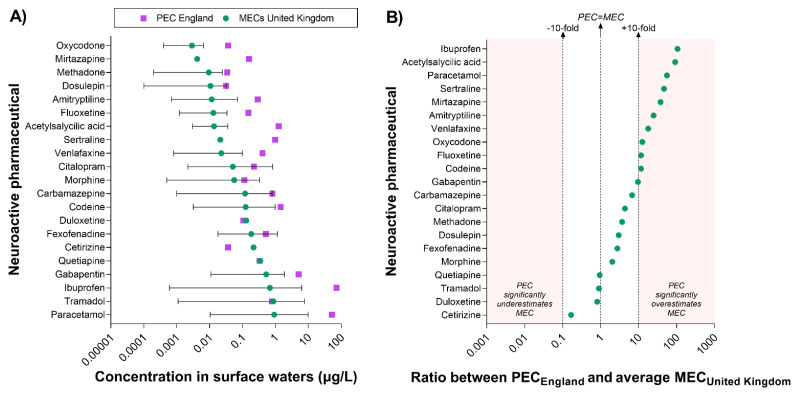
There is a growing concern that neuroactive chemicals released into the environment can perturb wildlife behaviour. Among these chemicals, pharmaceuticals such as antidepressants and anxiolytics have been receiving increasing attention, as they are specifically prescribed to modify behavioural responses. Many laboratory studies have demonstrated that some of these compounds can affect various aspects of the behaviour of a range of aquatic organisms; however, these investigations are focused on a very small set of neuroactive pharmaceuticals, and they often consider one compound at a time. In this study, to better understand the environmental and toxicological dimension of the problem, we considered all pharmaceuticals explicitly intended to modulate the central nervous system (CNS), and we hypothesised that these compounds have higher probability of perturbing animal behaviour. Based on this hypothesis, we used the classification of pharmaceuticals provided by the British National Formulary (based on their clinical applications) and identified 210 different CNS-acting pharmaceuticals prescribed in the UK to treat a variety of CNS-related conditions, including mental health and sleep disorders, dementia, epilepsy, nausea, and pain. The analysis of existing databases revealed that 84 of these compounds were already detected in surface waters worldwide. Using a biological read-across approach based on the extrapolation of clinical data, we predicted that the concentration of 32 of these neuroactive pharmaceuticals in surface waters in England may be high enough to elicit pharmacological effects in wild fish. The ecotoxicological effects of the vast majority of these compounds are currently uncharacterised. Overall, these results highlight the importance of addressing this environmental challenge from a mixture toxicology and systems perspective. The knowledge platform developed in the present study can guide future region-specific prioritisation efforts, inform the design of mixture studies, and foster interdisciplinary efforts aimed at identifying novel approaches to predict and interpret the ecological implications of chemical-induced behaviour disruption.
人们越来越担心释放到环境中的神经活性化学物质会扰乱野生动物的行为。在这些化学物质中,抗抑郁药和抗焦虑药等药物受到了越来越多的关注,因为它们是专门用于改变行为反应的。许多实验室研究表明,其中一些化合物会影响一系列水生生物行为的各个方面;然而,这些研究集中在极少数的神经活性药物上,而且它们通常一次只考虑一种化合物。在本研究中,为了更好地理解该问题的环境和毒理学层面,我们考虑了所有明确旨在调节中枢神经系统(CNS)的药物,并假设这些化合物更有可能扰乱动物行为。基于这一假设,我们使用了英国国家处方集提供的药物分类(基于其临床应用),并确定了在英国用于治疗各种中枢神经系统相关疾病(包括心理健康和睡眠障碍、痴呆、癫痫、恶心和疼痛)的210种不同的中枢神经系统作用药物。对现有数据库的分析表明,全球地表水中已检测到其中84种化合物。使用基于临床数据外推的生物类推方法,我们预测英国地表水中32种此类神经活性药物的浓度可能高到足以在野生鱼类中引发药理作用。目前,这些化合物中绝大多数的生态毒理学效应尚未得到表征。总体而言,这些结果凸显了从混合物毒理学和系统角度应对这一环境挑战的重要性。本研究中开发的知识平台可以指导未来针对特定区域的优先排序工作,为混合物研究的设计提供信息,并促进跨学科努力,以确定预测和解释化学诱导行为破坏的生态影响的新方法。