Tokajuk Joanna, Deptuła Piotr, Piktel Ewelina, Daniluk Tamara, Chmielewska Sylwia, Wollny Tomasz, Wolak Przemysław, Fiedoruk Krzysztof, Bucki Robert
Department of Medical Microbiology and Nanobiomedical Engineering, Medical University of Białystok, Mickiewicza 2C, 15-222 Białystok, Poland.
Dentistry and Medicine Tokajuk, Zelazna 9/7, 15-297 Bialystok, Poland.
Biomedicines. 2022 May 7;10(5):1086. doi: 10.3390/biomedicines10051086.
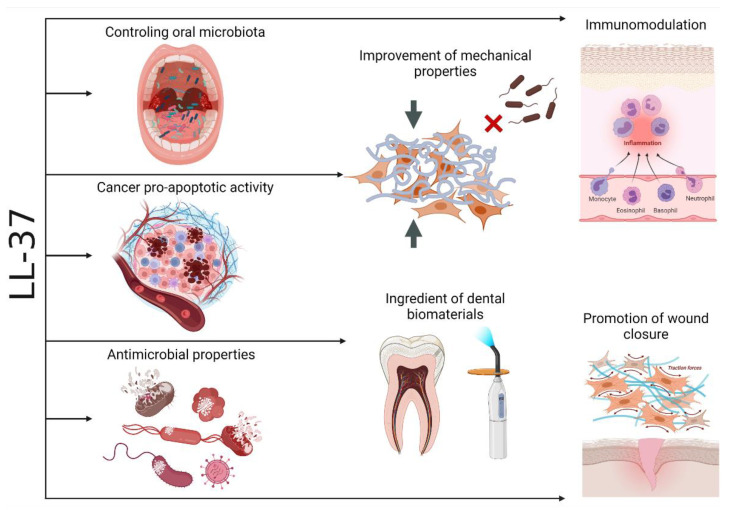
The mechanisms for maintaining oral cavity homeostasis are subject to the constant influence of many environmental factors, including various chemicals and microorganisms. Most of them act directly on the oral mucosa, which is the mechanical and immune barrier of the oral cavity, and such interaction might lead to the development of various oral pathologies and systemic diseases. Two important players in maintaining oral health or developing oral pathology are the oral microbiota and various immune molecules that are involved in controlling its quantitative and qualitative composition. The LL-37 peptide is an important molecule that upon release from human cathelicidin (hCAP-18) can directly perform antimicrobial action after insertion into surface structures of microorganisms and immunomodulatory function as an agonist of different cell membrane receptors. Oral LL-37 expression is an important factor in oral homeostasis that maintains the physiological microbiota but is also involved in the development of oral dysbiosis, infectious diseases (including viral, bacterial, and fungal infections), autoimmune diseases, and oral carcinomas. This peptide has also been proposed as a marker of inflammation severity and treatment outcome.
维持口腔内环境稳定的机制受到许多环境因素的持续影响,包括各种化学物质和微生物。其中大多数直接作用于口腔黏膜,口腔黏膜是口腔的机械和免疫屏障,这种相互作用可能导致各种口腔疾病和全身性疾病的发生。维持口腔健康或引发口腔病变的两个重要因素是口腔微生物群和参与控制其数量和质量组成的各种免疫分子。LL-37肽是一种重要分子,从人Cathelicidin(hCAP-18)释放后,插入微生物表面结构后可直接发挥抗菌作用,并作为不同细胞膜受体的激动剂发挥免疫调节功能。口腔LL-37的表达是口腔内环境稳定的一个重要因素,它维持生理微生物群,但也参与口腔生态失调、传染病(包括病毒、细菌和真菌感染)、自身免疫性疾病和口腔癌的发生。这种肽也被提议作为炎症严重程度和治疗结果的标志物。