Terkawi M Alaa, Ebata Taku, Yokota Shunichi, Takahashi Daisuke, Endo Tsutomu, Matsumae Gen, Shimizu Tomohiro, Kadoya Ken, Iwasaki Norimasa
Department of Orthopedic Surgery, Faculty of Medicine and Graduate School of Medicine, Hokkaido University, Kita-15, Nish-7, Kita-ku, Sapporo 060-8638, Japan.
Biomedicines. 2022 May 10;10(5):1109. doi: 10.3390/biomedicines10051109.
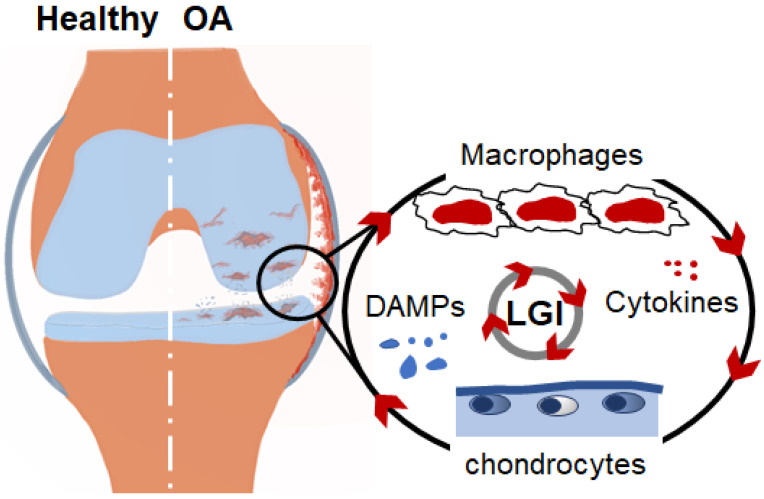
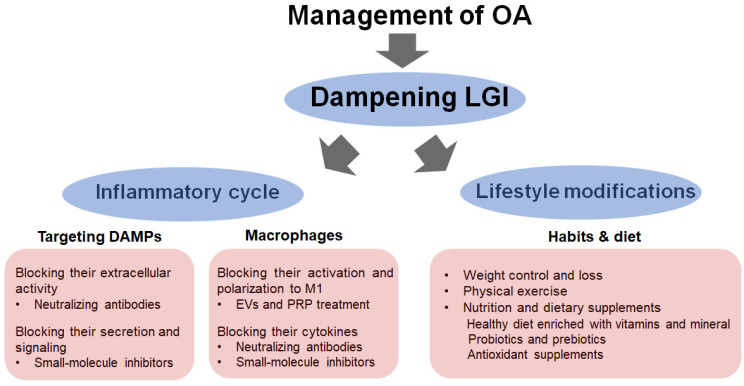
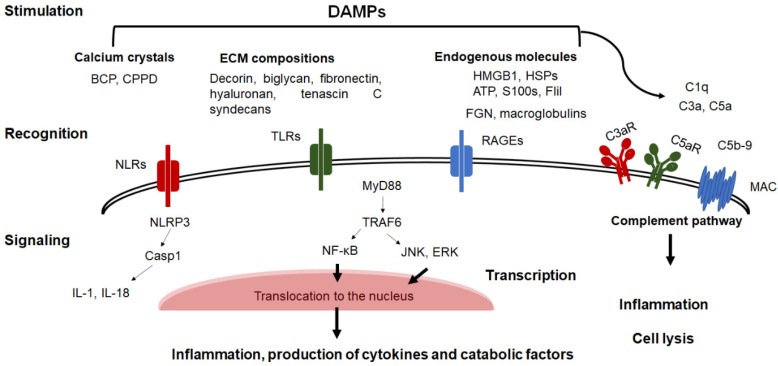
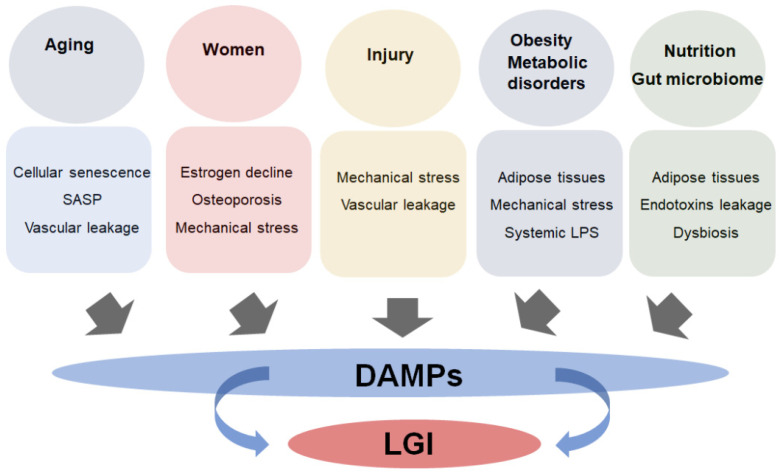
Osteoarthritis (OA) is a musculoskeletal disease characterized by cartilage degeneration and stiffness, with chronic pain in the affected joint. It has been proposed that OA progression is associated with the development of low-grade inflammation (LGI) in the joint. In support of this principle, LGI is now recognized as the major contributor to the pathogenesis of obesity, aging, and metabolic syndromes, which have been documented as among the most significant risk factors for developing OA. These discoveries have led to a new definition of the disease, and OA has recently been recognized as a low-grade inflammatory disease of the joint. Damage-associated molecular patterns (DAMPs)/alarmin molecules, the major cellular components that facilitate the interplay between cells in the cartilage and synovium, activate various molecular pathways involved in the initiation and maintenance of LGI in the joint, which, in turn, drives OA progression. A better understanding of the pathological mechanisms initiated by LGI in the joint represents a decisive step toward discovering therapeutic strategies for the treatment of OA. Recent findings and discoveries regarding the involvement of LGI mediated by DAMPs in OA pathogenesis are discussed. Modulating communication between cells in the joint to decrease inflammation represents an attractive approach for the treatment of OA.
骨关节炎(OA)是一种肌肉骨骼疾病,其特征为软骨退变和僵硬,并伴有受累关节的慢性疼痛。有人提出,OA的进展与关节中低度炎症(LGI)的发展有关。支持这一观点的是,LGI现在被认为是肥胖、衰老和代谢综合征发病机制的主要促成因素,而这些已被证明是发生OA的最重要风险因素。这些发现导致了对该疾病的新定义,OA最近被认为是一种关节低度炎症性疾病。损伤相关分子模式(DAMPs)/警报素分子是促进软骨和滑膜中细胞相互作用的主要细胞成分,它们激活参与关节LGI起始和维持的各种分子途径,进而推动OA的进展。更好地理解LGI在关节中引发的病理机制是发现OA治疗策略的决定性一步。本文讨论了关于DAMPs介导的LGI参与OA发病机制的最新发现。调节关节中细胞间的通讯以减轻炎症是一种有吸引力的OA治疗方法。