State Institute of Health, Bavarian Health and Food Safety Authority, 91058 Erlangen, Germany.
Institute of Clinical Epidemiology and Biometry, University of Würzburg, 97080 Würzburg, Germany.
Int J Environ Res Public Health. 2022 May 11;19(10):5864. doi: 10.3390/ijerph19105864.
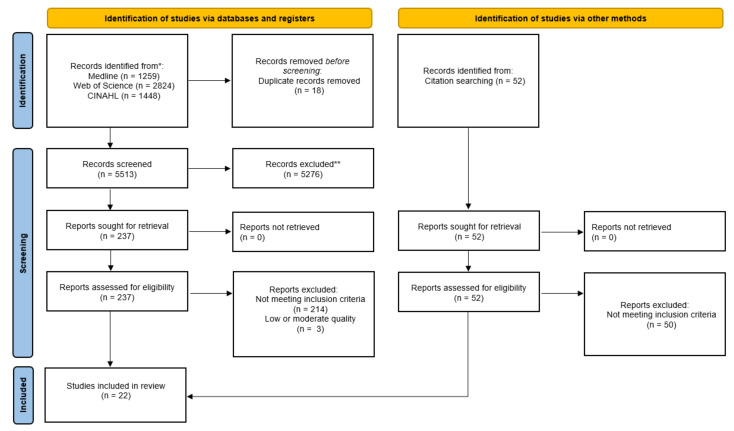
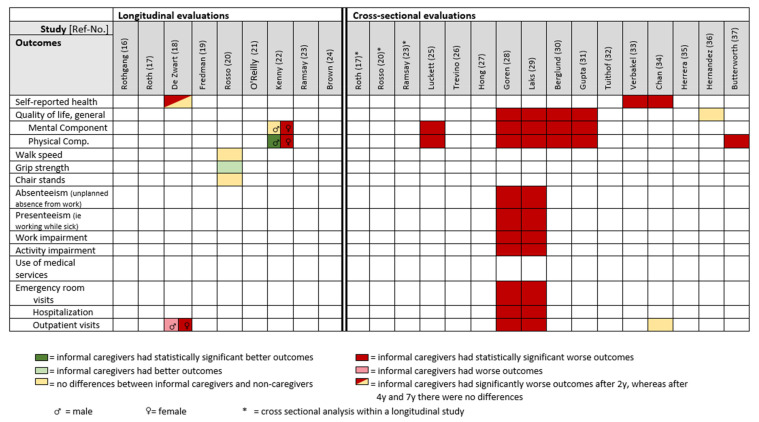
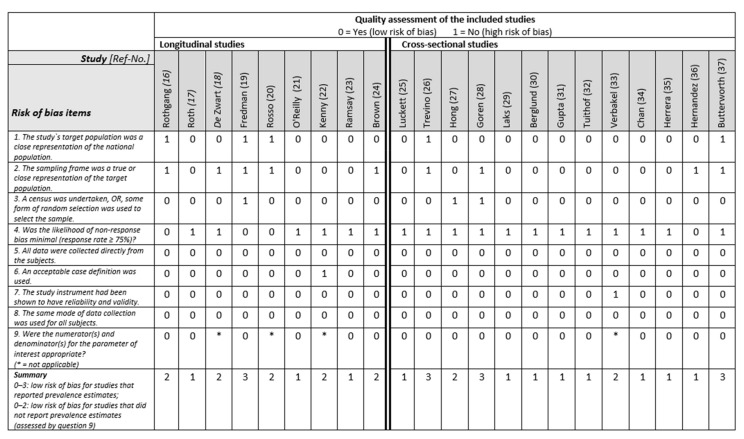
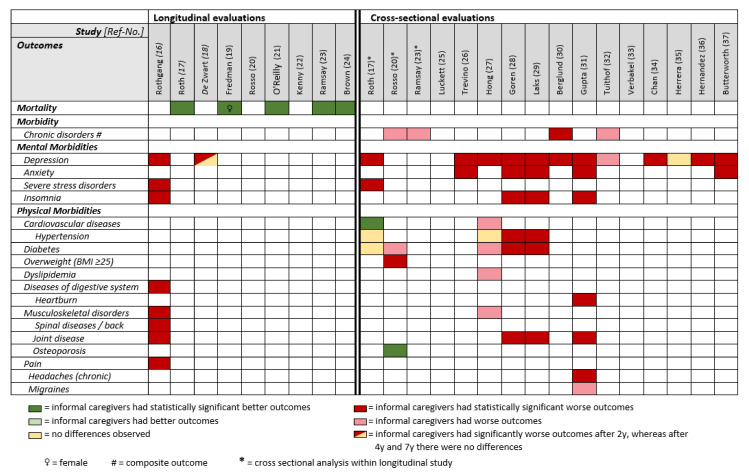
A systematic overview of mental and physical disorders of informal caregivers based on population-based studies with good methodological quality is lacking. Therefore, our aim was to systematically summarize mortality, incidence, and prevalence estimates of chronic diseases in informal caregivers compared to non-caregivers. Following PRISMA recommendations, we searched major healthcare databases (CINAHL, MEDLINE and Web of Science) systematically for relevant studies published in the last 10 years (without language restrictions) (PROSPERO registration number: CRD42020200314). We included only observational cross-sectional and cohort studies with low risk of bias (risk scores 0-2 out of max 8) that reported the prevalence, incidence, odds ratio (OR), hazard ratio (HR), mean- or sum-scores for health-related outcomes in informal caregivers and non-caregivers. For a thorough methodological quality assessment, we used a validated checklist. The synthesis of the results was conducted by grouping outcomes. We included 22 studies, which came predominately from the USA and Europe. Informal caregivers had a significantly lower mortality than non-caregivers. Regarding chronic morbidity outcomes, the results from a large longitudinal German health-insurance evaluation showed increased and statistically significant incidences of severe stress, adjustment disorders, depression, diseases of the spine and pain conditions among informal caregivers compared to non-caregivers. In cross-sectional evaluations, informal caregiving seemed to be associated with a higher occurrence of depression and of anxiety (ranging from 4 to 51% and 2 to 38%, respectively), pain, hypertension, diabetes and reduced quality of life. Results from our systematic review suggest that informal caregiving may be associated with several mental and physical disorders. However, these results need to be interpreted with caution, as the cross-sectional studies cannot determine temporal relationships. The lower mortality rates compared to non-caregivers may be due to a healthy-carer bias in longitudinal observational studies; however, these and other potential benefits of informal caregiving deserve further attention by researchers.
缺乏基于人群的、方法学质量较高的研究对非正式照护者的精神和身体障碍进行系统综述。因此,我们的目的是系统总结与非照护者相比,非正式照护者的慢性病死亡率、发病率和患病率估计值。根据 PRISMA 建议,我们系统地在主要的医疗保健数据库(CINAHL、MEDLINE 和 Web of Science)中搜索了过去 10 年(无语言限制)发表的相关研究(PROSPERO 注册号:CRD42020200314)。我们仅纳入了偏倚风险低(风险评分 0-2 分,满分 8 分)的观察性横断面和队列研究,这些研究报告了非正式照护者和非照护者的健康相关结局的患病率、发病率、比值比(OR)、风险比(HR)、平均值或总分。为了进行彻底的方法学质量评估,我们使用了经过验证的清单。通过分组结果来综合结果。我们纳入了 22 项研究,这些研究主要来自美国和欧洲。与非照护者相比,非正式照护者的死亡率明显较低。关于慢性发病情况,一项大型德国健康保险评估的纵向研究结果表明,与非照护者相比,非正式照护者严重压力、适应障碍、抑郁、脊柱疾病和疼痛状况的发病率显著增加且具有统计学意义。在横断面评估中,非正式照护似乎与更高的抑郁和焦虑发生率(分别为 4%至 51%和 2%至 38%)、疼痛、高血压、糖尿病和生活质量降低有关。本系统综述的结果表明,非正式照护可能与多种精神和身体障碍有关。然而,由于横断面研究无法确定时间关系,因此这些结果需要谨慎解释。与非照护者相比,较低的死亡率可能归因于纵向观察性研究中的健康照顾者偏差;然而,这些和非正式照护的其他潜在益处值得研究人员进一步关注。