Department of Health Policy and Management, Erasmus University Rotterdam, P.O. Box 738, 3000 DR Rotterdam, The Netherlands.
Institute of Medical Information & Library, Chinese Academy of Medical Sciences & Peking Union Medical College, Beijing 100020, China.
Int J Environ Res Public Health. 2022 May 18;19(10):6141. doi: 10.3390/ijerph19106141.
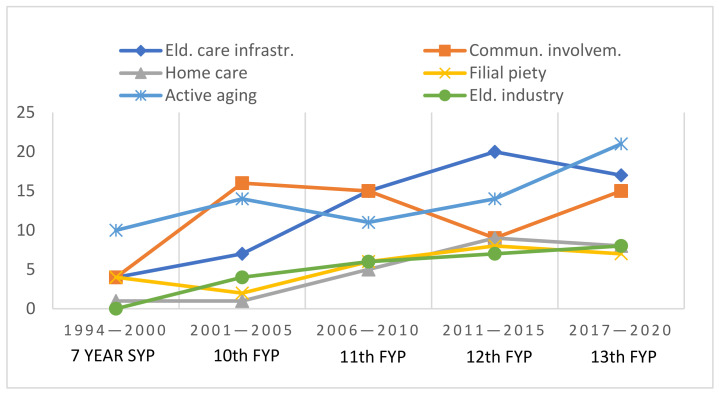
Until the 1980s, institutional elder care was virtually unknown in China. In a few decades, China had to construct a universal social safety net and assure basic elderly care. China's government has been facing several challenges: the eroding traditional family care, the funding to assure care services for the older population, as well as the shortage of care delivery services and nursing staff. This paper examines China's Five-Year Policy Plans from 1994 to 2020. Our narrative review analysis focuses on six main topics revealed in these policies: care infrastructure, community involvement, home-based care, filial piety, active aging and elder industry. Based on this analysis, we identified several successive and often simultaneously strategic steps that China introduced to contend with the aging challenge. In Western countries, elder care policies have been shifting to the home care approach. China introduced home care as the elder care cornerstone and encouraged the revival of the filial piety tradition. Although China has a unique approach, the care policies for the aged population in China and Western countries are converging by emphasizing home-based care, informal care and healthy aging.
直到 20 世纪 80 年代,机构养老在中国几乎是闻所未闻的。在短短几十年里,中国必须构建一个普遍的社会保障网,并确保基本的老年护理。中国政府一直面临着几个挑战:传统家庭护理的侵蚀、为老年人口提供护理服务的资金,以及护理服务和护理人员的短缺。本文考察了中国 1994 年至 2020 年的五年政策计划。我们的叙述性综述分析重点关注这些政策中揭示的六个主要主题:护理基础设施、社区参与、居家护理、孝道、积极老龄化和老年产业。基于这一分析,我们确定了中国为应对老龄化挑战而引入的几个连续的、往往是同时的战略步骤。在西方国家,老年护理政策已经转向家庭护理方法。中国将家庭护理作为老年护理的基石,并鼓励孝道传统的复兴。尽管中国有独特的方法,但中西方的老年人护理政策正在通过强调居家护理、非正式护理和健康老龄化而趋同。