Arghittu Antonella, Dettori Marco, Deriu Grazia Maria, Soddu Serena, Manca Pietro Carmelo, Carboni Anna Angela, Collu Irene, Palmieri Alessandra, Deiana Giovanna, Azara Antonio, Castiglia Paolo, Masia Maria Dolores
Department of Biomedical Sciences, University of Sassari, 07100 Sassari, Italy.
University Hospital of Sassari, 07100 Sassari, Italy.
Healthcare (Basel). 2022 May 5;10(5):845. doi: 10.3390/healthcare10050845.
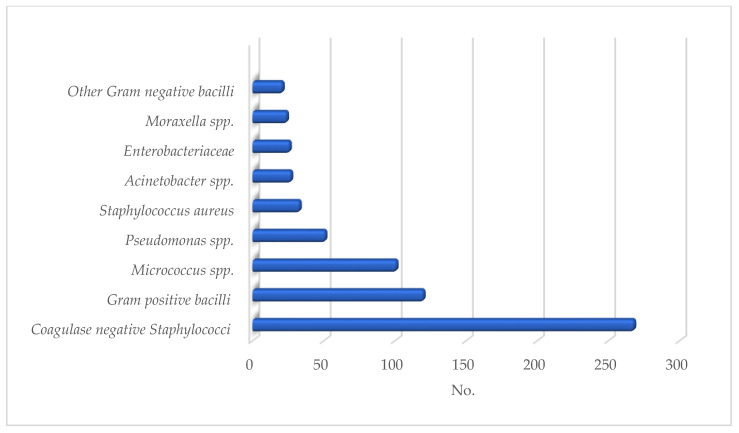
Bacterial infectious risk is a major problem in transfusion medicine. The type of micro-organisms isolated during bacterial contamination of blood products indicates that the donor’s skin is its main source. In this context, the primary measures to reduce this risk are: (a) optimal disinfection of the donor’s arm and (b) satellite bag diversion of the initial volume of blood collected. This work aimed to verify the effectiveness of skin disinfection of the blood donor’s venipuncture site. Two methodological approaches were used: (a) qualitative and quantitative microbiological testing of the skin at the collection site, before and post-disinfection; (b) qualitative microbiological testing of the first deviated blood. Pre-disinfection testing showed skin microbial load values between 3 and >200 CFU/plate. More than two-thirds of the isolates were Gram-positive bacteria (77.8%) of which 57.7% were staphylococci. Among Gram-negative bacteria, Pseudomonadaceae, Enterobacteriaceae, and Acinetobacter spp. were isolated from the blood donors (BDs). Post-disinfection, a 100% reduction in microbial load was observed in 84.4% of BDs. Microbiological testing of the first blood diverted sample revealed the presence of microbial flora in 1.9% samples; of the isolates, 83.3% were non-aureus staphylococci. This study highlights the importance of the correct application of skin disinfection procedures in order to ensure blood safety.
细菌感染风险是输血医学中的一个主要问题。在血液制品细菌污染过程中分离出的微生物类型表明,献血者的皮肤是其主要来源。在这种情况下,降低这种风险的主要措施是:(a) 对献血者手臂进行最佳消毒;(b) 对最初采集的血液进行卫星袋分流。这项工作旨在验证对献血者静脉穿刺部位皮肤消毒的有效性。采用了两种方法:(a) 在消毒前后对采集部位的皮肤进行定性和定量微生物检测;(b) 对首次分流的血液进行定性微生物检测。消毒前检测显示皮肤微生物负荷值在3至>200 CFU/平板之间。超过三分之二的分离株为革兰氏阳性菌(77.8%),其中57.7%为葡萄球菌。在革兰氏阴性菌中,从献血者中分离出了假单胞菌科、肠杆菌科和不动杆菌属。消毒后,84.4%的献血者微生物负荷降低了100%。对首次分流的血液样本进行微生物检测发现,1.9%的样本中存在微生物菌群;在分离株中,83.3%为非金黄色葡萄球菌。本研究强调了正确应用皮肤消毒程序以确保血液安全的重要性。