Sousa Beatriz, Martins João, Castelo-Branco Miguel, Gonçalves Joana
Coimbra Institute for Biomedical Imaging and Translational Research (CIBIT), University of Coimbra, 3000-548 Coimbra, Portugal.
Institute for Nuclear Sciences Applied to Health (ICNAS), University of Coimbra, 3000-548 Coimbra, Portugal.
J Clin Med. 2022 May 18;11(10):2839. doi: 10.3390/jcm11102839.
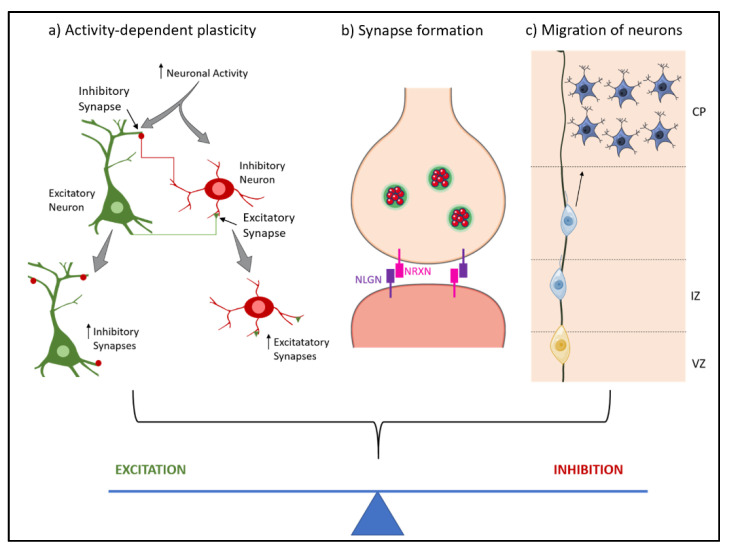
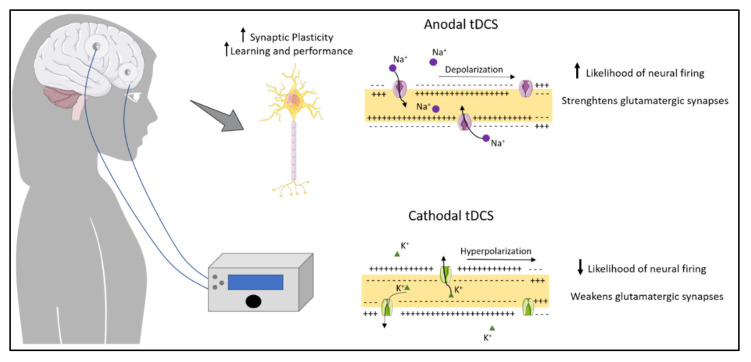
Transcranial direct current stimulation (tDCS) has been proposed as a promising therapy for rehabilitation of neurodevelopmental disorders. In this review, we discuss studies on the impact of tDCS as a therapy for autism, schizophrenia, and attention deficit/hyperactivity disorder, as well as the tDCS' mechanism of action, and propose future paths of research to optimize tDCS treatment protocols. The mechanism underlying tDCS effects is the modulation of excitatory and/or inhibitory activity, making it a valuable tool for restoring the excitation/inhibition (E/I) balance which is disrupted in many neurodevelopmental disorders. Clinical studies have shown that tDCS therapy is well-tolerated by patients and seems to ameliorate behavior and cognitive functions. Alterations in early development of neuronal circuits lead to disruptions in brain activity in neurodevelopmental disorders. An increasing amount of research into the effects of tDCS on neuronal activity has provided a foundation for its use as a therapy for behavior and cognitive characteristics of neurodevelopmental disorders. Clinical studies show that tDCS appears to ameliorate behavioral and cognitive outcomes of patients with autism, schizophrenia, and attention deficit/hyperactivity disorder. More research is needed to understand the mechanisms of action of tDCS and to optimize treatment protocols.
经颅直流电刺激(tDCS)已被提议作为一种治疗神经发育障碍的有前景的疗法。在这篇综述中,我们讨论了关于tDCS作为自闭症、精神分裂症和注意力缺陷多动障碍治疗方法的影响的研究,以及tDCS的作用机制,并提出了优化tDCS治疗方案的未来研究方向。tDCS效应的潜在机制是对兴奋性和/或抑制性活动的调节,这使其成为恢复在许多神经发育障碍中被破坏的兴奋/抑制(E/I)平衡的有价值工具。临床研究表明,患者对tDCS治疗耐受性良好,并且似乎能改善行为和认知功能。神经回路早期发育的改变会导致神经发育障碍中大脑活动的紊乱。对tDCS对神经元活动影响的研究越来越多,这为其作为治疗神经发育障碍行为和认知特征的疗法提供了基础。临床研究表明,tDCS似乎能改善自闭症、精神分裂症和注意力缺陷多动障碍患者的行为和认知结果。需要更多的研究来了解tDCS的作用机制并优化治疗方案。