Saito Shigeo, Ku Chia-Chen, Wuputra Kenly, Pan Jia-Bin, Lin Chang-Shen, Lin Ying-Chu, Wu Deng-Chyang, Yokoyama Kazunari K
Saito Laboratory of Cell Technology, Yaita 329-1571, Japan.
Horus Co., Ltd., Nakano, Tokyo 164-0001, Japan.
J Pers Med. 2022 Apr 29;12(5):715. doi: 10.3390/jpm12050715.
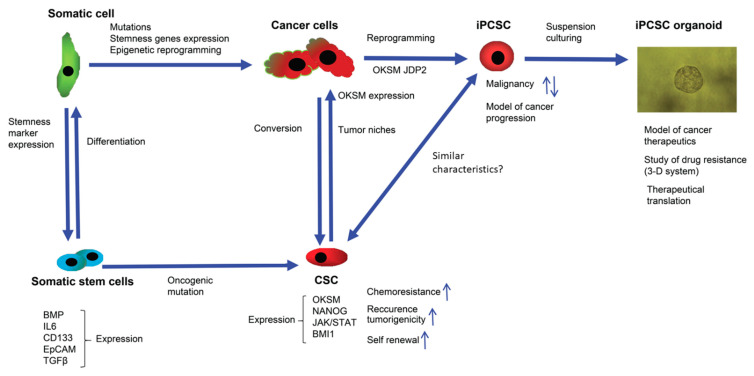
The use of biomarkers in cancer diagnosis, therapy, and prognosis has been highly effective over several decades. Studies of biomarkers in cancer patients pre- and post-treatment and during cancer progression have helped identify cancer stem cells (CSCs) and their related microenvironments. These analyses are critical for the therapeutic application of drugs and the efficient targeting and prevention of cancer progression, as well as the investigation of the mechanism of the cancer development. Biomarkers that characterize CSCs have thus been identified and correlated to diagnosis, therapy, and prognosis. However, CSCs demonstrate elevated levels of plasticity, which alters their functional phenotype and appearance by interacting with their microenvironments, in response to chemotherapy and radiotherapeutics. In turn, these changes induce different metabolic adaptations of CSCs. This article provides a review of the most frequently used CSCs and stem cell markers.
几十年来,生物标志物在癌症诊断、治疗和预后评估方面一直发挥着高效作用。对癌症患者治疗前后及癌症进展过程中生物标志物的研究,有助于识别癌症干细胞(CSCs)及其相关微环境。这些分析对于药物的治疗应用、有效靶向和预防癌症进展以及研究癌症发生机制至关重要。因此,已鉴定出能够表征CSCs的生物标志物,并将其与诊断、治疗和预后相关联。然而,CSCs表现出较高的可塑性水平,通过与微环境相互作用,它们会对化疗和放疗产生反应,从而改变其功能表型和外观。反过来,这些变化会诱导CSCs产生不同的代谢适应性变化。本文对最常用的CSCs和干细胞标志物进行了综述。