Department of Anesthesiology and Pain Medicine, Wonkwang University School of Medicine Hospital, 895 Muwang-ro, Iksan 54538, Korea.
Department of Obstetrics and Gynecology, Wonkwang University School of Medicine Hospital, 895 Muwang-ro, Iksan 54538, Korea.
Medicina (Kaunas). 2022 May 23;58(5):690. doi: 10.3390/medicina58050690.
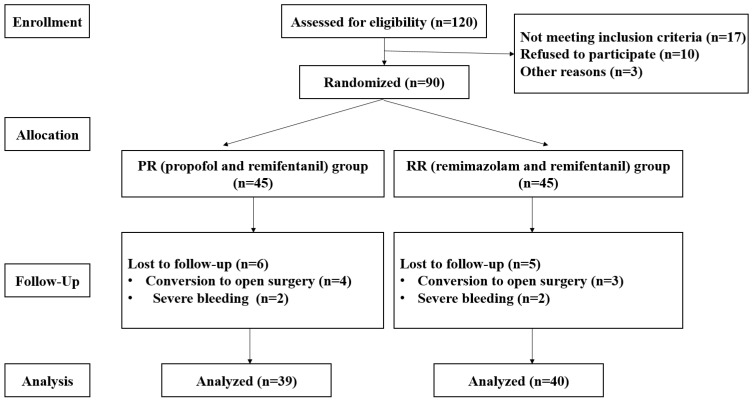
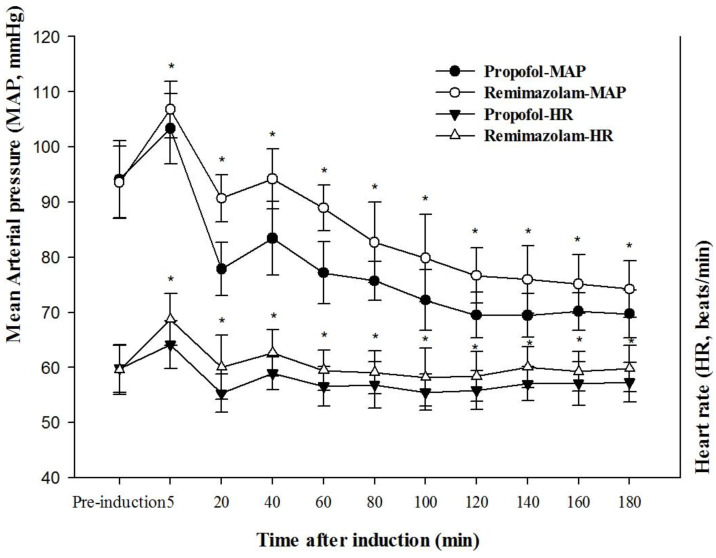
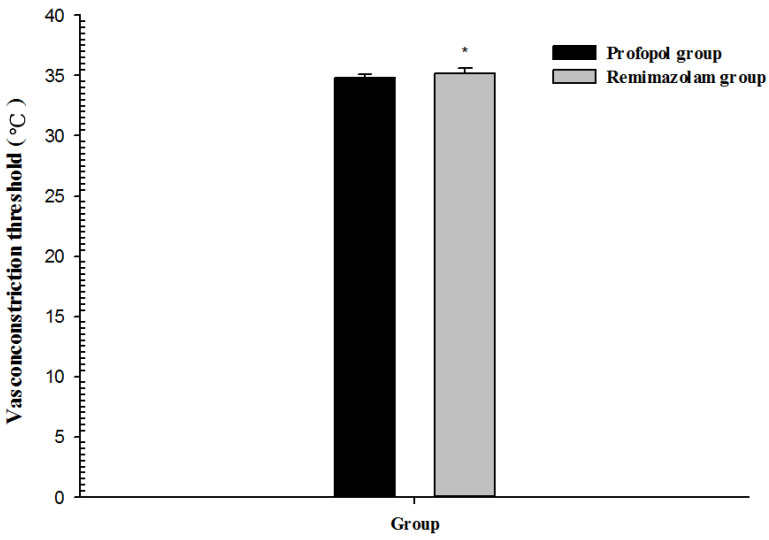
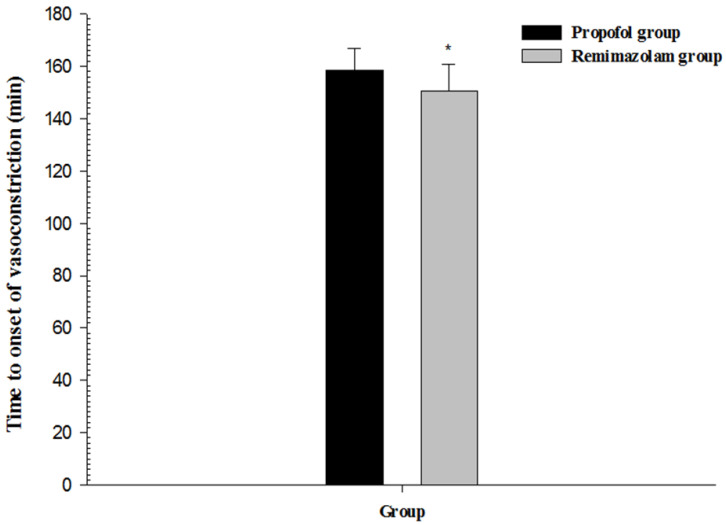
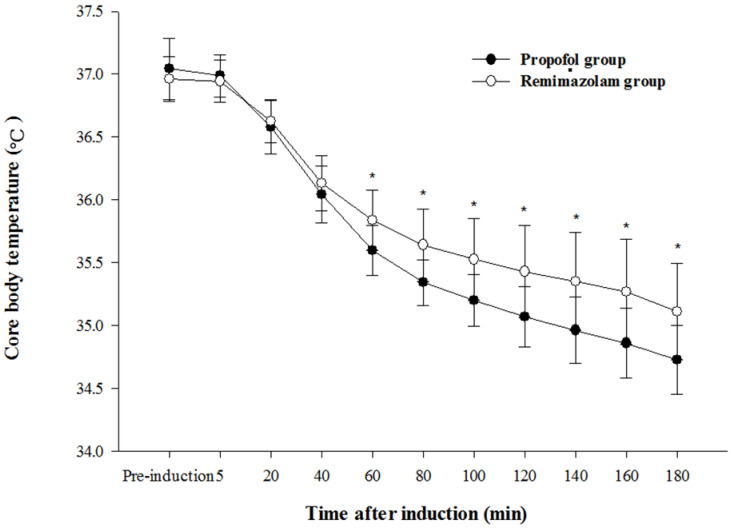
Background and Objectives: Different types of anesthetics affect thermoregulatory mechanisms, such as the redistribution of body temperature, loss of skin heat, or inhibition of thermoregulatory vasoconstriction. Therefore, we compared remimazolam with propofol in terms of core body temperature in patients undergoing robotic-assisted and laparoscopic radical prostatectomy. Materials and methods: Ninety patients were randomly assigned to either the propofol−remifentanil (PR) group or the remimazolam−remifentanil (RR) group. The PR group (n = 45) received effect-site concentrations of 6.0 μg/mL of propofol and 4 ng/mL of remifentanil, followed by 0.9 mg/kg of 1% rocuronium and maintenance with effect-site concentrations of 2−4 μg/mL of propofol and 3 ng/mL of remifentanil. The RR group (n = 45) received remimazolam 6 mg/kg/h by continuous intravenous infusion and the effect-site concentration of 4 ng/mL of remifentanil, followed by 0.9 mg/kg of 1% rocuronium, remimazolam 1−3 mg/kg/h, and remifentanil 3 ng/mL. The primary outcome was core body temperature, and secondary outcomes included vasoconstriction threshold (°C) and time to onset of vasoconstriction (min). Results: The core body temperature in the RR group was significantly higher at 60, 80, 100, 120, 140, 160, and 180 min after induction than in the PR group (p < 0.01). The vasoconstriction threshold was significantly higher in the RR group (35.2 ± 0.4) than in the PR group (34.8 ± 0.3) (p < 0.01). The time to onset of vasoconstriction was significantly less in the RR group (150.5 ± 10.2) than in the PR group (158.5 ± 8.4) (p < 0.01). However, the incidence of intraoperative hypothermia was not significant between two groups. Conclusions: Remimazolam appears to reduce vasoconstriction threshold less than and had a faster onset of vasoconstriction, resulting in superior thermoregulatory control.
不同类型的麻醉会影响体温调节机制,例如体温分布、皮肤热量丧失或体温调节性血管收缩的抑制。因此,我们比较了瑞马唑仑与丙泊酚在机器人辅助腹腔镜根治性前列腺切除术中对核心体温的影响。
90 例患者随机分为丙泊酚-瑞芬太尼组(PR 组,n = 45)和瑞马唑仑-瑞芬太尼组(RR 组,n = 45)。PR 组给予 6.0μg/mL 丙泊酚和 4ng/mL 瑞芬太尼的效应部位浓度,随后给予 0.9mg/kg 的 1%罗库溴铵,并以 2-4μg/mL 丙泊酚和 3ng/mL 瑞芬太尼的效应部位浓度维持。RR 组给予瑞马唑仑 6mg/kg/h 持续静脉输注和 4ng/mL 瑞芬太尼的效应部位浓度,随后给予 0.9mg/kg 的 1%罗库溴铵,瑞马唑仑 1-3mg/kg/h 和 3ng/mL 瑞芬太尼。主要结局是核心体温,次要结局包括血管收缩阈值(°C)和血管收缩开始时间(min)。
RR 组在诱导后 60、80、100、120、140、160 和 180min 时的核心体温明显高于 PR 组(p < 0.01)。RR 组的血管收缩阈值明显高于 PR 组(35.2 ± 0.4)比(34.8 ± 0.3)(p < 0.01)。RR 组的血管收缩开始时间明显短于 PR 组(150.5 ± 10.2)比(158.5 ± 8.4)(p < 0.01)。然而,两组术中低体温的发生率无显著差异。
瑞马唑仑似乎可降低血管收缩阈值,且血管收缩开始时间更快,从而更好地控制体温调节。