Włodarczyk Dorota, Ziętalewicz Urszula
Department of Health Psychology, Medical University of Warsaw, 00-575 Warsaw, Poland.
Vaccines (Basel). 2022 May 5;10(5):723. doi: 10.3390/vaccines10050723.
The influenza vaccination rate remains unsatisfactorily low, especially in the healthy adult population. The positive deviant approach was used to identify key psychosocial factors explaining the intention of influenza vaccination in medics and compare them with those in non-medics.
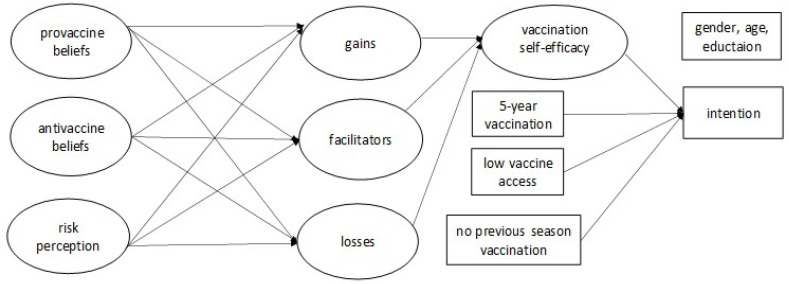
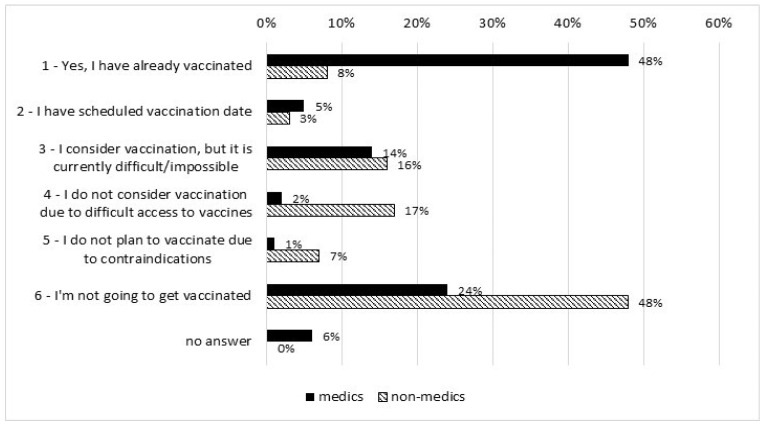
There were 709 participants, as follows: 301 medics and 408 non-medics. We conducted a cross-sectional study in which a multi-module self-administered questionnaire examining vaccination beliefs, risk perception, outcome expectations (gains or losses), facilitators' relevance, vaccination self-efficacy and vaccination intention was adopted. We also gathered information on access to vaccination, the strength of the vaccination habit and sociodemographic variables.
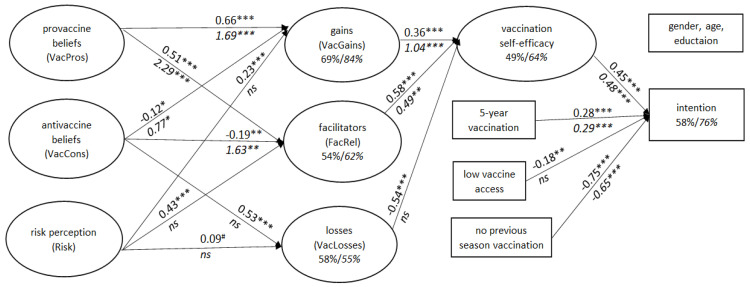
We used SEM and were able to explain 78% of the variance in intention in medics and 56% in non-medics. We identified both direct and indirect effects between the studied variables. In both groups, the intention was related to vaccination self-efficacy, stronger habits and previous season vaccination, but access to vaccines was significant only in non-medics.
Applying the positive deviance approach and considering medics as positive deviants in vaccination performance extended the perspective on what factors to focus on in the non-medical population. Vaccination promotion shortly before the flu season should target non- or low-intenders and also intenders by the delivery of balanced information affecting key vaccination cognitions. General pro-vaccine beliefs, which may act as implicit attitudes, should be created in advance to build proper grounds for specific outcome expectations and facilitators' recognition. It should not be limited only to risk perception. Some level of evidence-based critical beliefs about vaccination can be beneficial.
流感疫苗接种率仍低得不尽人意,尤其是在健康成年人群中。采用积极偏差方法来确定解释医护人员流感疫苗接种意愿的关键心理社会因素,并将其与非医护人员的因素进行比较。
共有709名参与者,如下:301名医护人员和408名非医护人员。我们进行了一项横断面研究,采用多模块自填问卷,调查疫苗接种信念、风险认知、结果期望(收益或损失)、促进因素的相关性、疫苗接种自我效能感和疫苗接种意愿。我们还收集了关于疫苗接种途径、疫苗接种习惯强度和社会人口统计学变量的信息。
我们使用结构方程模型,能够解释医护人员意愿方差的78%和非医护人员意愿方差的56%。我们确定了研究变量之间的直接和间接影响。在两组中,意愿都与疫苗接种自我效能感、更强的习惯和上一季接种疫苗有关,但疫苗接种途径仅在非医护人员中具有显著意义。
应用积极偏差方法并将医护人员视为疫苗接种表现方面的积极偏差者,扩展了对非医疗人群应关注哪些因素的认识。在流感季节来临前不久进行疫苗接种推广时,应针对未接种或接种意愿低的人群,以及接种意愿者,提供影响关键疫苗接种认知的平衡信息。应提前树立可能作为隐性态度的普遍的支持疫苗接种信念,为特定的结果期望和促进因素的认知奠定适当基础。这不应该仅限于风险认知。一些基于证据的关于疫苗接种的批判性信念可能是有益的。