Dhalaria Pritu, Arora Himanshu, Singh Ajeet Kumar, Mathur Mansi, S Ajai Kumar
Immunization Technical Support Unit, Ministry of Health & Family Welfare, Government of India, New Delhi 110070, India.
Vaccines (Basel). 2022 May 9;10(5):739. doi: 10.3390/vaccines10050739.
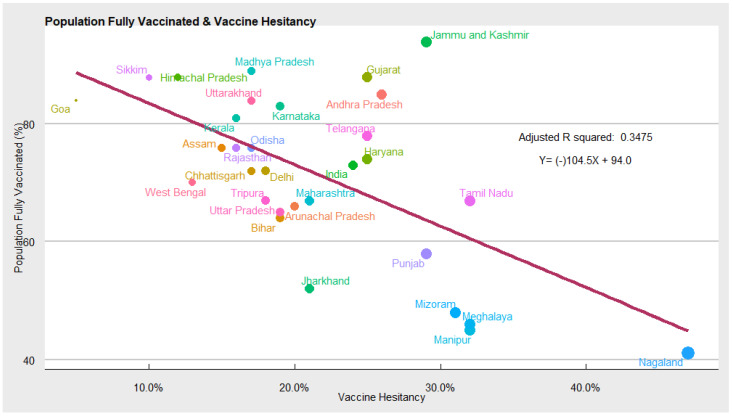
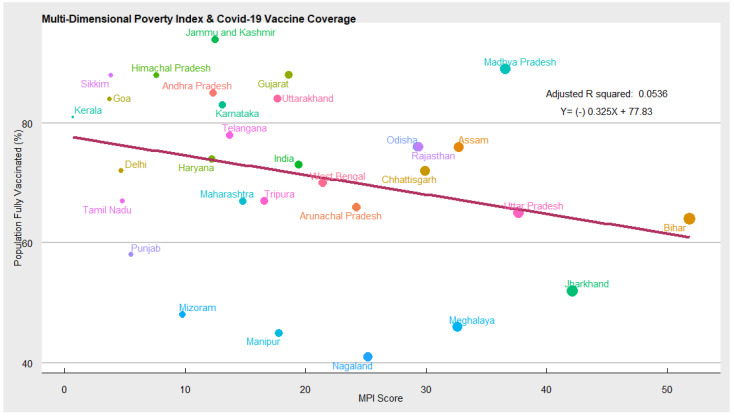
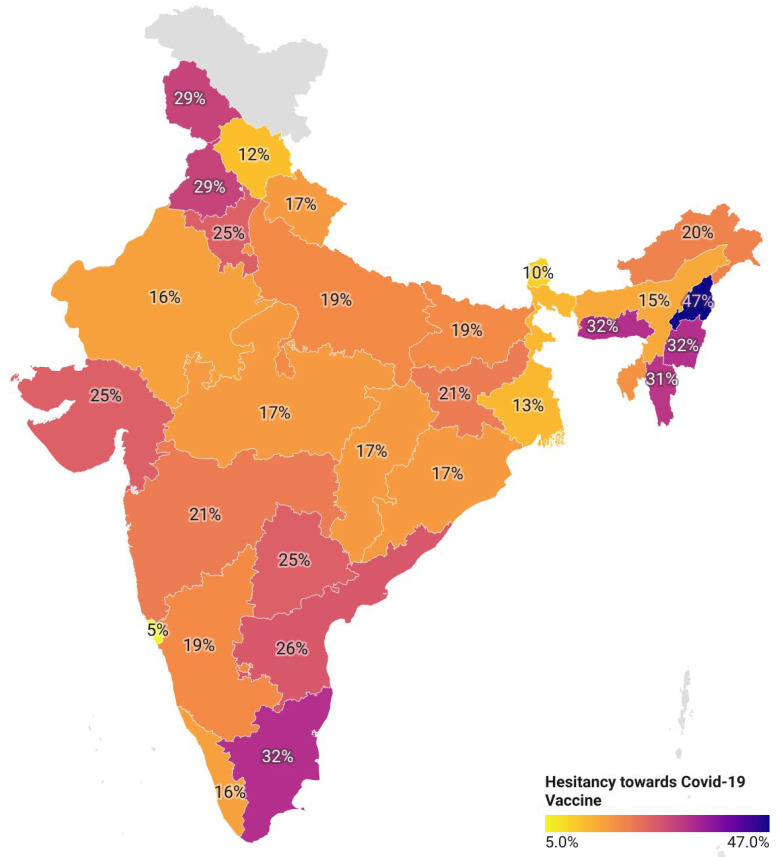
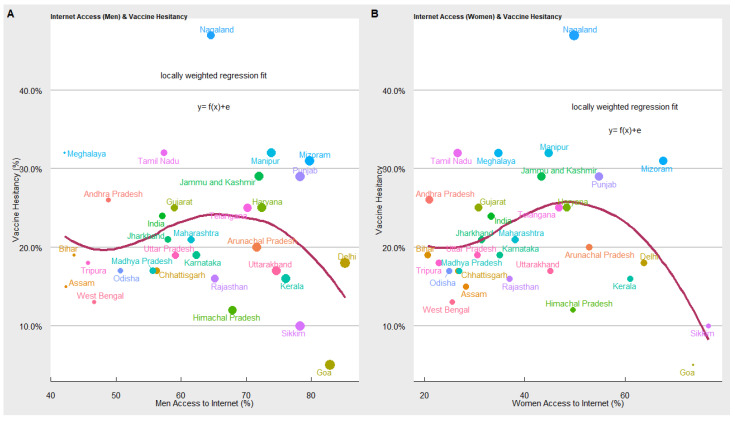
Our paper examines the key determinants of COVID-19 vaccination coverage in India and presents an analytical framework to probe whether vaccine hesitancy, socioeconomic factors and multi-dimensional deprivations (MPI) play a role in determining COVID-19 vaccination uptake. Our exploratory analysis reveals that COVID-19 vaccine hesitancy has a negative and statistically significant impact on COVID-19 vaccination coverage. A percentage increase in vaccine hesitancy can lead to a decline in vaccination coverage by 30 percent. Similarly, an increase in the proportion of people living in multi-dimensional poverty reduces the COVID-19 vaccination coverage. A unit increase in MPI or proportion of people living in acute poverty leads to a mean decline in vaccination coverage by 50 percent. It implies that an increase in socioeconomic deprivation negatively impacts health outcomes, including vaccination coverage. We additionally demonstrated that gender plays a significant role in determining how access to digital technologies such as the internet impacts vaccine coverage and hesitancy. We found that, as males' access to the internet increases, vaccination coverage also increases. This may be attributed to India's reliance on digital tools (COWIN, AAROGYA SETU, Imphal, India) to allocate and register for COVID-19 vaccines and the associated digital divide (males have greater digital excess than females). Conversely, females' access to the internet is statistically significant and inversely associated with coverage. This can be attributed to higher vaccine hesitancy among the female population and lower utilization of health services by females.
我们的论文研究了印度新冠疫苗接种覆盖率的关键决定因素,并提出了一个分析框架,以探究疫苗犹豫、社会经济因素和多维贫困(MPI)在决定新冠疫苗接种率方面是否发挥作用。我们的探索性分析表明,新冠疫苗犹豫对新冠疫苗接种覆盖率有负面且在统计上显著的影响。疫苗犹豫率每上升一个百分点,疫苗接种覆盖率可能会下降30%。同样,多维贫困人口比例的增加会降低新冠疫苗接种覆盖率。MPI或极端贫困人口比例每增加一个单位,疫苗接种覆盖率平均下降50%。这意味着社会经济剥夺的增加会对包括疫苗接种覆盖率在内的健康结果产生负面影响。我们还证明,性别在决定互联网等数字技术的接入如何影响疫苗覆盖率和疫苗犹豫方面发挥着重要作用。我们发现,随着男性互联网接入的增加,疫苗接种覆盖率也会增加。这可能归因于印度依赖数字工具(印度曼尼普尔邦的COWIN、AAROGYA SETU)来分配和登记新冠疫苗以及相关的数字鸿沟(男性的数字资源比女性更多)。相反,女性的互联网接入在统计上具有显著性,且与覆盖率呈负相关。这可归因于女性人群中较高的疫苗犹豫率以及女性对医疗服务的利用率较低。