Department of Medicine, and Norris Comprehensive Cancer Center, Keck School of Medicine, University of Southern California, Los Angeles, CA, 90033, USA.
Center for Inflammation and Epigenetics, Houston Methodist Research Institute, Houston, TX, 77030, USA.
Adv Sci (Weinh). 2022 Aug;9(22):e2103701. doi: 10.1002/advs.202103701. Epub 2022 May 29.
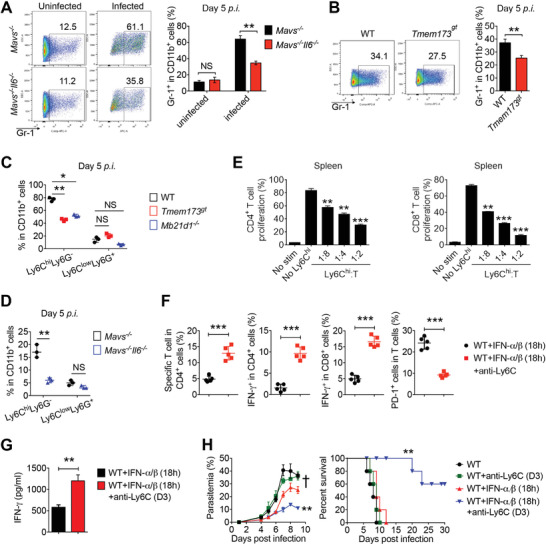
Cyclic GMP-AMP synthase (cGAS) and stimulator of interferon genes (STING) play critical roles in the innate immunity against infectious diseases and are required to link pathogen DNA sensing to immune responses. However, the mechanisms by which cGAS-STING-induced cytokines suppress the adaptive immune response against malaria infections remain poorly understood. Here, cGAS-STING signaling is identified to play a detrimental role in regulating anti-malaria immunity. cGAS or STING deficiency in mice markedly prolongs mouse survival during lethal malaria Plasmodium yoelii nigeriensis N67C infections by reducing late interleukin (IL)-6 production. Mechanistically, cGAS/STING recruits myeloid differentiation factor 88 (MyD88) and specifically induces the p38-dependent signaling pathway for late IL-6 production, which, in turn, expands CD11b Ly6C proinflammatory monocytes to inhibit immunity. Moreover, the blockage or ablation of the cGAS-STING-MyD88-p38-IL-6 signaling axis or the depletion of CD11b Ly6C proinflammatory monocytes provides mice a significant survival benefit during N67C and other lethal malaria-strain infections. Taken together, these findings identify a previously unrecognized detrimental role of cGAS-STING-MyD88-p38 axis in infectious diseases through triggering the late IL-6 production and proinflammatory monocyte expansion and provide insight into how targeting the DNA sensing pathway, dysregulated cytokines, and proinflammatory monocytes enhances immunity against infection.
环鸟苷酸-腺苷酸合酶 (cGAS) 和干扰素基因刺激物 (STING) 在抗感染固有免疫中发挥关键作用,需要将病原体 DNA 感应与免疫反应联系起来。然而,cGAS-STING 诱导细胞因子抑制疟疾感染适应性免疫反应的机制仍知之甚少。在这里,cGAS-STING 信号被确定在调节抗疟免疫中发挥有害作用。cGAS 或 STING 缺陷的小鼠在致死性疟疾 Plasmodium yoelii nigeriensis N67C 感染中显著延长了小鼠的存活期,这是通过减少晚期白细胞介素 (IL)-6 的产生来实现的。在机制上,cGAS/STING 募集髓样分化因子 88 (MyD88),并特异性诱导晚期 IL-6 产生依赖于 p38 的信号通路,这反过来又扩增 CD11b Ly6C 促炎性单核细胞以抑制免疫。此外,阻断或消融 cGAS-STING-MyD88-p38-IL-6 信号轴或耗尽 CD11b Ly6C 促炎性单核细胞可使小鼠在 N67C 和其他致死性疟疾株感染期间获得显著的生存获益。总之,这些发现确定了 cGAS-STING-MyD88-p38 轴在传染病中的一个以前未被认识到的有害作用,通过触发晚期 IL-6 的产生和促炎性单核细胞的扩增,并深入了解如何靶向 DNA 感应途径、失调的细胞因子和促炎性单核细胞来增强对感染的免疫力。