Hu Michael, Ling Zihan, Ren Xi
Department of Biomedical Engineering, Carnegie Mellon University, 5000 Forbes Avenue, Pittsburgh, PA, 15213, USA.
J Biol Eng. 2022 May 30;16(1):13. doi: 10.1186/s13036-022-00292-x.
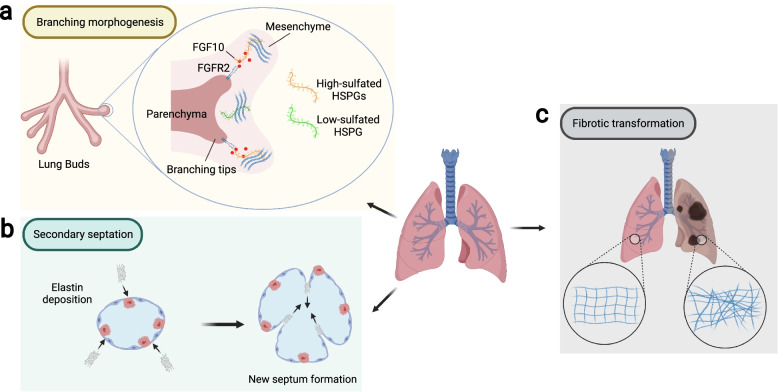
The extracellular matrix (ECM) constitutes the main acellular microenvironment of cells in almost all tissues and organs. The ECM not only provides mechanical support, but also mediates numerous biochemical interactions to guide cell survival, proliferation, differentiation, and migration. Thus, better understanding the everchanging temporal and spatial shifts in ECM composition and structure - the ECM dynamics - will provide fundamental insight regarding extracellular regulation of tissue homeostasis and how tissue states transition from one to another during diverse pathophysiological processes. This review outlines the mechanisms mediating ECM-cell interactions and highlights how changes in the ECM modulate tissue development and disease progression, using the lung as the primary model organ. We then discuss existing methodologies for revealing ECM compositional dynamics, with a particular focus on tracking newly synthesized ECM proteins. Finally, we discuss the ramifications ECM dynamics have on tissue engineering and how to implement spatial and temporal specific extracellular microenvironments into bioengineered tissues. Overall, this review communicates the current capabilities for studying native ECM dynamics and delineates new research directions in discovering and implementing ECM dynamics to push the frontier forward.
细胞外基质(ECM)构成了几乎所有组织和器官中细胞的主要无细胞微环境。ECM不仅提供机械支持,还介导众多生化相互作用,以指导细胞存活、增殖、分化和迁移。因此,更好地理解ECM组成和结构中不断变化的时空变化——即ECM动态变化——将为组织稳态的细胞外调节以及在各种病理生理过程中组织状态如何从一种状态转变为另一种状态提供基本见解。本综述概述了介导ECM与细胞相互作用的机制,并以肺作为主要模型器官,重点介绍了ECM的变化如何调节组织发育和疾病进展。然后,我们讨论了揭示ECM组成动态变化的现有方法,特别关注追踪新合成的ECM蛋白。最后,我们讨论了ECM动态变化对组织工程的影响,以及如何在生物工程组织中实现时空特异性的细胞外微环境。总的来说,本综述介绍了目前研究天然ECM动态变化的能力,并描绘了发现和应用ECM动态变化以推动前沿研究的新方向。