Division of Epidemiology & Clinical Research, Department of Pediatrics, University of Minnesota, Minneapolis, MN, USA.
Program in Health Disparities Research, Department of Family Medicine & Community Health, University of Minnesota Medical School, University of Minnesota, Minneapolis, MN, USA.
JNCI Cancer Spectr. 2022 May 2;6(3). doi: 10.1093/jncics/pkac040.
Although advanced parental age has been definitively linked to pediatric acute lymphoblastic leukemia, studies of parental age and pediatric solid tumors have not reached firm conclusions. This analysis aimed to elucidate the relationship between parental age and pediatric solid tumors through meta-analysis of existing studies based in population registries.
We searched Medline (PubMed) and Embase for registry-based studies of parental age and solid tumors through March 2022. We performed random-effects meta-analysis to estimate pooled effects and 95% confidence intervals (CIs). All statistical tests were 2-sided.
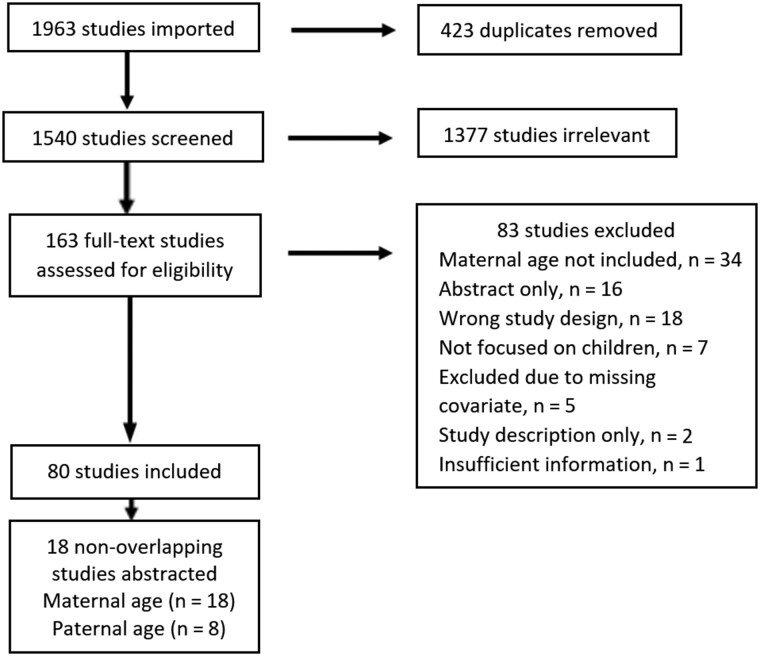
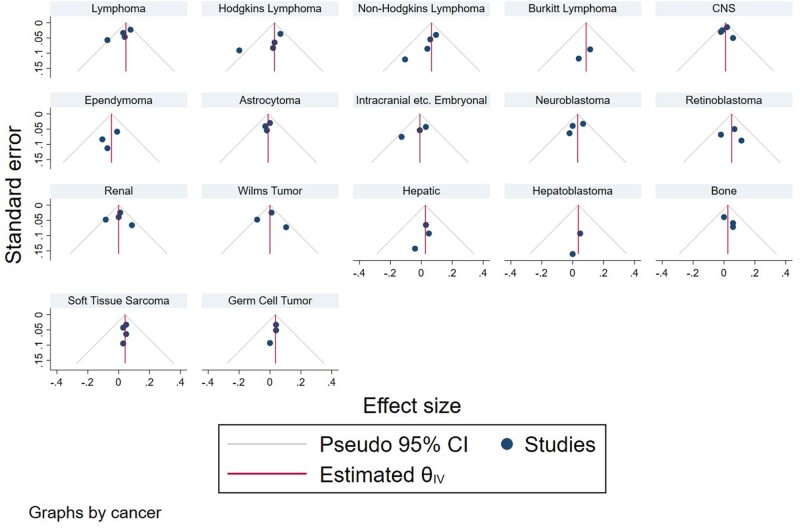
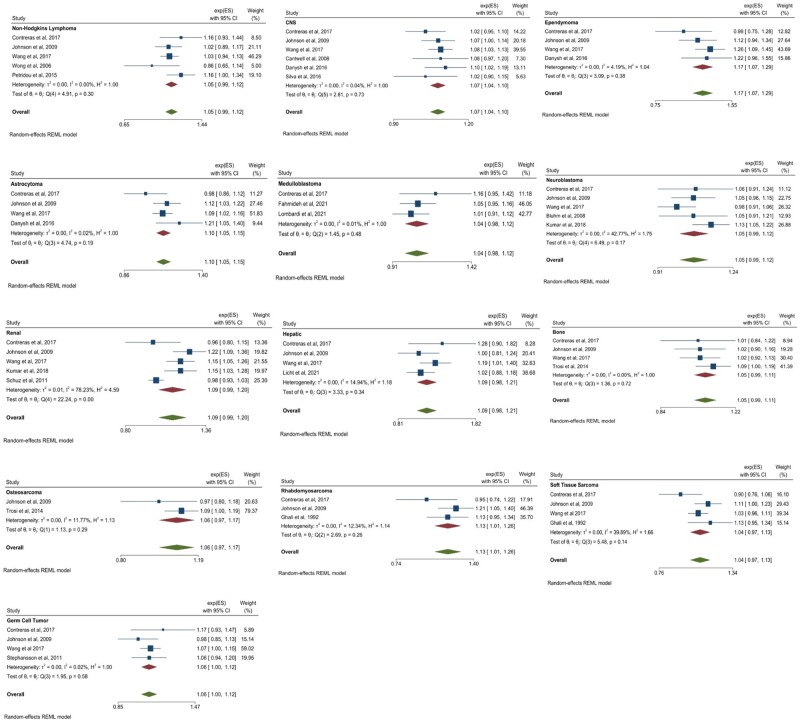
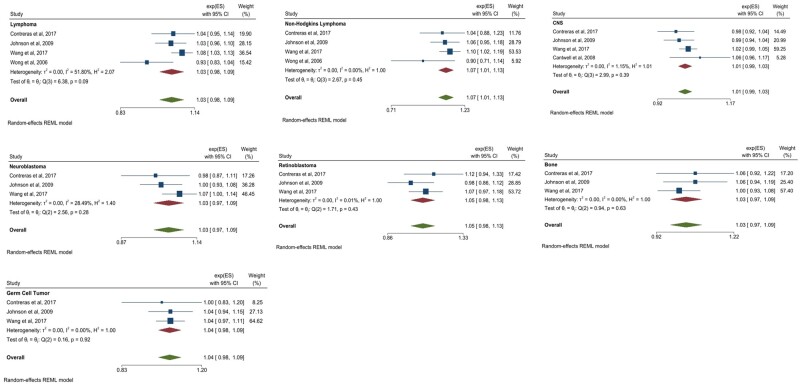
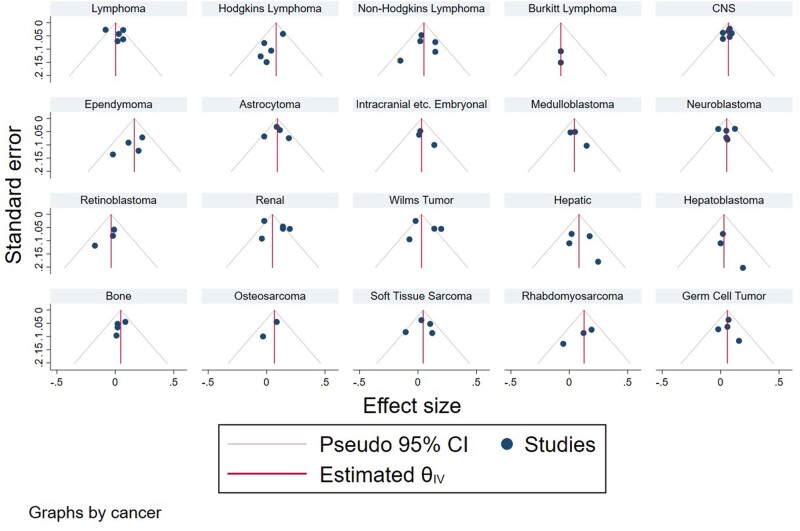
A total of 15 studies covering 10 childhood solid tumor types (30 323 cases and 3 499 934 controls) were included in this analysis. A 5-year increase in maternal age was associated with an increased risk of combined central nervous system tumors (odds ratio [OR] = 1.07, 95% CI = 1.04 to 1.10), ependymoma (OR = 1.19, 95% CI = 1.09 to 1.31), astrocytoma (OR = 1.10, 95% CI = 1.05 to 1.15), rhabdomyosarcoma (OR = 1.14, 95% CI = 1.03 to 1.25), and germ cell tumors (OR = 1.06, 95% CI = 1.00 to 1.12). A 5-year increase in paternal age was associated with an increased risk of non-Hodgkin lymphoma (OR = 1.06, 95% CI = 1.00 to 1.12).
This meta-analysis of registry-based analyses of parental age and childhood cancer supports the association between older maternal age and certain childhood solid cancers. There is also some evidence that paternal age may be associated with certain cancers such as non-Hodgkin lymphoma. However, as maternal and paternal age are highly correlated, disentangling potential independent causal effects of either factor will require large studies with extensive data on potential confounders.
尽管高龄父母与儿科急性淋巴细胞白血病有明确关联,但关于父母年龄与儿科实体瘤的研究尚未得出明确结论。本分析旨在通过对基于人群登记的现有研究进行荟萃分析,阐明父母年龄与儿科实体瘤之间的关系。
我们检索了 Medline(PubMed)和 Embase 中截至 2022 年 3 月的基于登记的父母年龄与实体瘤研究。我们采用随机效应荟萃分析来估计汇总效应和 95%置信区间(CI)。所有统计检验均为双侧。
本分析共纳入 15 项研究,涵盖 10 种儿童实体瘤类型(30323 例病例和 3499934 例对照)。母亲年龄每增加 5 岁,发生中枢神经系统肿瘤(优势比[OR] = 1.07,95%CI = 1.04 至 1.10)、室管膜瘤(OR = 1.19,95%CI = 1.09 至 1.31)、星形细胞瘤(OR = 1.10,95%CI = 1.05 至 1.15)、横纹肌肉瘤(OR = 1.14,95%CI = 1.03 至 1.25)和生殖细胞瘤(OR = 1.06,95%CI = 1.00 至 1.12)的风险增加。父亲年龄每增加 5 岁,发生非霍奇金淋巴瘤(OR = 1.06,95%CI = 1.00 至 1.12)的风险增加。
本荟萃分析基于人群登记的父母年龄与儿童癌症分析,支持母亲年龄较大与某些儿童实体癌之间的关联。也有一些证据表明,父亲年龄可能与某些癌症如非霍奇金淋巴瘤有关。然而,由于母亲和父亲的年龄高度相关,要想厘清两者中任一因素的潜在独立因果效应,需要进行有大量数据的大型研究,包括潜在混杂因素。