Center for Gut Microbiota Research, The Chinese University of Hong Konggrid.10784.3a, Hong Kong, China.
Department of Medicine and Therapeutics, The Chinese University of Hong Konggrid.10784.3a, Hong Kong, China.
mSystems. 2022 Jun 28;7(3):e0151021. doi: 10.1128/msystems.01510-21. Epub 2022 Jun 1.
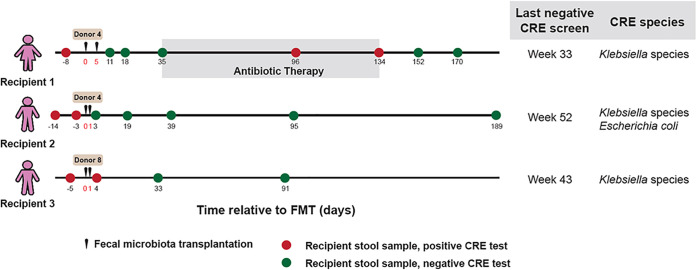
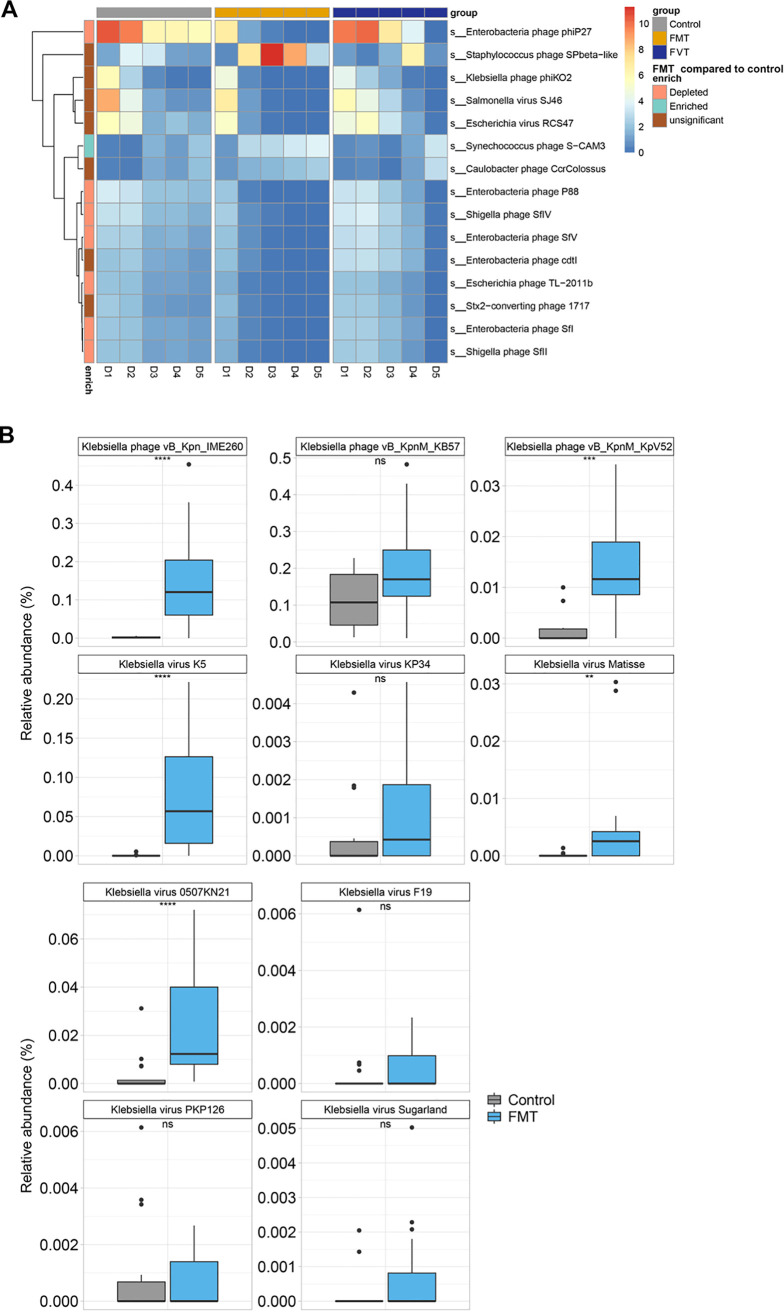
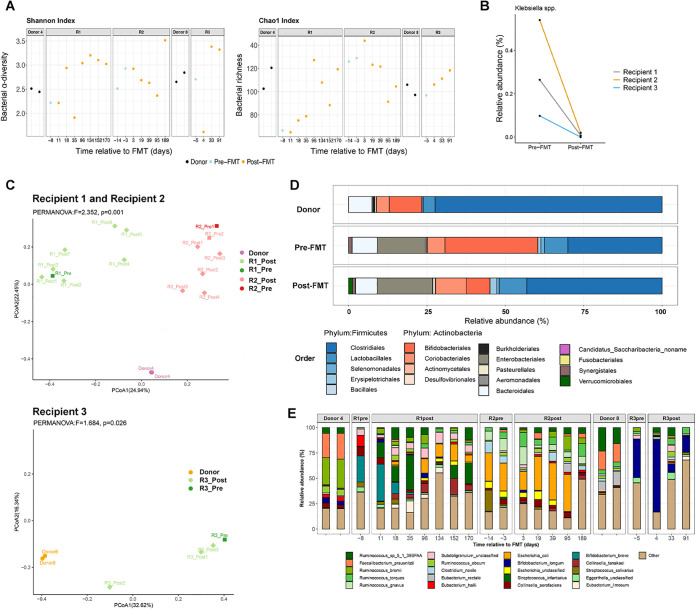
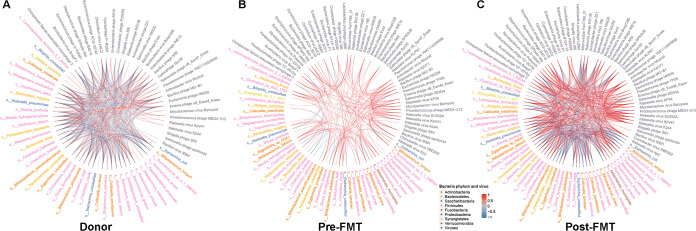
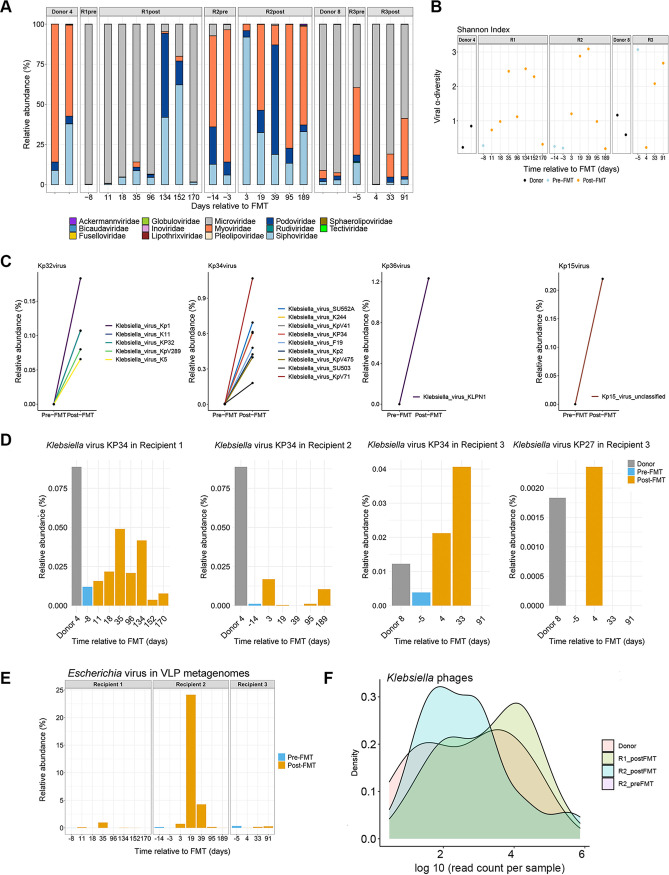
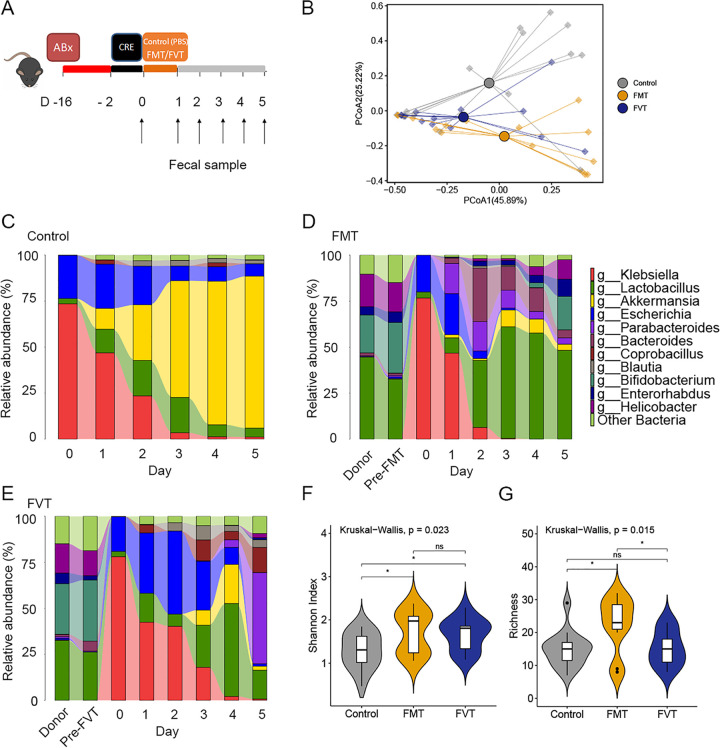
Understanding the role of fecal microbiota transplantation (FMT) in the decolonization of multidrug-resistant organisms (MDRO) is critical. Specifically, little is known about virome changes in MDRO-infected subjects treated with FMT. Using shotgun metagenomic sequencing, we characterized longitudinal dynamics of the gut virome and bacteriome in three recipients who successfully decolonized carbapenem-resistant (CRE), including Klebsiella spp. and Escherichia coli, after FMT. We observed large shifts of the fecal bacterial microbiota resembling a donor-like community after transfer of a fecal microbiota dominated by the genus . We found a substantial expansion of Klebsiella phages after FMT with a concordant decrease of Klebsiella spp. and striking increase of Escherichia phages in CRE E. coli carriers after FMT. We also observed the CRE elimination and similar evolution of Klebsiella phage in mice, which may play a role in the collapse of the Klebsiella population after FMT. In summary, our pilot study documented bacteriome and virome alterations after FMT which mediate many of the effects of FMT on the gut microbiome community. Fecal microbiota transplantation (FMT) is an effective treatment for multidrug-resistant organisms; however, introducing a complex mixture of microbes also has unknown consequences for landscape features of gut microbiome. We sought to understand bacteriome and virome alterations in patients undergoing FMT to treat infection with carbapenem-resistant . This finding indicates that transkingdom interactions between the virome and bacteriome communities may have evolved in part to support efficient FMT for treating CRE.
了解粪便微生物群移植(FMT)在多药耐药菌(MDRO)去定植中的作用至关重要。具体来说,对于接受 FMT 治疗的 MDRO 感染患者,病毒组变化知之甚少。使用 shotgun 宏基因组测序,我们对成功去定植碳青霉烯耐药的(CRE)的三个受者的肠道病毒组和细菌组的纵向动态进行了特征描述,包括克雷伯菌属和大肠埃希菌。我们观察到在转移以属为主的粪便微生物群后,粪便细菌微生物群发生了巨大变化,类似于供体样群落。在 FMT 后,克雷伯氏菌噬菌体大量扩张,克雷伯氏菌属数量相应减少,CRE 大肠杆菌携带者中的大肠埃希氏菌噬菌体数量显著增加。我们还观察到 CRE 的消除和克雷伯氏菌噬菌体的类似进化在小鼠中,这可能在 FMT 后克雷伯氏菌种群的崩溃中起作用。总之,我们的初步研究记录了 FMT 后细菌组和病毒组的改变,这些改变介导了 FMT 对肠道微生物组群落的许多影响。粪便微生物群移植(FMT)是治疗多药耐药菌的有效方法;然而,引入复杂的微生物混合物也会对肠道微生物组的景观特征产生未知的影响。我们试图了解接受 FMT 治疗感染碳青霉烯耐药的患者的细菌组和病毒组的改变。这一发现表明,病毒组和细菌组群落之间的跨域相互作用可能部分是为了支持有效的 FMT 治疗 CRE 而进化的。