Liggins Institute, The University of Auckland, Auckland, New Zealand.
Institute of Biotechnology, Helsinki Institute of Life Science, University of Helsinki, Helsinki, Finland.
Microbiome. 2024 Jul 6;12(1):122. doi: 10.1186/s40168-024-01833-w.
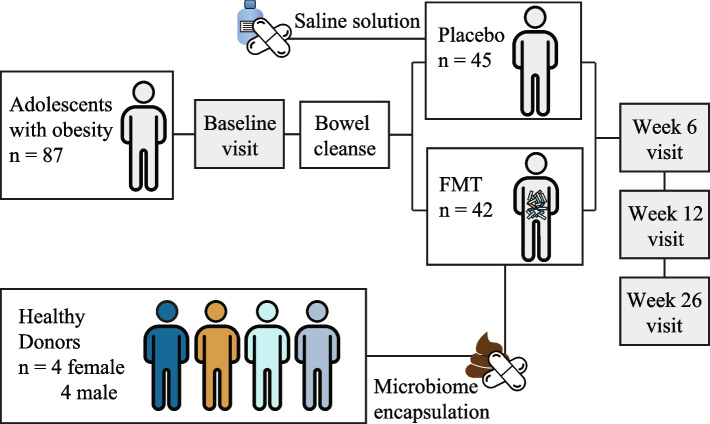
Fecal microbiota transplantation (FMT) is a therapeutic intervention used to treat diseases associated with the gut microbiome. In the human gut microbiome, phages have been implicated in influencing human health, with successful engraftment of donor phages correlated with FMT treatment efficacy. The impact that gastrointestinal phages exert on human health has primarily been connected to their ability to modulate the bacterial communities in the gut. Nonetheless, how FMT affects recipients' phage populations, and in turn, how this influences the gut environment, is not yet fully understood. In this study, we investigated the effects of FMT on the phageome composition of participants within the Gut Bugs Trial (GBT), a double-blind, randomized, placebo-controlled trial that investigated the efficacy of FMT in treating obesity and comorbidities in adolescents. Stool samples collected from donors at the time of treatment and recipients at four time points (i.e., baseline and 6 weeks, 12 weeks, and 26 weeks post-intervention), underwent shotgun metagenomic sequencing. Phage sequences were identified and characterized in silico to examine evidence of phage engraftment and to assess the extent of FMT-induced alterations in the recipients' phageome composition.
Donor phages engrafted stably in recipients following FMT, composing a significant proportion of their phageome for the entire course of the study (33.8 ± 1.2% in females and 33.9 ± 3.7% in males). Phage engraftment varied between donors and donor engraftment efficacy was positively correlated with their phageome alpha diversity. FMT caused a shift in recipients' phageome toward the donors' composition and increased phageome alpha diversity and variability over time.
FMT significantly altered recipients' phage and, overall, microbial populations. The increase in microbial diversity and variability is consistent with a shift in microbial population dynamics. This proposes that phages play a critical role in modulating the gut environment and suggests novel approaches to understanding the efficacy of FMT in altering the recipient's microbiome.
The Gut Bugs Trial was registered with the Australian New Zealand Clinical Trials Registry (ACTR N12615001351505). Trial protocol: the trial protocol is available at https://bmjopen.bmj.com/content/9/4/e026174 . Video Abstract.
粪便微生物群移植(FMT)是一种用于治疗与肠道微生物群相关疾病的治疗干预措施。在人类肠道微生物群中,噬菌体已被认为会影响人类健康,供体噬菌体的成功定植与 FMT 治疗效果相关。胃肠道噬菌体对人类健康的影响主要与其调节肠道细菌群落的能力有关。然而,FMT 如何影响受者的噬菌体群体,以及这反过来如何影响肠道环境,尚未完全了解。在这项研究中,我们调查了 FMT 对 Gut Bugs 试验(GBT)参与者噬菌体组组成的影响,GBT 是一项双盲、随机、安慰剂对照试验,旨在研究 FMT 治疗青少年肥胖和合并症的疗效。在治疗时从供体和四个时间点(即基线和 6 周、12 周和 26 周干预后)采集的粪便样本进行了鸟枪法宏基因组测序。通过计算机鉴定和分析噬菌体序列,以检查噬菌体定植的证据,并评估 FMT 诱导受者噬菌体组组成变化的程度。
FMT 后,供体噬菌体在受者中稳定定植,在整个研究过程中构成其噬菌体组的重要组成部分(女性为 33.8±1.2%,男性为 33.9±3.7%)。噬菌体定植在供体之间存在差异,供体定植效果与噬菌体组α多样性呈正相关。FMT 导致受者噬菌体组向供体组成的转变,并随着时间的推移增加噬菌体组的α多样性和可变性。
FMT 显著改变了受者的噬菌体和整体微生物群。微生物多样性和可变性的增加与微生物种群动力学的变化一致。这表明噬菌体在调节肠道环境中发挥着关键作用,并提出了新的方法来理解 FMT 改变受者微生物组的疗效。
Gut Bugs 试验在澳大利亚和新西兰临床试验注册中心(ACTRN12615001351505)注册。试验方案:试验方案可在 https://bmjopen.bmj.com/content/9/4/e026174 获得。视频摘要。