Hong Jon-Chao, Lee Yi-Fang, Chen Hsin-Han, Nguyen Hoang Bao Ngoc
Department of Industrial Education, National Taiwan Normal University, Taipei, Taiwan.
Institute for Research Excellence in Learning Sciences, National Taiwan Normal University, Taipei, Taiwan.
Front Psychol. 2022 May 13;13:857782. doi: 10.3389/fpsyg.2022.857782. eCollection 2022.
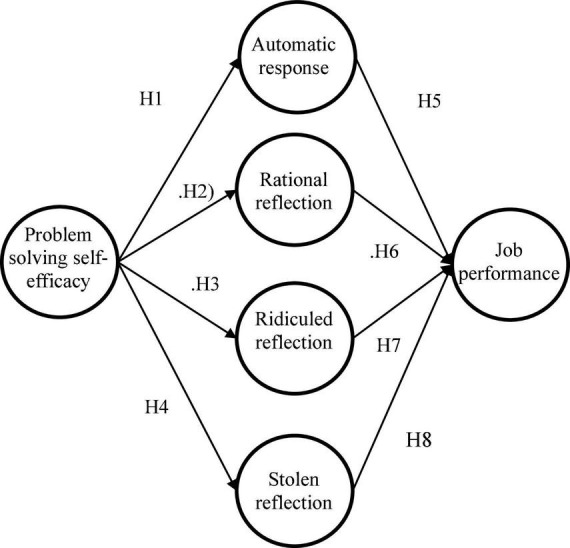
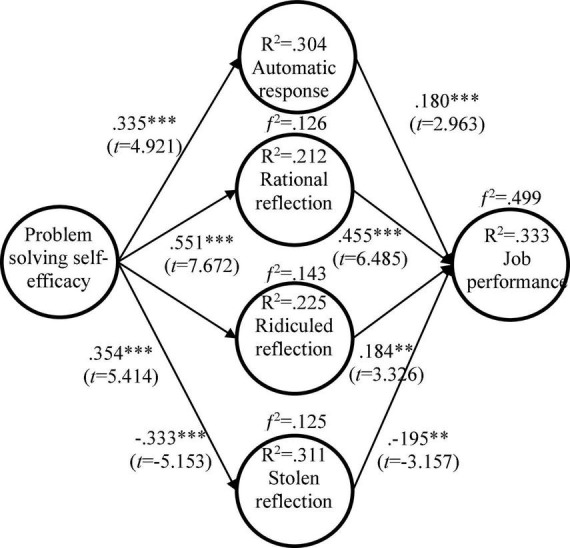
Knowledge sharing is an essential approach to creative problem solving in technology firms, but few studies have considered the information system integration service industry. To address this gap, drawing on the micro-ecology theory, we developed a research model to explore the mediating role of four types of knowledge sharing (i.e., automatic response, rational reflection, ridiculed reflection, and stolen reflection) in the relationship between problem solving self-efficacy (PSSE) and IT workers' job performance. Data were collected from 307 System Integration IT workers by using the snowball sampling method a Google questionnaire. Structural equation modeling was used to test the hypotheses of the relationships between the variables. The results showed that PSSE can positively predict four knowledge sharing types; except for stolen reflection, the others can positively predict job performance. The implication of this study is that automatic response systems and rational reflection systems in knowledge sharing can enhance job performance, supported by PSSE. It is hoped that managers can generate System Integration workers' rational reflection to effectively evoke knowledge sharing.
知识共享是科技公司创造性解决问题的重要途径,但很少有研究关注信息系统集成服务行业。为填补这一空白,基于微观生态理论,我们构建了一个研究模型,以探讨四种知识共享类型(即自动响应、理性反思、嘲讽反思和窃取反思)在解决问题自我效能感(PSSE)与IT工作者工作绩效之间关系中的中介作用。我们采用雪球抽样法,通过谷歌问卷从307名系统集成IT工作者那里收集了数据。运用结构方程模型对变量间关系的假设进行了检验。结果表明,PSSE能够正向预测四种知识共享类型;除窃取反思外,其他类型均能正向预测工作绩效。本研究的意义在于,在PSSE的支持下,知识共享中的自动响应系统和理性反思系统能够提升工作绩效。希望管理者能够激发系统集成工作者的理性反思,从而有效促进知识共享。