Institute of Social Medicine and Epidemiology, Brandenburg Medical School Theodor Fontane, Brandenburg, Germany.
Faculty of Health Sciences Brandenburg, Brandenburg Medical School Theodor Fontane, Brandenburg, Germany.
BMC Emerg Med. 2021 Apr 6;21(1):42. doi: 10.1186/s12873-021-00436-0.
Recent studies have shown a decrease of admissions to accident and emergency (A&E) departments after the local outbreaks of COVID-19. However, differential trends of admission counts, for example according to diagnosis, are less well understood. This information is crucial to inform targeted intervention. Therefore, we aimed to compare admission counts in German A&E departments before and after 12th march in 2020 with 2019 according to demographic factors and diagnosis groups.
Routine data of all admissions between 02.12.2019-30.06.2020 and 01.12.2018-30.06.2019 was available from six hospitals in five cities from north-western, eastern, south-eastern, and south-western Germany. We defined 10 diagnosis groups using ICD-10 codes: mental disorders due to use of alcohol (MDA), acute myocardial infarction (AMI), stroke or transient ischemic attack (TIA), heart failure, pneumonia, chronic obstructive pulmonary disease (COPD), cholelithiasis or cholecystitis, back pain, fractures of the forearm, and fractures of the femur. We calculated rate ratios comparing different periods in 12.03.2020-30.06.2020 with 12.03.2019-30.06.2019.
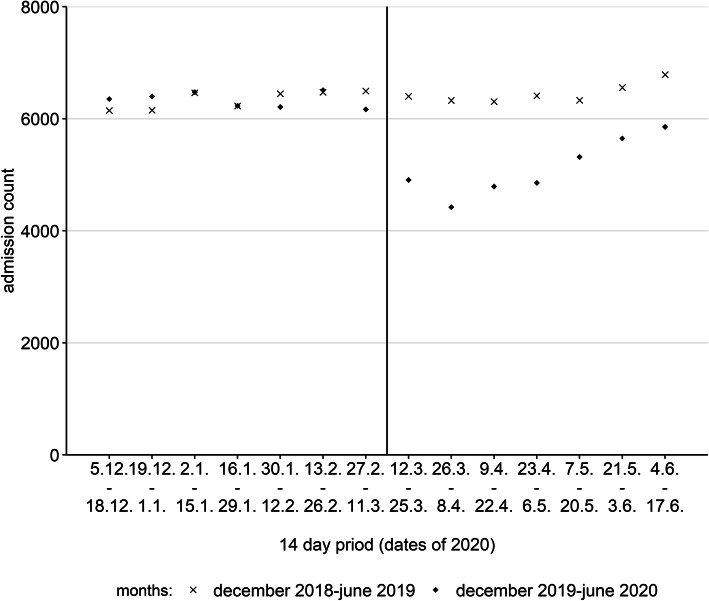
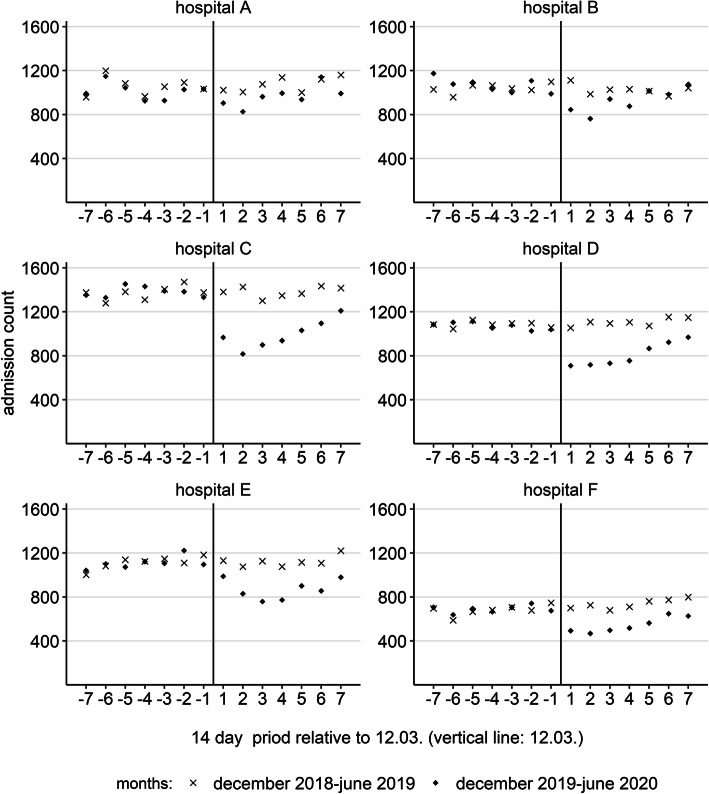
Forty-one thousand three hundred fifty-three cases were admitted between 12.03.2020-30.06.2020 and 51,030 cases between 12.03.2019-30.06.2019. Admission counts prior to 12.03. were equal in 2020 and 2019. In the period after 12.03., the decrease of admissions in 2020 compared to 2019 was largest between 26.03. and 08.04. (- 30%, 95% CI - 33% to - 27%). When analysing the entire period 12.03.-30.06., the decrease of admissions was heterogeneous among hospitals, and larger among people aged 0-17 years compared to older age groups. In the first 8 weeks after 12.03., admission counts of all diagnoses except femur fractures and pneumonia declined. Admissions with pneumonia increased in this early period. Between 07.05. and 30.6.2020, we noted that admissions with AMI (+ 13%, 95% CI - 3% to + 32%) and cholelithiasis or cholecystitis (+ 20%, 95% CI + 1% to + 44%) were higher than in 2019.
Our results suggest differential trends of admission counts according to age, location, and diagnosis. An initial decrease of admissions with MDA, AMI, stroke or TIA, heart failure, COPD, cholelithiasis or cholecystitis, and back pain imply delays of emergency care in Germany. Finally, our study suggests a delayed increase of admissions with AMI and cholelithiasis or cholecystitis.
最近的研究表明,在 COVID-19 本地爆发后,前往急症室(A&E)就诊的人数有所减少。然而,入院人数的差异趋势,例如根据诊断进行的趋势,了解得还不够。这些信息对于有针对性的干预至关重要。因此,我们旨在根据人口统计学因素和诊断组比较 2020 年 3 月 12 日之前和之后与 2019 年同期德国 A&E 部门的入院人数。
从德国西北部、东部、东南部和西南部的五家医院获得了 2019 年 12 月 2 日至 2020 年 6 月 30 日和 2018 年 12 月 1 日至 2019 年 6 月 30 日之间所有入院的常规数据。我们使用 ICD-10 代码定义了 10 个诊断组:酒精使用所致精神障碍(MDA)、急性心肌梗死(AMI)、中风或短暂性脑缺血发作(TIA)、心力衰竭、肺炎、慢性阻塞性肺疾病(COPD)、胆石症或胆囊炎、腰痛、前臂骨折和股骨骨折。我们计算了不同时期的比率比,比较了 2020 年 3 月 12 日至 6 月 30 日与 2019 年 3 月 12 日至 6 月 30 日之间的差异。
2020 年 3 月 12 日至 6 月 30 日期间有 41353 例病例入院,2019 年同期有 51030 例病例入院。2020 年 3 月 12 日之前的入院人数与 2019 年相同。在 3 月 12 日之后的时期,与 2019 年相比,2020 年的入院人数下降幅度最大,在 3 月 26 日至 4 月 8 日之间下降了 30%(95%CI:-33%至-27%)。在分析整个 3 月 12 日至 6 月 30 日期间,医院之间的入院人数下降存在异质性,0-17 岁人群的入院人数下降幅度大于其他年龄组。在 3 月 12 日之后的前 8 周,除股骨骨折和肺炎外,所有诊断的入院人数都有所下降。在此早期阶段,肺炎的入院人数有所增加。在 2020 年 5 月 7 日至 6 月 30 日期间,我们注意到 AMI(+13%,95%CI:-3%至+32%)和胆石症或胆囊炎(+20%,95%CI:+1%至+44%)的入院人数高于 2019 年。
我们的研究结果表明,入院人数的差异趋势与年龄、地点和诊断有关。MDA、AMI、中风或 TIA、心力衰竭、COPD、胆石症或胆囊炎和腰痛的急诊护理延迟表明德国的急诊护理延迟。最后,我们的研究表明 AMI 和胆石症或胆囊炎的入院人数延迟增加。