Giusto Ali, Mootz Jennifer J, Korir Mercy, Jaguga Florence, Mellins Claude Ann, Wainberg Milton L, Puffer Eve S
New York State Psychiatric Institute, Columbia University, Department of Psychiatry, New York, NY, 10032, USA.
Moi University Teaching and Referral Hospital, Eldoret, Kenya.
SSM Ment Health. 2021 Dec;1. doi: 10.1016/j.ssmmh.2021.100019. Epub 2021 Sep 16.
Men's alcohol misuse does not occur in a vacuum but has a cascade of consequences for families and children, with ties to violence, poor parenting, and poor partner and child mental health. Despite the intersection of individual and interpersonal problems associated with men's alcohol use, studies exploring the impact of men's completion of alcohol misuse treatment on family and family member outcomes are scarce. Here we begin to explore this question.
We conducted qualitative interviews (N = 13) with female partners and children (8-17 years) of men with problem drinking who completed individual treatment targeting alcohol misuse, depressed mood, and family-focused efforts in Eldoret, Kenya. Interviews and thematic content analysis were guided by ecological-transactional systems theory.
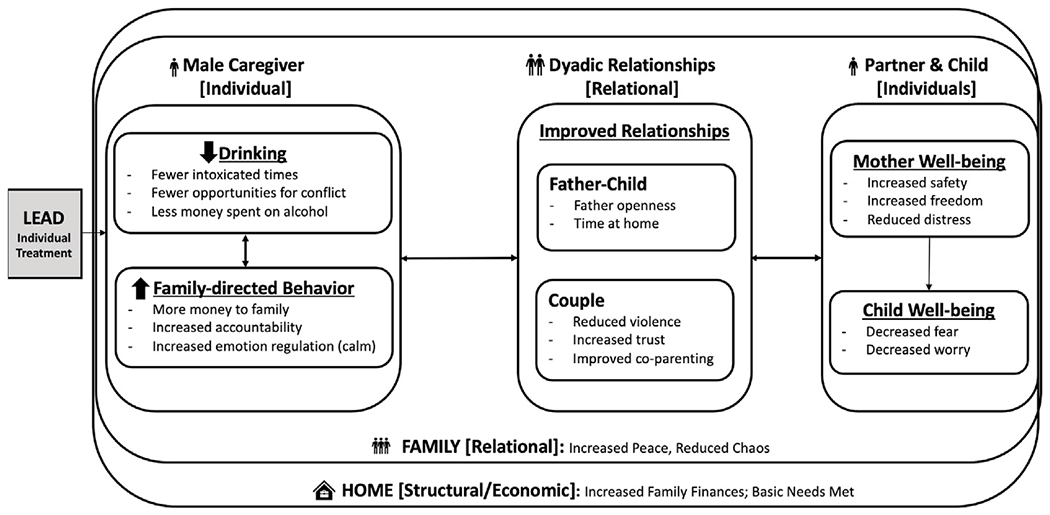
Findings highlighted positive perceived changes for men, families, women and children that interacted together in a bi-directional pathway. Partners and children described men's reduced drinking, reduced spending, increased family-focused effort (e.g., coming home early), as well as increased emotion regulation, and openness to and communication with family. These changes were tied to perceived improvements in the couple and father-child relationship, including improved trust and time together, which were tied to improvements in women and children's emotional well-being (e.g., hope). Concurrently, reports noted men's increased effort to share money earned with the family which alleviated financial stress and helped ensure basic needs were met. Results aligned with the ecological transactional systems frame, with individuals in the family, family relationships, and economic climate each dynamically shaping each other.
Although larger studies are needed, results provide promising signals regarding the potential downstream effects of individual treatment on family systems and members, which may in turn help maintain men's changes in drinking.
男性滥用酒精并非孤立发生,而是会给家庭和孩子带来一系列后果,与暴力、不良养育方式以及伴侣和孩子的心理健康问题相关。尽管男性饮酒相关的个人和人际问题相互交织,但探索男性完成酒精滥用治疗对家庭及家庭成员影响的研究却很匮乏。在此,我们开始探讨这个问题。
我们对肯尼亚埃尔多雷特地区有饮酒问题且完成了针对酒精滥用、情绪低落及家庭问题的个体治疗的男性的女性伴侣和孩子(8至17岁)进行了定性访谈(N = 13)。访谈和主题内容分析以生态交易系统理论为指导。
研究结果突出了男性、家庭、女性和孩子在双向路径中共同产生的积极感知变化。伴侣和孩子描述了男性饮酒减少、开支减少、更多关注家庭(如早回家),以及情绪调节能力增强、对家庭更开放并与家人交流增多。这些变化与夫妻关系和父子关系的改善相关,包括信任增加和相处时间增多,进而与女性和孩子的情绪幸福感(如希望)提升相关。同时,报告指出男性增加了与家人分享收入的努力,这减轻了经济压力并有助于确保基本需求得到满足。结果与生态交易系统框架相符,家庭中的个体、家庭关系和经济环境相互动态影响。
尽管需要更大规模的研究,但研究结果为个体治疗对家庭系统及成员的潜在下游影响提供了有希望的信号,这反过来可能有助于维持男性饮酒行为的改变。