Qiao Shuai, Lee Chia-Wei, Sherpa Dawafuti, Chrustowicz Jakub, Cheng Jingdong, Duennebacke Maximilian, Steigenberger Barbara, Karayel Ozge, Vu Duc Tung, von Gronau Susanne, Mann Matthias, Wilfling Florian, Schulman Brenda A
Department of Molecular Machines and Signaling, Max Planck Institute of Biochemistry, 82152, Martinsried, Germany.
Fourth Affiliated Hospital, Zhejiang University School of Medicine, Yiwu, 322000, Zhejiang, China.
Nat Commun. 2022 Jun 1;13(1):3041. doi: 10.1038/s41467-022-30803-9.
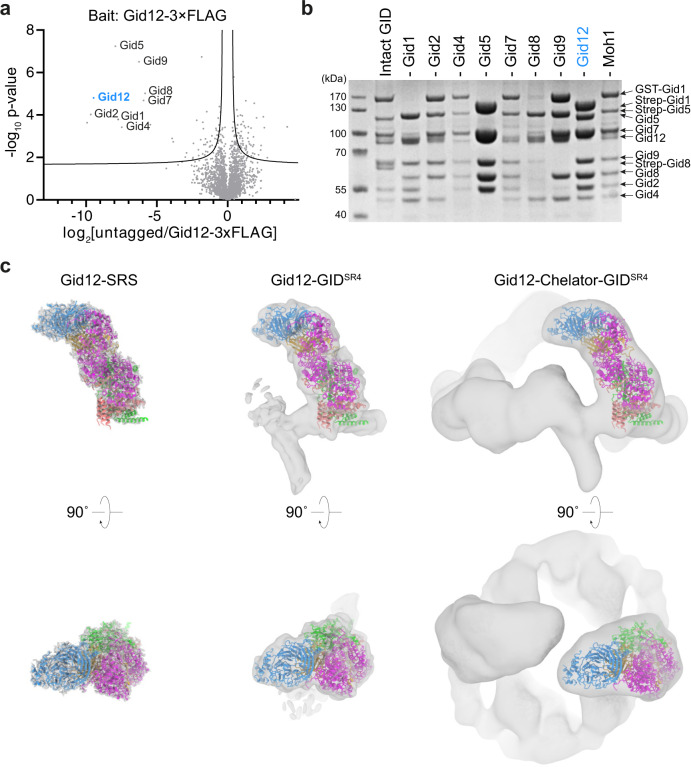
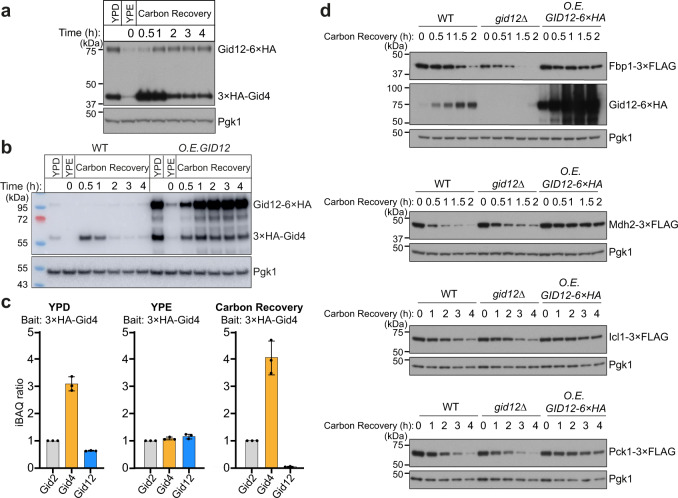
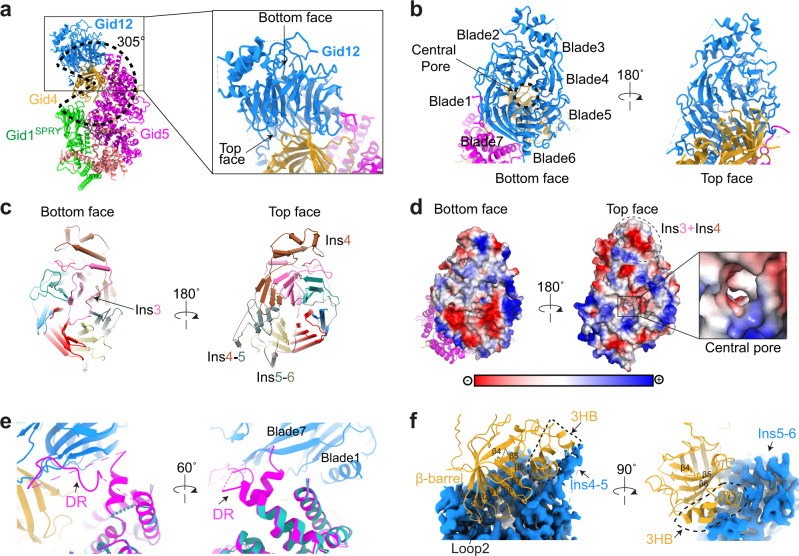
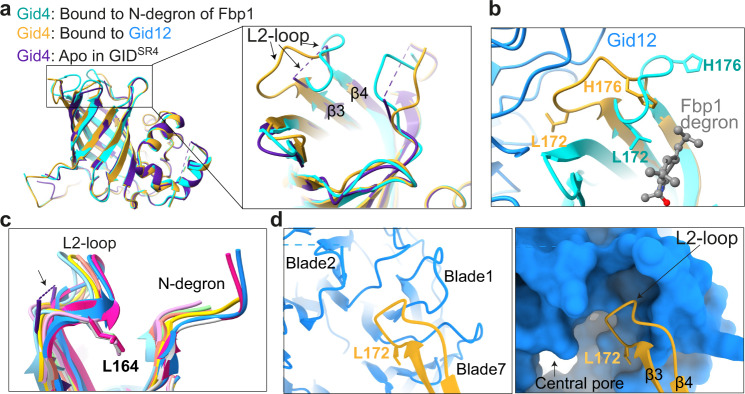
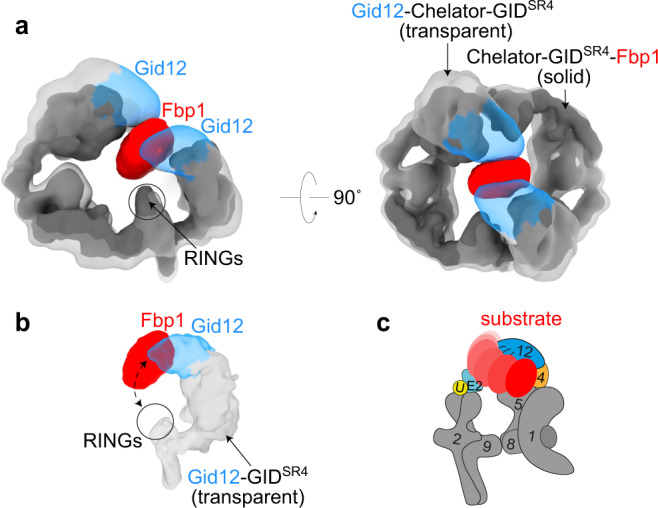
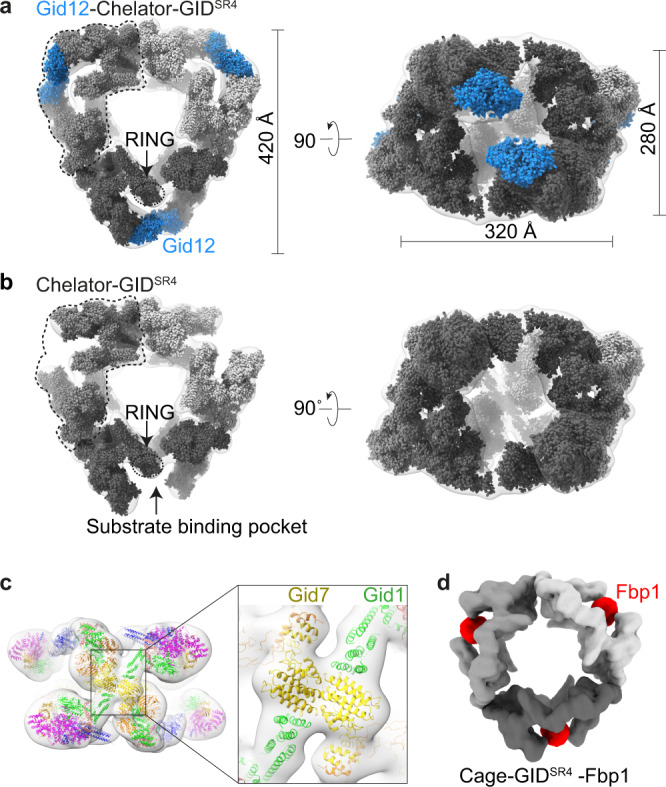
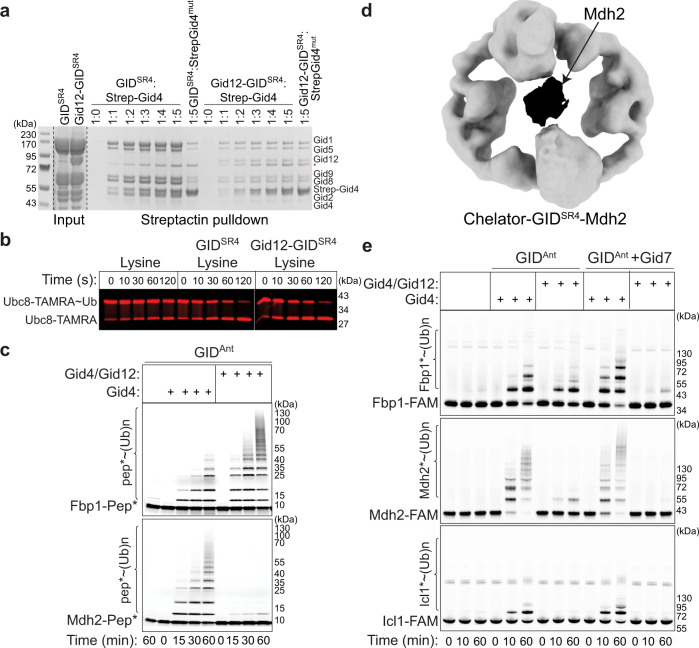
Protein degradation, a major eukaryotic response to cellular signals, is subject to numerous layers of regulation. In yeast, the evolutionarily conserved GID E3 ligase mediates glucose-induced degradation of fructose-1,6-bisphosphatase (Fbp1), malate dehydrogenase (Mdh2), and other gluconeogenic enzymes. "GID" is a collection of E3 ligase complexes; a core scaffold, RING-type catalytic core, and a supramolecular assembly module together with interchangeable substrate receptors select targets for ubiquitylation. However, knowledge of additional cellular factors directly regulating GID-type E3s remains rudimentary. Here, we structurally and biochemically characterize Gid12 as a modulator of the GID E3 ligase complex. Our collection of cryo-EM reconstructions shows that Gid12 forms an extensive interface sealing the substrate receptor Gid4 onto the scaffold, and remodeling the degron binding site. Gid12 also sterically blocks a recruited Fbp1 or Mdh2 from the ubiquitylation active sites. Our analysis of the role of Gid12 establishes principles that may more generally underlie E3 ligase regulation.
蛋白质降解是真核细胞对细胞信号的主要反应,受到多层调控。在酵母中,进化上保守的GID E3连接酶介导葡萄糖诱导的果糖-1,6-二磷酸酶(Fbp1)、苹果酸脱氢酶(Mdh2)和其他糖异生酶的降解。“GID”是E3连接酶复合物的集合;一个核心支架、RING型催化核心以及一个超分子组装模块与可互换的底物受体一起选择泛素化的靶标。然而,关于直接调节GID型E3的其他细胞因子的知识仍然很基础。在这里,我们从结构和生化方面将Gid12表征为GID E3连接酶复合物的调节剂。我们的冷冻电镜重建结果表明,Gid12形成了一个广泛的界面,将底物受体Gid4封闭在支架上,并重塑了降解子结合位点。Gid12还在空间上阻止募集的Fbp1或Mdh2进入泛素化活性位点。我们对Gid12作用的分析确立了可能更普遍地构成E3连接酶调控基础的原则。